St. Clare is the little plant of St. Francis, as she called herself. A blog to my call to become a Poor Clare Colettine. If St. Clare was a "little plant", I am a scraggly weed.
On the memorial of St. Peter of Alcantara (Oct. 19th), Fr. George
preached on this Franciscan's remarkable life of extreme penance and
lofty contemplation, and explains that although many can't imitate his
austerities, we must strive to live a continual life of penance and
sacrifice.
Ave Maria!
Born at Alcántara, Spain,
1499; died 18 Oct., 1562. His father, Peter Garavita, was the
governor of the place, and his mother was of the noble family of
Sanabia. After a course of grammar and philosophy in his native town,
he was sent, at the age of fourteen, to the University
of Salamanca. Returning home, he became a Franciscan in
the convent of
the Stricter Observance at Manxaretes in 1515. At the age of
twenty-two he was sent to found a new community of the Stricter
Observance at Badajoz.
He was ordainedpriest in
1524, and the following year made guardian of the convent of
St. Mary of the Angels at Robredillo. A few years later he began
preaching with much success. He preferred to preach to the poor; and
his sermons,
taken largely from the Prophets and Sapiential Books, breathe the
tenderest human sympathy. The reform of the "Discalced Friars"
had, at the time when Peter entered the order, besides
the convents in Spain,
the Custody of Sta. Maria Pietatis in Portugal,
subject to the General of the Observants.
Having been elected minister of St.
Gabriel's province in 1538, Peter set to work at once. At the chapter
of Plasencia in
1540 he drew up the Constitutions of the Stricter Observants, but his
severe ideas met
with such opposition that he renounced the office of provincial and
retired with John
of Avila into the mountains of Arabida, Portugal,
where he joined Father Martin a Santa Maria in his life
of eremitical solitude.
Soon, however, other friars came
to join him, and several little communities were established. Peter
being chosen guardian and master of novices at
the convent of
Pallais. In 1560 these communities were erected into the Province of
Arabida. Returning to Spain in
1553 he spent two more years in solitude, and then journeyed barefoot
to Rome,
and obtained permission of Julius
III to found some poor convents in Spain under
the jurisdiction of
the general of the Conventuals.
Convents were established at Pedrosa, Plasencia,
and elsewhere; in 1556 they were made a commissariat, with Peter as
superior, and in 1561, a province under the title of St. Joseph. Not
discouraged by the opposition and ill-success his efforts at reform
had met with in St. Gabriel's province, Peter drew up the
constitutions of the new province with even greater severity. The
reform spread rapidly into other provinces
of Spain and Portugal.
In
1562 the province of St. Joseph was put under the jurisdiction of
the general of the Observants, and two new custodies were formed: St.
John Baptist's in Valencia,
and St. Simon's in Galicia. Besides the above-named associates of
Peter may be mentioned St.
Francis Borgia,John
of Avila, and Ven.
Louis of Granada. In St. Teresa, Peter perceived a soul chosen
of God for
a great work, and her success in the reform of Carmel was in great
measure due to his counsel, encouragement, and defense. It was a
letter from St. Peter (14 April, 1562) that encouraged her to found
her first monastery at Avila,
24 Aug. of that year. St. Teresa's autobiography is the source of
much of our information regarding Peter's life, work, and gifts
of miracles and
prophecy.
Perhaps the most remarkable of
Peter's graces were
his gift of contemplation and the virtue of penance. Hardly less
remarkable was his love of God,
which was at times so ardent as to cause him, as it did St.
Philip Neri, sensible pain, and frequently rapt him into ecstasy.
The poverty he practiced and enforced was as cheerful as it was real,
and often let the want of even the necessaries of life be felt. In
confirmation of his virtues and mission of reformation God worked
numerous miracles through
his intercession and by his very presence. He
was beatified by Gregory
XV in 1622, and canonized by Clement
IX in 1669. Besides the Constitutions of the Stricter
Observants and many letters on spiritual subjects, especially to St.
Teresa, he composed a short treatise on prayer,
which has been translated into all the languages of Europe.
His feast is
October 22nd for the Franciscans (often seen as October 19th for the
general calendar).
TREATISE ON PRAYER AND MEDITATION
by
St. Peter of Alcantara
Chapter I.
Of the Fruit to be Derived from Prayer and
Meditation
SINCE this short treatise speaks of prayer and meditation, it will
be well to state in a few words what is the fruit which may be
derived from this holy exercise, so that men may give themselves to
it with more willing heart. It is a well known fact that one of
the greatest hindrances we have to attaining our final happiness and
blessedness, is the evil inclination of our hearts, the difficulty
and dullness of spirit we have in respect to good rules; for, if this
was not in the way, it would be the easiest thing possible to run in
the path of virtues, and attain to the end for which we were
created. Concerning which the Apostle says, "I delight in
the Law of God, according to the inward man; but I see another law in
my members warring against the law of my mind, and bringing me into
captivity to the law of sin." (Rom. 7:22-23) This, then,
is the universal cause of all our evil. One of the most
efficacious means for overcoming this dullness and difficulty, and
for facilitating this matter, is devotion; for as St. Thomas says,
"Devotion is nothing else than a certain readiness and aptitude
for doing good." For this takes away from our mind all
that difficulty and dullness, and makes us quick and ready for all
good. It is a spiritual refection, a refreshment, like the dew
of Heaven, a breath and inspiration of the Holy Spirit, a
supernatural affection. It so orders, strengthens, and
transforms a man's heart, that it imparts a new taste and inspiration
for spiritual things, a new distaste and abhorrence for sensible
things. The experience of every day shows us this. For
when a spiritually minded person rises from deep devout prayer, then
straight away all his good resolutions are renewed, together with
fervor and determination to do good; the desire then to please, and
to love, a Lord so good and kind as He has then shown Himself to be,
a willingness to endure fresh troubles, and chastenings, even to
shedding blood for His sake, then, finally, all the freshness of soul
is renewed and blooms again.
If you ask me, by what means so powerful and noble an
affection of devotion is attained, the same holy teacher answers that
it is by meditation and contemplation of diving things; for
from deeply meditating and pondering over these things there springs
up this disposition, and affection in the will, which is called
devotion; and this stirs and moves us to all good. It is
on this account that this holy and religious exercise is so extolled
and commended by all the Saints, as being The Means of acquiring
devotion, which, though it is but one virtue only, yet it disposes
and moves one to all the other virtues, and exists as a general
stimulus to them all.
If you would see how true this is, hear how plainly St.
Bonaventure declares it in these words:
"If you would suffer patiently the adversities and
miseries of this life, be a man of prayer. If you would gain
power and strength to overcome the temptations of the enemy, be a man
of prayer. If you would mortify your will with all its
affections and lusts, be a man of prayer. If you would
understand the cunning devices of Satan, and defend yourself against
his deceits, be a man of payer. If you would live joyfully, and
with sweetness walk in the path of penitence and sorrow, be a man of
prayer. If you would drive out the troublesome gnats of vain
thoughts and cares from your soul, be a man of prayer. If you
would sustain your soul with the richness of devotion, and kept it
ever full of good thoughts and desires, be a man of prayer. If
you would strengthen and confirm your heart in the pilgrimage with
God, be a man of prayer. Lastly, if you would root out from
your soul every vice and in their place plant the virtues, be a man
of prayer, for in this is obtained the unction and grace of the Holy
Spirit who teaches all things.”
"And besides all this, if you would climb to the
height of contemplation, and delight in the sweet embraces of the
Bridegroom, exercise yourself in prayer, for this is the way by which
the soul mounts up to contemplation and to the taste of heavenly
things.
"You see, then, of how great virtue and power is
prayer, and for proof of all that has been said (to say nothing of
Holy Scripture) let this now be sufficient assurance that we have
seen and heard, and see, day by day, many simple persons who have
attained to all these things above mentioned and to others greater,
through the exercise of prayer."
Thus far the words of St. Bonaventure. Then, what richer treasure?
What field can be found more fertile, yielding more abundantly than
this? Hear also what another most religious and holy doctor,
speaking of this same virtue, says:
"In prayer the soul is cleansed from sin, pastured
with charity, confirmed in faith, strengthened in hope, gladdened in
spirit. By prayer the inward man is directed aright, the heart
is purified, the truth discovered, temptation overcome, sadness
avoided, the perceptions renewed, languishing virtue restored,
lukewarmness dismissed, the rust of vices done away; and in it
there do not cease to come forth living sparkles of heavenly desires,
with which the flame of divine love burns. Great are the
excellencies of prayer, great are its privileges! Before it
Heaven is opened, secrete things are made manifest, and to it the
ears of God are ever attentive." (St. Lawrence Justinian, In
Signo Vitae)
This now is sufficient to show in some way what is the fruit of
this holy exercise.
Chapter II.
Of the Subject Matter of Meditation
HAVING seen what fruit may come of Prayer and Mediation, let us
now see what are the things on which we should meditate.
To which the answer is, that inasmuch as this holy exercise is
ordained to create in our hearts the love and fear of God, and to
lead us to keep His Commandments, the most fitting subject for this
exercise will be that which should most surely lead to the end
proposed. And although it be true that all created things,
whether earthly or heavenly, may move us to this, yet, generally
speaking, the Mysteries of our Faith which are contained in the
Creed, are the most efficacious, and profitable. For here are
treated the subjects of the Divine blessings, the Last Judgment, the
pains of Hell, and the glory of Paradise, where there are the most
powerful stimulants to move our hearts to the love and fear of God;
and in it are treated also the Life and Passion of Our Savior Christ,
in which consists all our good. These two subjects especially
are treated of in the Creed, and are those on which we for the most
part make our Meditations. And therefore, with much reason it
is said, that the Creed is the most fitting subject for this holy
exercise, although at the same time, there may be with every one some
subject which might more especially move his heart to the love and
fear of God.
Agreeably, then, with this, in order to help on
the young who are now entering upon this path, to whom we should give
food which has been, as it were, already digested, I will now briefly
set forth two kinds of Meditation for all the days of the week.
Taken, for the most part, from the Mysteries of our Faith, some are
for the evening, and some for the morning; so that, as we give
our bodies their two meals each day, so should we give our souls,
whose food is Meditation and the consideration of things Divine.
Of these Mediations, some are upon the Mysteries of Sacred Passion
and Resurrection of Christ, and some upon the other Mysteries of
which I have spoken. Those who have not time to make such
retirement twice in the day, will, at least, be able to mediate one
week upon the former mysteries, and another week upon the latter.
Or, they may fine themselves entirely to those on the Passion and
Life of Jesus Christ, which are the principal ones; although it
would not be well, in the beginning of the soul's conversion, to omit
the others, seeing that they are especially suitable at such time
when the fear of God and detestation of our sins are to be chiefly
desired.
MEDITATION FOR MONDAY
On this day, you shall enter upon the memory of your sins, and
upon the knowledge of yourself, to see how many evil things you have
done, and to see that you have nothing that is good save from God.
For this consideration is the means of acquiring humility, the mother
of all the virtues.
Monday Morning Meditation
For this purpose you
must first think of the multitude of the sins of your past life,
especially of those committed in the days when you knew not God.
For if you consider them well, you will find that they are more in
number than the hairs of your head, and that you lived in that day
like the Gentile who knows not God. Consider then, briefly, the
Ten Commandments, and the Seven Deadly sins, and you will see that
there are none into which you have not often fallen, in deed or word
or thought. Let your mind, then, rest upon the Divine
Blessings, and upon your past time, and consider how you have made
use of them. For you have to give an account of all these
before God. Tell me, then, how have you used the days of your
childhood, your youth, your manhood, indeed all the days of your past
life?
In what way did you use your bodily senses, and the
powers of your soul, which God gave to you for the purpose of knowing
and serving Him? In what did you use your eyes, except in things of
vanity?
In what did you use your ears, except to hear things of
falsehood; in what your tongue, except in all manner of rash
oaths and murmurings? and your taste and all your senses, except in
sensual pleasures and flattery?
How have you profited by the Holy
Sacraments, which God ordained for your assistance?
What
thanksgivings have you made for all His benefits?
How have you
responded to His inspirations?
How have you used your health and
strength, your natural talents, your earthly goods, your
opportunities and occasions for living well?
What care have you
taken of your neighbor whom God commended to you, and what works of
mercy towards him can you show?
Then what will you answer on that day of reckoning when God shall
say unto you: "Give an account of your stewardship."
O withered tree, destined for eternal torments! What will you
answer on that day, when there shall be required from you the account
of your whole life, and of every point and moment in it? Think, next,
of the sins which you have committed, and do each day commit, even
after your eyes have been opened to the knowledge of God, and you
will find that the old Adam still lives in you, with many of the old
roots and habits. See how you have stood aloof from God, how
unthankful you have been for His benefits, how rebellious against his
inspirations, how slothful in things concerning His service, which
you never performed with that readiness and diligence and purity of
intention which you do owe Him; nay, think of how you have discharged
them even for the sake of human respects and interests!
Consider, also, moreover, how hard you are towards your
neighbor, and how gentle with yourself; how you love your own will,
your self, your flesh, your honor, and your own interests!
See how
you are always proud, ambitious, quick to anger, vainglorious,
envious, malicious, prone to amusement, inconstant, full of levity,
sensual, given to recreations, laughter and idle talk. See,
too, how inconstant you are in good purposes, how inconsiderate in
your words, and imprudent in your deeds, and how cowardly and
half-hearted in any matter of importance.
And further, after you have taken note of the multitude of
your sins, consider then their gravity, so that you may see how on
all sides your misery has grown upon you. For this you should,
in the first place, think of these three circumstances in your past
life, namely,
Against Whom have you sinned?
For what end did you
sin?
And in what way?
If you think, against Whom you did sin, you will find that it was
against God, whose goodness and majesty are infinite, whose blessings
and mercies to man are more in number than the sands of the
sea-shore. Or if you think, for what end you did sin, it was
for some point of honor, some foul lust, or some trivial interest, or
very often for something of no interest whatsoever, for no other
reason than habit, and disregard for God. Or if you think, in
what way you did sin, it was with such ease and audacity as to be
without scruple or fear; nay, at time with such ease and content as
if you were sinning against a god made of wood who neither knew nor
saw anything that was done on earth. Is this the honor which is
due to so great a Majesty? Is this the thanks you gave for so
great blessings? Is this the return you make for that most
Precious Blood shed upon the Cross, for those scourgings and
buffetings endured on your behalf? O miserable you, for what
you have lost, and more for what you have gained for yourself, and
much more still, if with all this, you do not sense your impending
perdition!
Monday Evening Meditation
After all this it is
most profitable to let your thoughts rest a while on the
consideration of your nothingness; that is, how you have by
yourself nothing, but sin, or in other words, nothingness; how
all else is from God alone. For it is clear that as all natural
gifts, so those too, of grace, which are greater, are His only.
From him is the grace of predestination, which is the source of all
other graces; from Him the grace of our vocation, and all the
grace accompanying it; from Him the grace of perseverance, and
that of life eternal.
What have you, then, from which to glory, save your nothingness
and sin?
Rest, then, awhile in the consideration of that
nothingness, and take note that this, and all else, comes from God;
so that you may see clearly and manifestly what you are, and what He
is; how poor you are, and how abundant in riches he is; and,
consequently, how little you can trust in and esteem yourself,
and how greatly you can trust in Him, love Him, glory in Him!
Then, having considered all these things, think of yourself
with thoughts most lowly. Ponder that you are nothing but "a
reed shaken in the wind." of no weights, or virtue, or firmness,
or steadfastness or anything else. Ponder that you are another
Lazarus, dead for four days, a carcass foul-smelling and abominable,
so much that they who pass by cover their noses, and shut their
eyes. Judge on your own that this is what you are before God
and His angels, and hold yourself to be unworthy to lift your eyes up
to Heaven, or that this earth should bear you, or that creatures
should serve you; unworthy of the bread which you eat and of the air
which you breathe. With that sinner of the street, cast
yourself down at the Savior's feet, with your face covered in
confusion and shame like the woman taken in adultery; and with much
sorrow and compunction of heart, beg of Him pardon for your sins, and
that, out of His infinite pity and mercy, He may vouchsafe to turn to
you, and receive you into His house.
THE SECOND PART OF THIS TREATISE WHICH SPEAKS OF DEVOTION
Chapter I.
What is Devotion?
THE greatest trouble those persons suffer from who give themselves
to Prayer is the failing in Devotion which they so often experience
in it. When there is no such failing, there is nothing sweeter,
or more easy that to pray. For this reason, now that we have
treated upon the subject-matter of Prayer, and upon the manner of
praying, it will be well to consider the things which help Devotion,
and also those which hinder it, and the temptations which most often
assail devout people in it; and certain other points that are
necessary to observe in this exercise. But first it will
greatly help the matter to set forth what Devotion is, that we may
know to begin with, what is the precious thing for which we are
contending.
Devotion, says St. Thomas Aquinas, is a power which makes one
prompt and ready for any virtue, and stirs and helps one to do well.
(Summa II, II, Q. 82, Art. 1.) This definition declares
manifestly the great necessity and usefulness of this power, for it
contains in itself more than some would think. We have on this
account to consider that the chief hindrance to living a good life is
the corruption of human nature which came to us through sin, and from
which comes the great inclination we have towards evil, and the
difficulty and unwillingness we have in respect to what is good.
These two things make the path of virtue most difficult to us, while
in itself it is the thing most sweet, most beautiful, most to be
desired, most honorable in the world. It is against this
difficulty and unwillingness the Divine Wisdom has provided this most
complete remedy in the power and succor of Devotion. For as the
north wind disperses the clouds, and leaves the sky clear and serene,
so true Devotion drives away from our mind all that unwillingness and
difficulty, and leaves it then free and disposed for all that is
good. This virtue so become as power within us as being at one
a very special gift of the Holy Spirit, a heavenly dew, a succor and
visitation of God attained through Prayer. Its very nature is
to contend against the difficulty of which we have spoken, and to
overcome this luke-warmness, to give us readiness and fill the soul
with good desires, to enlighten the understanding, to strengthen the
Will, to kindle in us the Love of God, to extinguish the flame of
evil desires, to teach hatred of worldly things, and abhorrence of
sin, and to give us new fervor, new spirit, new power, and incentive
to well doing.
For as Samson, wile possessed of his hair, had greater
strength than any man in the world, and when this was taken away from
him, became as weak as other men; so is the Christian soul strong
when he has this Devotion, and weak when he has it not.
And this is what St. Thomas desired to show in his definition,
and, without doubt, this is the greatest praise one could give to
this virtue, that, being of itself only one virtue, it is a stimulus
and incentive to all others. Let not him then that would travel
by the path of virtues, go without these spurs; for without
them he will never be able to arouse the evil beast of his nature
form is sluggishness.
From what has been said it will be clearly
seen, then, what is true and real Devotion. For Devotion is not
a certain tenderness of heart, or sense of consolation which those
who pray feel sometimes, unless there be also a promptitude and
disposition for good works, for, when at times God would prove who
are His own, it often happens that the one is found and not the
other. The truth is that form this Devotion and readiness there
often arises the consolation spoken of: and, on the other hand,
that very consolation and spiritual delight will increase the
Devotion itself, which is the readiness and incentive to well-doing.
And, therefore, God's servants may, with good reason, desire and ask
for these joys and consolations, not for the pleasure they give, but
because they are the means of increasing the Devotion which fits them
for well-doing, as the Prophet showed when he said, "I will
run the way of Thy commandments, when Thou has set my heart at
liberty," (Ps. 119:32) that is, with the joy of Thy
consolation which was the cause of my readiness.
And now let us proceed to treat of those means by which this
Devotion is to be attained, and, since with this virtue are united
all others leading to the special knowledge of God, we will consider
the means of attaining to the perfection of Prayer and Contemplation,
to the consolations of the Holy Spirit and the love and wisdom of
God, and to that union of our souls with God, which is the goal of
all spiritual life.
And this, lastly, is to consider the mans by
which we may attain to the possession of God Himself in this life,
which is that Treasure of the Gospel, the "Pearl of great
price" for the possession of which the husbandman joyfully
despoiled himself of all that he had.
Hence it is we see that the highest aim of our theology is,
that from it we may learn the way to the Supreme Good, and may make
this life to become a ladder by which we may advance step by step to
the eternal happiness awaiting us.
Taken from the English Translation, A Golden Treatise on Mental
Prayer, edited by G. S. Hollings, S.S.J.E., (reedited by the
Franciscan Archive), publ. by A. R. Mowbray & Co. Ltd., 1904:
a non-copyrighted edition.
(As there is no picture of Bl. Josephine, I use an old photo of a Poor Clare nun above as I didn't want to have a post with no pictures!)
Blessed Josephine Leroux entered the convent of the Poor Clares at
Valenciennes when she was 22 years old. In 1770 she made her vows. Then
the French Revolution broke out, and the religious were rudely driven
from their convents.
Josephine at first returned to her family. But when Valenciennes
was captured by the Austrians, Josephine could not resist the impulse to
return to the enclosure. However, the convent of the Poor Clares at
Valenciennes had not yet been rebuilt, and she took refuge in the
convent of the Ursulines, where her own sister lived.
But the victorious revolutionary army retook the city, and
Josephine was placed under arrest as having been disloyal to her
country. Without being in any way perturbed, she confronted the band of
soldiers who came to arrest her and she said, "It was hardly necessary
to make so much ado for the purpose of taking a weak woman captive!"
Then, having served her captors with refreshments, she followed them to
prison.
Because she had resumed the life of a religious contrary to the laws,
Josephine was condemned to death. With holy serenity and perfect
resignation to God's holy will she accepted the death sentence and
prepared for it by receiving the Bread of Heaven for her journey to the
Divine Bridegroom. With a cheerful countenance she went out to the place
of execution, singing sacred hymns along the way. She declared herself
truly fortunate at being deemed worthy to give her life for the Catholic
Faith.
"Could anyone fear to leave this place of exile," she said, "when he reflects on the beauty of Paradise?"
At the scaffold she gratefully kissed the hand of the
executioner, and in a clear voice forgave everybody. Then she placed her
head on the block. Her sister, Mary Scholastic, and four other
companions died a martyr's death with her. This occurred on October 23,
1794. Pope Benedict XV enrolled her among the blessed.
God our Father, You give us joy each year in honoring the memory of
blessed Josephine. May her prayers be a source of help for us, and may
her example and chastity be our inspiration.
from: The Franciscan Book Of Saints, ed. by Marion Habig, OFM
James was born in the 14th century of a noble
Polish family of Strepar and was educated in a Christian manner by his pious
parents. To escape the dangers of the world, he entered the poor order of St.
Francis when he was a young man. Very soon he became distinguished among his
brethren for eminent virtue, rare attainments, and zeal for the salvation of
souls.
The neighboring realm of Russia presented at that
time a wide field for the exercise of his zeal. Partly it was still inhabited
by heathens; and where the Catholic Church had flourished for centuries, Greek
schismatics had long been endeavoring to win the people from the Mother Church
at Rome. With the consent of his superiors James went to Russia to preach the
Gospel and to save the faithful from going astray. About 1360, he had a share
in the organization of a special group of Franciscan missionaries called
Societas Peregrinantium or Travelers for Christ, who did excellent work in
Russia. Wallachia, and Podolia, and in 1401 extended their activities also to
the Tatars near the Caspian Sea and other parts of Asia.
Father James' missionary efforts were so
successful, and his apostolic virtues were so pronounced, that on the death of
the archbishop of Halicz, the pope named him his successor at the request of
the king of Poland in 1392. Only because he was compelled, did James accept
the dignity. But even as a bishop he wore the Franciscan habit and as far as
possible continued his missionary labors.
To preserve the Catholics of the old and the newly
acquired districts in Christian truth, he built many new churches and
convents. His large income was used only for this purpose and for the support
of the poor.
To secure God's blessing on the territory entrusted
to his spiritual care, he considered nothing more helpful than veneration of
the Mother of God. Next to God he placed his confidence in her. Instead of the
family coat-of-arms, he had the image of Mary engraved on his seal; everything
he prescribed for his diocese was to have the seal of Mary. He had her image
also on his pastoral ring. Every evening devotions were held in her honor in
the cathedral or wherever he chanced to be; and he always attended the
services. He urged the people to attend these devotions, as well as special
devotions of adoration of the Blessed Sacrament, for which he issued special
regulations and granted indulgences.
James was also mindful of the temporal welfare of
his flock. In order to check the frequent inroads of the Tatars, who were
laying the country waste, he proposed such excellent measures to the Polish
parliament that he was quite generally called the protector of the
kingdom.
After a laborious and blessed episcopate of 19
years, God called him to receive his heavenly reward in the year 1410. Clothed
in the habit of the order and wearing the marks of his episcopal dignity, he
was entombed in the Franciscan church at Lwow, to which the archbishopric had
been transferred from Halicz. When his grave was opened after 200 years his
body and clothing were found entirely incorrupt. Later the remains were
removed to the cathedral.
The continued veneration paid to him was formally
approved by Pope Pius VI.
ON THE VENERATION OF MARY
1. The months of May
and October are especially set aside by the Church for the veneration of the
Blessed Virgin Mary. We should not, however, limit our veneration to these two
months. Like Blessed James, we should venerate her throughout the year and all
our life. She was the mother of the primitive Christian Church; the apostles
and the first Christians at Jerusalem were gathered about her when the Holy
Spirit descended. She was the bond which encircled the first Christian
community with motherly love, when "the multitude of believers had but one
heart and one soul" (Acts 4:32). Blessed James expected veneration of Mary to
bring harmony to his diocese as well as the fruits of the Holy Spirit. May
those fruits also enter our hearts, our homes, our congregations, and the
whole Catholic Church. -- Is Mary truly honored in your home? 2. Consider
how God Himself honored Mary. He sent one of the most eminent heavenly
spirits, the archangel Gabriel, to her who at God's behest said to her: "Hail,
full of grace, the Lord is with you, blessed are you among women... Thy Holy
Spirit shall come upon you, and the Holy One who shall be born of you shall be
called the Son of God" (Luke 1:28-35).The Holy Trinity thus entered into a
most intimate union with her, since God the Father was with her, the Holy
Spirit overshadowed her, and the Son of God was to be born of her. Could he
who would not honor her still be called a child of God? Filled with the Holy
Spirit, she herself proclaims: "From henceforth all generations shall call me
blessed" (Luke 1:48). Great favors will surely be granted to him who venerates
her whom the Blessed Trinity has honored. O Mary, Daughter of the heavenly
Father, Mother of the Divine Son, and Spouse of the Holy Spirit, pray for
us!
3. Consider that Blessed James rightly expected the veneration of Mary
to bring special blessings particularly to his sacred ministry. With Mary's
blessing the apostles set out to preach the Gospel, and she continually raised
her hands to heaven both for those who preached the Faith and for those who
accepted the Faith from them. Catholic life flourishes the more abundantly the
more she is honored. Her maternal protection and powerful intercession will
obtain blessings for the shepherd so that he may guide his sheep in a truly
apostolic spirit, and for the flock so that it may lead a Christian life and
arrive at the blessed goal.
PRAYER OF THE CHURCH O God, who didst
wonderfully renew the apostolic spirit in Thy blessed bishop and confessor
James, we beseech Thee, grant us his intercession that we may ever adhere to
Thee in faith and in true service. Through Christ our Lord. Amen.
The
city of Milan was abounded in men of learning and virtue. Our present age has
revealed a new star there, which is destined to show an amazed modern
generation that profound learning and humble faith can well go hand in
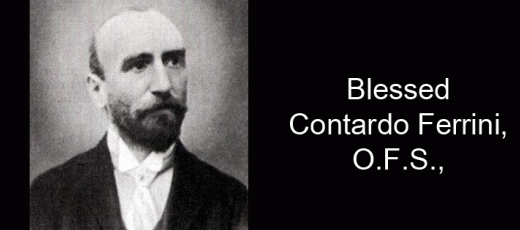
hand. Contardo Ferrini was born of a distinguished family
on April 4, 1859. When he was still a student in high school and college he
encouraged his companions to lead good lives and exercised a kind of lay
apostolate among them. After winning his doctorate in law, he obtained a
government scholarship to study abroad. He went to Berlin, where he studied
Roman-Byzantine law, a field in which he achieved international fame. In the
capital of the German empire prejudices against Catholics did not keep
Professor Ferrini from publicly professing his faith. On returning to Italy,
he taught in various higher institutions of learning and eventually at the
University of Paris.
It must be stressed here that Ferrini's life was
practically an unbroken elevation of his soul to God. His keen intellectual
ways penetrated to the Last Principle of all things. "Our life," he said,
"must reach out towards the Infinite, and from that source we must draw
whatever we can expect of merit and dignity."
Every day he approached the Holy Table. He made a
short meditation daily, and also read from Thomas a Kempis. His favorite books
were those of the Bible. The better to savor the spirit of their contents, he
read them in the original languages, of which he had a perfect command. Like
another Joseph of Egypt, he preserved his purity unsullied amid the dangers of
big city life. He practiced many and varied mortifications to arm himself
against harm.
In 1886 he joined the Third Order of St. Francis,
and for the rest of his life he faithfully observed its rule. He also enrolled
himself in the St, Vincent de Paul Society. In his speeches and writings as
well as in his conduct, he made it a point to show that faith and science are
not only opposed to each other, but that faith is rather a shield to protect
us from error and guide us to true heights.
In 1900 Contardo Ferrini was afflicted with a heart
lesion in consequence of excessive labor. In the autumn of 1902, feeling the
need of rest, he repaired to his country house at Suna. There, however, he was
stricken with typhus. Due to his weakened condition, he was unable to resist
the malignant fever, and died on October 17, 1902, at the age of
43.
The high esteem in which the deceased was held, now
became evident. Letters of condolence from the professors of the university
praised him as a saint. The people of Suna promptly expressed a desire to see
him numbered among the saints. The demand for his beatification grew more
insistent with time, and there was universal rejoicing when in 1909 Pope St.
Pius X appointed Cardinal Ferrari to begin the process. Pope Pius XI conferred
on him the title Venerable in 1931; and Pope Pius XII beatified him in
1947.
ON THE HOLY SCRIPTURES 1. Holy Writ is not the only
source of faith. It is incomplete for one thing, for St. John says: "There are
also many other things which Jesus did" (John 21:25). Then, too, the
prophecies about the kingdom of heaven which Christ gave His apostles before
His ascension, are not recorded. And from the Epistles of St. Paul (1 Cor 5:9
& Col 4:16) we learn that part of the Scriptures have even been lost.
Although Contardo Ferrini entertained great love for the Scriptures, he did
not regard them as the only authority in matters of faith, but paid equal
respect to the teachings of Holy Church. -- Scripture and the appointment to
teach go hand in hand. 2. Holy Writ most not be our only source of faith.
Christ did not say, "Distribute Bibles!" But He did say, "Teach all nations!"
(Matt 28:19). Holy Writ itself ought to assure us that it is the only source
of our faith if that were the case; but nowhere can we find a statement to
that effect. Neither is the meaning of Holy Writ plain to all who read it.
Nowhere do we find it stated just what belongs to holy Writ; our separated
brethren have learned that from the teachers of the Catholic Church. -- Let
nothing and nobody keep you from heeding the teachings of the Catholic
Church. 3. At no time was Holy Scripture used as the only source of faith.
Certainly not in the beginning of Christianity; for then the Gospels and
Epistles had not yet been written and distributed. Nor at any later time; for
even Protestantism has not held the Bible to be the only rule, since the
observance of Sunday, the baptism of infants, and may other practices are not
mentioned in the Bible. Should non-Catholics reproach you for neglecting the
Bible, let your answer be: Holy Scriptures tells us nowhere that we should
read the word of God, but it does tell us to hear the word of God. From Sunday
to Sunday, the Catholic Church gives us the explanation of the Scriptures.
Intelligent and leading Protestants themselves complain of the mischief done
by the so-called free interpretation of the Bible. As far as reading the Bible
is concerned, good Catholic read and pray it often in the prayers of the
liturgy, especially the missal and the divine office. And the Church has
granted an indulgence to the faithful who spend at least a quarter of an hour
in reading Holy Scripture with the great reverence due to the word of God and
after the manner of spiritual reading.
Remember
that I am the enemy of useless desires, no less than I am of dangerous
and bad desires. Because even though one's desires are good,
nevertheless the desire is always defective in our regard, especially
when it is combined with excessive haste. Because God does not expect
this sort of good, but He wants us to practice another.