
Thursday, September 6, 2012


Tuesday, September 4, 2012
Beloved St. Padre Pio! A Litany of Padre Pio

Litany of St. Pio of Pietrelcina (Padre Pio)
(feast day: September 23)
Lord, have mercy.Christ, have mercy.
Christ, hear us.
Christ, graciously hear us.
Holy Mary, Mother of God, pray for us.
Our Lady of Grace, pray for us.
St. Francis, spiritual father of Padre Pio, pray for us.
St. Pio of Pietrelcina…
St. Pio, faithful son of Mary…
St. Pio, poor son of St. Francis…
St. Pio, obedient son of the Church…
St. Pio, friend of the angels…
St. Pio, priest of God…
St. Pio, priest of Christ, the infant of Bethlehem…
St. Pio, priest of Christ crucified…
St. Pio, priest of Christ the great High Priest…
St. Pio, priest who bore the wounds of Christ…
St. Pio, priest who called sinners to repentance…
St. Pio, counselor of the troubled…
St. Pio, holy friar of the people…
St. Pio, channel of God’s mercy…
St. Pio, channel of God’s healing…
St. Pio, channel of God’s love…
St. Pio, channel of God’s grace…
St. Pio, reader of hearts…
St. Pio, prophet of future events…
St. Pio, victim of divine love…
St. Pio, enemy of Satan…
St. Pio, enemy of sin…
St. Pio, wise man of the Gargano Mountains…
St. Pio, founder of the House for the Relief of Suffering…
St. Pio, companion of the poor…
St. Pio, healer of the sick…
St. Pio, strength of the poor souls in purgatory…
St. Pio, apostle of the confessional…
St. Pio, apostle of the Eucharist…
St. Pio, apostle of the Rosary…
St. Pio, apostle of prayer…
Lamb of God, you take away the sins of the world. Spare us, O Lord.
Lamb of God, you take away the sins of the world. Graciously hear us, O Lord.
Lamb of God, you take away the sins of the world. Have mercy on us.
Pray for us, O blessed St. Pio of Pietrelcina,
that we may be made worthy of the promises of Christ.
Let us pray.
O God, who raised up St. Pio of Pietrelcina as a dramatic sign of your presence in the middle of a most painful and difficult century, grant that we who seek his intercession and follow his holy example may experience the same profound conversion through his prayers today as did thousands who were graced by his priestly ministry during his time on earth. We ask this through Christ our Lord. Amen.
(This original litany appears in the book, Saints for Our Times: New Novenas and Prayers [Pauline Books and Media, 2007])

Saturday, September 1, 2012
Poor Clare Colettines of Cleveland - video
Thanks to my friend, "emmaberry", for putting this DVD I sent her onto her computer so it could be uploaded! I've had this video for awhile on VHS since the mid 90s and then copied it to DVD in the mid 2000s but I never knew how to upload it to the
computer to help others to discern with this community!
This was shown on EWTN in the mid 90s and was first copied to a VHS and then I copied to DVD so that is why the first few seconds looks so bad! Old VHS tape.
This was shown on EWTN in the mid 90s and was first copied to a VHS and then I copied to DVD so that is why the first few seconds looks so bad! Old VHS tape.
Also, the visual and audio quality is not as good as the DVD. I believe it is due to the only way it could be uploaded. So please excuse the poor quality. But it beats sitting in a DVD case with my other DVDs!
**Also, if anyone notices, the narrator of this tape IS Sr. ? Grace? (Mary Grace, Margaret Grace?, forget her name!), she is the nun with the English accent in Mother Angelica's PCPA order in Birmingham who does the voice for saying "For those who can not now received Jesus in the Blessed Sacrament, we offer the following prayer..." on all the EWTN masses on TV. I used to know her name but it's eluding me at the moment!**
It's funny when I visited them back in the mid 2000s, I told them about this video on EWTN and how I had seen it and copied it. Mother Abbess and the sisters told me how funny it was to make it as the director (or whoever!) wanted to just go and spontaneously start doing things: like "Go clean or dust!" even though that had been done earlier in the day so they felt silly doing things! Also, what isn't audible it seems is during the scene of the sisters doing the altar bread baking, when the lid pops up by itself, the camera man says something like "whoa!" and it's funny to hear a male voice in the monastery! Then the scene with the sisters gardening with their hoes, that too had been done so they didn't want to mess what they did so they "pretended to garden!". They told me other funny stories and examples but too long to recount new.
ANYONE who thinks they have a Poor Clare Colettine vocation must definitely visit this community! They are so wonderful, holy, traditional, completely follow the Rule of St. Clare and the Reform of St. Colette and of Our Holy Father St. Francis. The nuns are so loving, warm, friendly, holy, beautiful, kind - I could go on forever!
Their monastery is a beautiful over 100 yrs old Victorian building and the chapel is so beautiful. This monastery is so permeated with the presence of God! Mostly due to the exposition of the Blessed Sacrament 24/7 for the nuns and usually 6am to 5pm or so (when I visited mid 2000s).
Wednesday, August 29, 2012
"A Right To Be Merry" by Mother M. Francis, Poor Clare Colettine nun

This book, "A Right To Be Merry" is available at Ignatius Press: http://www.ignatius.com/Products/RTBM-E/a-right-to-be-merry.aspx.
For anyone who loves the Poor Clare Colettines, whether you have a vocation to them or not!, loves St. Clare, you must read this book! It is written by Mother Mary Francis, PCC, formerly the Mother Abbess of the Roswell PCC community (http://www.poorclaresroswell.com/index.html). She passed away a few years ago.

(Mother Mary Francis, PCC 1921-2006)
I love this book! I have read this book only about 5 times! I must buy a new one as my original one is falling apart, dog-eared, highlighted and underlined to death! This book since it was first printed - in the 40's or 50's? forget now, has led to countless vocations to the Poor Clare Colettines.
This is the perfect book to give to young girls who are thinking of a vocation or not - it may MAKE them think of one! It's also a great read for anyone to understand the Poor Clare Colettines better. It explains the many "why's" people have of religious life and especially the enclosed monastic life, the vows, and Franciscan/PCC way of life: the bare feet, poverty, rising at midnight, their rule of life, the vows of obedience, poverty, chastity and enclosure, etc. Often it's funny, serious and just a gem!
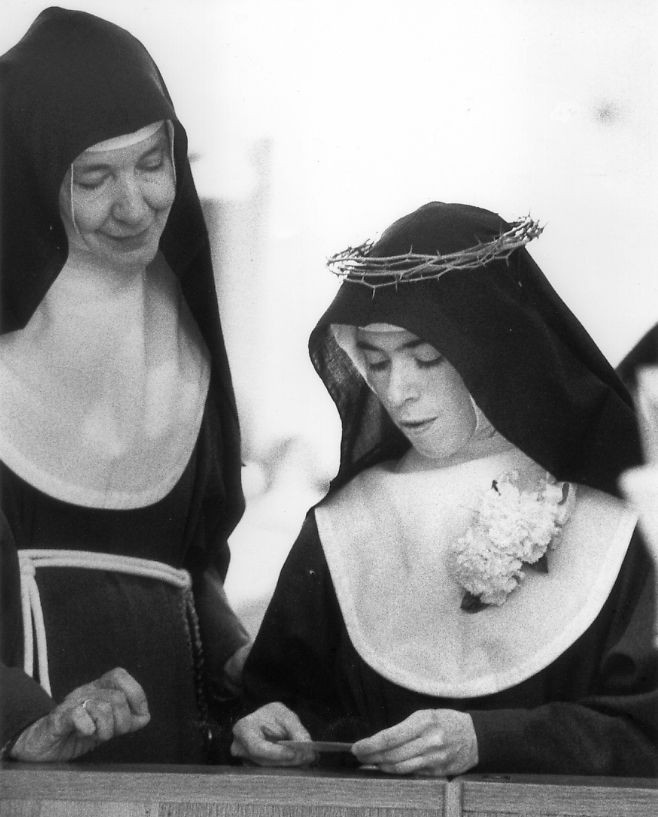
(Below, Mother Mary Franics, left, with a nun on her Solemn Profession Day. On Solemn Profession Days, a Poor Clare Colettine nun wears a crown of thorns to be one and show her total surrender, marriage and giving of herself to her Crucified Spouse.)
Great Movies on St. Francis and St. Clare of Assisi
These movies are also available at Amazon. To give support to a great Catholic company, below are the links to Ignatius Press' site for these movies:

"Clare and Francis"
http://www.ignatius.com/Products/CF-M/clare-and-francis.aspx

"Saint Francis"
http://www.ignatius.com/Products/STFRA-M/saint-francis.aspx
Both movies are very good - fairly accurate - but people who know the lives of these saints will see differences or some inaccuracies. I.E. in "Saint Franics", they have the two saints about the same age and playing together as children when in reality, St. Francis was 12 years older than St. Clare and they have Clare staying in a Benedictine monastery instead of her founding the Poor Ladies (as they were called then) in the church, San Damiano, that St. Francis rebuilt, etc. But over all these are good movies.
"Clare and Francis"
http://www.ignatius.com/Products/CF-M/clare-and-francis.aspx
http://www.ignatius.com/Products/STFRA-M/saint-francis.aspx
Both movies are very good - fairly accurate - but people who know the lives of these saints will see differences or some inaccuracies. I.E. in "Saint Franics", they have the two saints about the same age and playing together as children when in reality, St. Francis was 12 years older than St. Clare and they have Clare staying in a Benedictine monastery instead of her founding the Poor Ladies (as they were called then) in the church, San Damiano, that St. Francis rebuilt, etc. But over all these are good movies.
St. Anthony of Padua, "Hammer of the Heretics"

St. Anthony (also known as Antony) is a Doctor of the Church, a Franciscan priest called the "Hammer of the Heretics", the "Wonder Worker", and the "Living Ark of the Covenant."
He was born Fernando Martin de Bulhom in 1195 in Lisbon, Portugal, t...
he
son of a knight of the court of King Alfonso II. His parents sent him
to be educated by the clergy at the Cathedral of Lisbon. At the age of
15 he joined the Canons Regular of St. Augustine and at 17, in order to
have more seclusion, asked for and obtained leave to transfer to the
priory of St. Cross, of the same order, at Coimbra, then the capital of
Portugal. There, for a period of eight years, he devoted himself to
study and prayer. With the help of a remarkable memory, he acquired a
thorough knowledge of the Scriptures.
The arrival of the relics of St. Bernard and companions, the first martyrs of the Franciscan Order, led Anthony to join the Franciscan Order at the age of 25. At this time, he changed his name to Antony in honor of St. Antony of Eygpt, which was the name of the chapel where he received the Franciscan habit. He was deeply inspired by the Franciscan martyrs and tried to emulate them. He received a friendly reception at the peaceful little Franciscan convent at Coimbra and in the same year his earnest wish to be sent to the missions in Africa was fulfilled.
But God had decreed otherwise. And so, Antony scarcely set foot on African soil when he gravely ill. Even after he had recovered, he was so weak that he boarded a boat back to Portugal. Unexpectedly, a storm came upon them and drove the ship to the east where it found refuge on coast of Sicily. There Antony was greeted and given shelter by the Franciscans of that island, and shortly thereafter was sent to Assisi, where the general chapter of the Order was held in May, 1221 A. D. Antony remained there nine months as chaplain to the hermits, occupied in the lowliest duties of the kitchen and convent, and to his heart's content he practiced interior as well as exterior mortification.
But the hidden jewel was soon to appear in all its brilliance. For the occasion of a ceremony of ordination some of the hermits along with Antony were sent to the town of Forli. Before the ceremony was to begin, however, it was announced that the priest who was to give the sermon had fallen sick. The local superior, to avoid the embarrassment of the moment, quickly asked the friars in attendance to volunteer. Each excused himself, saying that he was not prepared, until finally, Antony was asked to give it. When he too, excused himself in a most humble manner, his superior ordered him by virtue of the vow of obedience to give the sermon. Antony began to speak in a very quiet and reserved manner; but soon the power of the Holy Spirit seized him, and he spoke with such eloquence that everyone was amazed.
When St. Francis was informed of the event, he gave Anthony the mission to preach throughout Italy. At the request of the brethren, Antony was later commissioned also to teach theology, "but in such a manner," St. Francis distinctly wrote, " that the spirit of prayer be not extinguished either in yourself or in the other brethren." Antony himself placed greater value in the salvation of souls than on learning. For that reason he never ceased to exercise his office as preacher despite his work of teaching.
Antony was called the "Wonder Worker for his many reported miracles. He preached to crowds in the rain, but his audiences remained dry despite the downpour.
The number of those who came to hear him was sometimes so great that no church was large enough to accommodate and so he had to preach in the open air. He was so energetic in defending the truths of the Catholic Faith that many heretics returned to the Church. This occasioned the epitaph given him by Pope Gregory IX "the ark of the covenant."
In all his labors he never forgot the admonition of his spiritual father, St. Francis, that the spirit of prayer must not be extinguished. If he spent the day in teaching and heard the confession of sinners till late in the evening, then many hours of the night were spent in intimate union with God.
Once a man, at whose home Antony was spending the night, came upon the saint and found him holding in his arms the Child Jesus, unspeakably beautiful and surrounded with heavenly light. For this reason St. Anthony is often depicted holding the Child Jesus.
In 1227 A. D., Antony was elected Minister Provincial of the friars living in northern Italy. Due to his taxing labors and his austere penance, he soon felt his strength so spent that he prepared himself for death. After receiving the last sacraments he kept looking upward with a smile. When he was asked what he saw there, he answered: "I see my Lord." He breathed forth his soul on June 13, 1231 A. D., at the age of 36. Soon the children in the streets of the city of Padua were crying: "The saint is dead, Antony is dead."
Antony was canonized in 1232 and named a Doctor of the Church in 1946. At Padua, a magnificent basilica was built in his honor, his holy relics were entombed there in 1263 A. D. From the time of his death up to the present day, countless miracles have occurred through St. Anthony's intercession.
Patron of: Poor, barren and pregnant women, also against shipwrecks, starvation and of American Indians, animals, boatmen, elderly people, fishermen, harvests, lost articles, mail, Portugal, travelers, travel hostesses, and watermen.
Alms given to obtain his intercession are called "St. Antony's Bread."
How he came to be invoked, as he now is, of the finder of lost articles has never been satisfactorily explained. The only story that relates to this is contained in the so-called Chronicles of the Twenty-Four Generals, number 21. A novice ran away from his monastery carrying with him a valuable psalter which Antony had been using. he prayed for its recovery and the novice was frightened by a startling apparition into returning it.
Symbol: book, bread, Infant Jesus, lily
He is occasionally accompanied by a mule which, legend said, fell on its knees when the Blessed Sacrament was upheld by St. Anthony, thus converting its heretical owner to believe in the Real Presence.
++++++++++++++++++++++++++++++++++++++++
A great movie on St. Anthony's life (fairly accurate) is "Saint Anthony" - an Italian movie with English subtitles. Available at: Amazon: http://www.amazon.com/Saint-Anthony-Daniele-Liotti/dp/B000MTEKGE/ref=sr_1_1?s=movies-tv&ie=UTF8&qid=1346288061&sr=1-1&keywords=st.+anthony

Subscribe to:
Posts (Atom)