Search This Blog

Saturday, August 10, 2013

Litany of St. Clare of Assisi - for her feast day tomorrow, August 11th


  Lord, have mercy upon us.
Christ, have mercy upon us.
Lord, have mercy upon us.

O Christ, hear us.
O Christ, graciously hear us.
O God the Father, of Heaven:
have mercy upon us.
O God the Son, Redeemer of the world:
O God, the Holy Ghost:
O Holy Trinity, one God:
have mercy upon us.
Holy Mary:
Pray for us.
Immaculate Virgin:
Mother and Mistress of our Order:
Pray for us.
St. Clare, first-born of thy Order:
Pray for us.
St. Clare, spouse of the Crucified:
St. Clare, lover of the Blessed Sacrament:
St. Clare, lover of the Sacred Heart:
St. Clare, lover of the Sacred Wounds:
St. Clare, lover of the Sacred Name:
St. Clare, lover of the Sacred Gospel:
St. Clare, to thy mother forenamed "resplendent":
St. Clare, resplendent with the light of Jesus:
St. Clare, resplendent in thy noble heritage:
St. Clare, resplendent in thy renunciation thereof:
St. Clare, resplendent in clinging to the altar as thy portion:
St. Clare, resplendent as first abbess of a great Order:
St. Clare, resplendent in putting the Saracens to flight:
St. Clare, resplendent in reparation for the sins of the world:
St. Clare, resplendent in wondrous miracles:
St. Clare, little plant of St. Francis:
St. Clare, princess of the poor:
St. Clare, duchess of the humble:
St. Clare, mistress of the chaste:
St. Clare, abbess of the penitent:
St. Clare, alabaster box of ointment broken at the feet of Jesus:
St. Clare, received at death by a choir of virgins:
St. Clare, censer of sweet perfume filling heaven and earth:
Pray for us.

O Lamb of God, that takest away the sins of the world:
spare us, O Lord.
O Lamb of God, that takest away the sins of the world:
graciously hear us, O Lord.
O Lamb of God, that takest away the sins of the world:
have mercy upon us.
V. Pray for us, O blessed Clare. Alleluia.
R. That we may be worthy of the promises of Christ. Alleluia. 
  Let us pray.

O God Who hast raised up blessed Clare as a shining lamp of holiness to lighten the way before a multitude of virgins: by her merits and prayers grant to us who do call to mind her commemoration, that in this life we may walk in Thy light, and in the life to come, may forever enjoy the light of Thy countenance. Through Christ our Lord. Amen.

Tuesday, August 6, 2013

Today is the Feast of Bl. Agathangelus and Cassian, Priests and Martyrs, First Order


Agathangel was born in Vendome in 1589 and Cassian in Nantes in 1607. Both received the habit of the Franciscan Order among the Capuchins and were sent to the African missions shortly after they had completed their studies. They met in Cairo. There they learned of the persecution of the Christians in Abyssinia. Filled with a desire to labor and suffer for Christ among their separated brethren, they went to that country. They had scarcely begun their work when they were seized and put in chains. They languished in prison for the space of a month, and then during another 25 days they were dragged to Gondar amid unheard-of treatment and during the extreme heat of a July sun. The king intended to force them to renounce their faith.

Father Cassian replied with firm determination: "We wish to live and die as children of the Catholic, apostolic, and Roman Church, outside of which there is no salvation. We do not wish to purchase our lives with the price of infamous apostasy. We do not wish to enjoy honors and riches, which you offer us at the price of our immortal souls."

Both confessors were then sentenced to he hanged. When the executioners were looking about for ropes, the two confessors, inflamed with a desire for martyrdom, called out: "If you need ropes, use our cords." So it was done. A few moments later the holy missionaries had won the crown of martyrdom. This happened on August 7, 1638. Pope Pius X beatified them with great solemnity.

THE ONLY CHURCH IN WHICH THERE IS SALVATION

1. Because it has been founded by Christ as the institution of salvation, the Catholic Church is the only one in which we can be saved. Christ always speaks of only one Church: "On this rock, I will build My Church," "he who will not hear the Church...", "there will be but one flock and one shepherd..." The Church would forfeit its own rights where it to recognize any other churches. The martyrs eloquently proclaimed this truth to the world by laying down their lives for the Faith and in defence of the only saving Church. -- We too must have the spirit of the martyrs; we must be ready to act as they did.


2. The Catholic Church, as the body of Christ, is the only saving Church. It is the mystical body of Christ, the incarnate Second Person of the Blessed Trinity. Is it possible to think of more than one body belonging to this Head? That is plainly impossible. Besides, it is the task of the Church to lead souls to God. There is only one such goal, and there cannot be various ways which are opposed to one another, as in the non-Catholic churches. The Catholic Church, therefore, says with Christ: "I am the way" (John 14:6). Be faithful to this way.


3. The Catholic Church is the only saving Church for all men. Of her it can be said: "Neither is there salvation in any other" (Acts 4:12). That is: He who attains to salvation is saved through the Church. either as a member of the Church or as belonging to the soul of the Church. Non-Catholics and heathens will be saved through the Church, if they live according to the dictates of their conscience and co-operate with the necessary graces which God gives them and thus belong to the soul of the Church. -- Rejoice that you are a member of the Church, and pray for those who are not within the fold.


PRAYER OF THE CHURCH

O God, who didst inflame Blesseds Agathangel and Cassian with Thy love and grant them to shed their blood for Thee, graciously grant at their intercession we may in this life so struggle against the enemy of our salvation that we may merit to be crowned by Thee in heaven. Through Christ our Lord. Amen.


from: The Franciscan Book of Saints, ed. by Marion Habig, ofm., © 1959 Franciscan Herald Press


(below is from a online translator of Spanish to English - will be errors)

From a letter of Blessed Agathangelus
Cardinal Prefect
of  the Propagation of the Faith Congregation

Eminence and Patron: Finding myself last month in Jerusalem, Reverend Father Guardian showed me the letter from the eminent Cardinals of the Sacred Congregation, in which it was stated that:"Your Paternity we notified the father apparently Paul of Lodi on the legality and desirability of visiting the churches of heretics and schismatics, keeping heart inside the security in the Catholic faith. This review is judged wrong by the Sacred Congregation, so you can not maintain this practice. "After I moved to Egypt and I submitted the question to three Our Fathers, theologians, and the trial of Father Archangel of Pistoia. The opinion of these parents is according to my staff, so I venture to submit to your Eminence as the youngest son, and I judge to be the most suitable for the glory of God and the salvation of souls, but always ready to accept any correction that I deserve, if I am not in the truth. The parents mentioned theologians studied the problem thoroughly, identified several recitals, we can reduce to four: that such communication does not result in Divinis scandal that there is no danger of losing the faith is not involved in any criminal act or ceremony which may mean heresy suppose not expressly approved such heresy or heretical rite.To obtain an accurate and judge aright these four conditions, timely insight into the true circumstances of place, time, existing rites classes here and other special situations, and the full knowledge it will never correct formation theologians and doctors of Christianity, by ignoring the specific customs of these places. So, in my humble opinion, I think this problem should be subject to the conscience of the missionaries, who think that communication with heretics and schismatics have to stay here and not be impeded for any reason, because otherwise would practice to eliminate the possibility of finding other means, other roads and other hope of doing good in these missions, and even create serious impediments existing peaceful relations.Given these important considerations and several others which I omit for the sake of brevity, allow me to quote the judgment of the glorious martyr and saint Pope Martin: "It is safe rule in times of persecution to be condescending, provided that this does not trespass or contempt, but rather narrowness and distress, that the need will always judge things with mercy, being benign and omitting, for better times, greater demands. " Copts abound here, and I took the trouble to examine their liturgical books, not finding in them no error except the heretics invocation Dioscorus and Severus. This is why I allowed our priests to use these books in the celebration of Mass, omitting only invoking heretics aforementioned, and so they do not have originated in this scandal any faithful people.

Start Novena to St. Maximilian Kolbe today! Two Novena's below:


"I don’t want to overlook those who adhere to the Novus Ordo calendar. Thanks to MJD for sending this to me, here is a Novena for the Feast of St. Maximilian Kolbe, which is on Aug. 14 in the Novus Ordo calendar (he’s not in the TLM calendar, as he was not a Saint, yet, when the calendar was last updated in 1962).

I can attest that St. Maximilian’s intercessions are quite powerful.
Why call on this saint for help?

Because he is known as the patron of our difficult age and a heavenly intercessor for:
  1. drug, alcohol and sexual addictions
  2. eating disorders
  3. the pro-life movement
  4. healing,spiritual, mental and physical conversionsFr_Maximilian_Kolbe_1936
  5. families
  6. prisoners
  7. success in a new ministry
Start novena prayer today!
O St. Maximilian Kolbe,
faithful follower of St. Francis,
inflamed by the love of God
you dedicated your life to the practice of virtue
and to works of the apostolate.
Look down with favor upon us
who devoutly confide in your intercession, especially for:
(here mention your special requests)
Having consecrated yourself to the Immaculate Virgin Mary,
you inspired countless souls to a holy life
and various forms of the apostolate
in order to do good to others
and to spread the kingdom of God.
Obtain for us the grace by our lives and labors img-20080513194124-maximilian-kolbe
to draw many souls to Christ.
In your close conformity to our Divine Savior
you reached such an intense degree of love
that you offered your life to save a fellow prisoner.
Implore God that we,
inflamed by such ardent charity,
may through our living faith and our apostolic works
witness Christ to others,
and thus merit to join you in the blessed vision of God.
Amen."

(the above from a great blog: http://veneremurcernui.wordpress.com/2013/08/06/start-novena-to-st-maximilian-kolbe-today/)

A longer Novena to St. Maximilian is:

Opening Prayer to St. Maximilian

O St. Maximilian Kolbe, faithful follower of St. Francis, inflamed by the love of God you dedicated your life to the practice of virtue and to works of the apostolate.

Look down with favor upon us who devoutly confide in your intercession.
Having consecrated yourself to the Immaculate Virgin Mary, you inspired countless souls to a holy life and various forms of the apostolate in order to do good to others and to spread the kingdom of God. Obtain for us the grace by our lives and labors to draw many souls to Christ.

In your close conformity to our Divine Savior you reached such an intense degree of love that you offered your life to save a fellow prisoner. Implore God that we, inflamed by such ardent charity, may through our living faith and our apostolic works witness Christ to others, and thus merit to join you in the blessed vision of God. Amen.

(Readings and Meditations for each day of novena are given here to be followed each day by the closing Novena prayer at the very bottom.)

Day 1: Maximilian's Call to Holiness

Reading: Raymond Kolbe was born of poor parents in Poland on January 7, 1894. Raymond came to love the Blessed Virgin quite early in life. This devotion did not prevent him from getting into trouble. His lively nature tried the patience of his mother. Once she remarked in exasperation, "Raymond, what is going to become of you?" After this incident there was a noticeable change in his behavior. His mother became worried. Upon questioning him, she found Raymond at first reluctant to tell her his "secret." Finally he told her how much her reproach had troubled him. He had prayed to Mary, and asked her the same question, "Mother of God, what will become of me?" She took compassion on the miserable boy and appeared to him holding in her hands two crowns, one white, the other red. She asked Raymond which one he would choose; the white signified purity, the red martyrdom. "I choose both" he answered. 


Meditation: Every genuine conversion experience be it that of a mischievous child or that of a hardened adult involves the individual's humble recognition of his own weaknesses and capacity for sin. May Maximilian's humility be ours in our pursuit of Christian holiness through ongoing conversion.

Please turn to the Novena Prayer. 

Day 2: Maximilian Discerns God's Will 

Reading: When Raymond Kolbe was a seminary student at Lwow, Poland, he bowed his face to the floor during Mass one day and promised the most holy Virgin that he would fight for her. It was a surprising thing to do, especially since he had already chosen to be a Franciscan priest. Not knowing how he was to fulfill his promise he began to picture to himself a struggle with material weapons. The more he thought about it the more he felt attracted to a military career, fighting for the freedom of his homeland under the banner of Our Lady of Czestochowa. Finally, he decided he had made a mistake: he would give up the idea of studying for the priesthood. He was on his way to inform the Minister Provincial of his decision when he was called to the parlor. His mother had just arrived for a visit. What Maria Kolbe told her son we do not know, but shortly afterward Raymond was invested in the Conventual Franciscan habit and took the name Maximilian Maria. 


On September 5, 1911, he made his first vows. The following year, another crisis arose, and again Maximilian Kolbe's destiny hung in the balance. His superiors had decided to send him to Rome for philosophical and theological studies, but Friar Maximilian requested that his name be stricken from the list. That night he reconsidered. Had he not placed his own will in the way of God's will as expressed by his superiors? Was it not better to obey? The following morning he told his Provincial that he was prepared to go to Rome.

Meditation: Discernment of the direction that God wishes our lives to take requires an absolute truthfulness with oneself and God. May Maximilian's inner honesty be ours as we strive continually to do God's will.

Please turn to the Novena Prayer. 

Day 3: Maximilian's Consecration to Mary

Reading: It was in Rome that Friar Maximilian learned the true meaning of his call to fight for Mary. Exposed to the rabid anti-Christian forces that burgeoned in Europe he saw the need for a new era of evangelization that would bring all peoples back to God. Suddenly during prayer one morning, Friar Maximilian was enlightened to understand the critical importance of the role God had given Mary in this work. Meditating on the Miraculous Medal conversion story of Alphonse Ratisbonne, a young nineteenth-century Jewish agnostic, Friar Maximilian was illumined to perceive Mary's role as the Holy Spirit's indispensable partner and instrument in the evangelizing work of conversion and growth in holiness. He saw that this work was a spiritual war with Satan, and that Mary needed consecrated souls to serve as her knights in this battle. Maximilian lost little time putting this inspiration into action. 


On October 16, 1917, he and six fellow Franciscans established the Militia of the Immaculata (MI) movement. Its goal was as simple and vast as the Church's mission: the interior transformation of all souls in Christ through the Immaculata. To achieve this goal, Friar Maximilian proposed a practical spirituality of "Total Consecration to Mary." He and all "MIs" would make a free and total offering of themselves to Our Lady, so that they might become instruments in her work for Christ.

Meditation: True consecration to Mary is a Marian way of livinga life of close union with Christ through the Holy Spirit. May we find in Maximilian's spirituality of Marian consecration a powerful means for living Christ's Gospel and spreading it to others.

Please turn to the Novena Prayer. 

Day 4: Maximilian's Faith

Reading: After his ordination, Father Maximilian returned to Poland in July 1919, worn by tuberculosis. Despite his poor health, he was assigned to the Franciscan friary at Cracow where the climate is fatal to tubercularsas a university professor. Not only was his body exhausted but at times his soul was harrowed by ridicule from some of his own Franciscan confreres. He had hoped on returning to interest all the friars at Cracow in his work. A good number of priests, brothers and student friars did respond to his call, but others shrugged their shoulders. They listened to him, then laughed among themselves, calling him a bore and a dreamer. One friar even found a nickname which delighted the detractors for awhile: "Marmalade." The young priest walked very slowly, like animated marmalade, to avoid any abrupt movement that could provoke hemorrhage. Maximilian bore this mockery with patience and mildness. Faith, alone, allowed him to find in God and the Immaculata the affirmation and support that some of his confreres initially denied him.

Meditation: When all seems lost and one is stripped of everything, there remains one vital source of spiritual energy: faith. May Maximilian's faith be ours, especially when adversity robs us of the affirmation and support we crave.


Please turn to the Novena Prayer. 

Day 5: Maximilian's Hope

Reading: Through Father Maximilian's efforts, the influence of the MI movement began to spread through Poland in the 1920s. As distances became too great for his one unaided human voice to reach, Maximilian realized that only the printed word would suffice. With a complete lack of capital, but full trust in providence, he began publishing the Knight of the Immaculata (Rycerz Niepokalanej) a sixteen-page magazine. Once when bankruptcy seemed imminent, he threw himself at the feet of the Immaculata and begged for help. As he was about to leave the church, he found an envelope on the altar with these words on it, "For thee, O Immaculate Mother." Inside was the exact sum to pay the debt. 


In 1927 when quarters for his printshop became too small, he entered into negotiations to purchase a large tract of land for a whole "City of the Immaculata" (Niepokalanow), where he and the friars would expand their apostolate. However, he again lacked capital. He explained to the landowner, Prince Drucki-Lubecki, that he could not afford the price. Abruptly the Prince decided to make a free gift of it to Maximilian and the friars. By 1939 Niepokalanow had become the largest Franciscan friary in the world with over 700 friars and students. The circulation of their magazine exceeded 750,000 copies per month.

Meditation: When the customary human solutions to the complexities that beset our lives prove ineffective, we are placed in a situation of total dependence upon God. May Maximilian's unflagging hopea complete trust in God's providencebe ours throughout the course of our life.

Please turn to the Novena Prayer. 

Day 6: Maximilian's Sanctification of Labor

Reading: Father Maximilian's zeal for the inner conversion and sanctification of all people was not confined by national boundaries. With appropriate ecclesiastical permission, he and four other friars sailed to the Orient in 1930. They established themselves in Japan, where they hoped to publish the Knight of the Immaculata in Japanese. As a condition to publish the magazine, Father Maximilian was obliged to teach philosophy in the diocesan seminary. In exchange, the bishop would allow diocesan priests to help in the translating of articles into the Japanese language. Remarkably, Father Maximilian was able to publish the first issue of Seibo no Kishi within one month of his arrival. Father Maximilian soon founded a second City of the Immaculata, Mugenzai no Sono. Throughout his apostolic labors in Japan, Father Maximilian suffered constantly from high fevers, violent headaches, and abscesses, due to overwork and an inadequate diet. He concealed these problems so well, however, that for some time only his most intimate companions had any awareness of the seriousness of his condition.

Meditation: Work can serve to enhance our dignity as God's people, when we work diligently to nourish our families and build up God's kingdom. May Maximilian's zealous commitment to each task at hand stimulate our own religious zeal for the daily work that God has entrusted to us.


Please turn to the Novena Prayer. 

Day 7: Maximilian's Obedience

Reading: Scarcely two months after his arrival in Japan and the first publication of a Japanese version of the Knight of the Immaculata, Father Maximilian was summoned by his superiors to defend this enterprise at the Province Chapter in Lwow, Poland. Obedient as always, he left Japan for this meeting, but his heart was heavy because there was no one capable of maintaining the gigantic work in his absence. Father Maximilian had no doubts that only through full obedience would his own labors for the Immaculata's cause be fruitful. At the chapter, the very future of the Japanese Niepokalanow was put to question. The expenses were heavy, and the capitular friars discussed the prudence of undertaking such a foolish venture. Father Maximilian followed his usual tactics. Having explained all his arguments and spoken from the abundance of his heart, he remained silent, waited, closed his eyes, with his hands under his capuche he held his rosary and very slowly while his superiors discussed the business he summoned his council, reciting innumerable Hail Marys. He won on all scores and returned to Japan with full permission to continue the Immaculata's work there.

Meditation: Submission to legitimate authority frees us from the tyranny of our own willfulness, stubbornness or selfishness. May Maximilian's obedience to authority in the Church move our consciences along the lines of a more generous obedience to Christ's chosen representatives.


Please turn to the Novena Prayer. 

Day 8: Maximilian and the Eucharist 

Reading: Under Father Maximilian's spiritual leadership, the friars of Niepokalanow and Mugenzai no Sono had incredible success in their press apostolate. Their secret for success was a community life of prayer centered on the Eucharist. In the mid-1930s, when the friars of Niepokalanow were about to inaugurate their first newspaper, the Maly Dziennik (Little Journal), they had formidable opponents in the secular press of Poland. For nine days, the friars prayed day and night before the Blessed Sacrament. The newspaper venture met with a tremendous success. Years later, Father Maximilian initiated a program of daytime adoration of the Eucharist at Niepokalanow. This began on December 8, 1939, the day on which Father Maximilian and the friars were released from a three-month imprisonment by their Nazi captors. He immediately introduced adoration of the Eucharist in order to increase his "active forces of prayer." Every half hour, day after day, a fresh group of four friars took its place before our Lord in the tabernacle. This became the friars' primary apostolate.

Meditation: For every Christian, prayer is not a luxury but a necessity. Maximilian knew that prayer before the Eucharist is the ultimate source for fruitful Christian living. May our own reverence for the Eucharist reflect this same conviction.


Please turn to the Novena Prayer. 

Day 9: Maximilian's Love

Reading: On February 17, 1941, Father Maximilian was arrested by the Gestapo for the second time. Subjected to extreme cruelty throughout his captivity, Father Maximilian prepared himself and his fellow prisoners for the ultimate moment: "They will not kill our souls . . . they will not be able to deprive us of the dignity of a Catholic. We will not give up." 


Love was to impel Father Maximilian to become a "martyr of charity" in the notorious Auschwitz concentration camp. After the escape of a prisoner, ten inmates were condemned to death by starvation. Sergeant Francis Gajowniczek cried out, "What will happen to my poor family?" At that moment, Father Maximilian slipped out of line, and boldly asked the commandant if he could take the place of Sergeant Gajowniczek. The astounded officer consented. Amidst the horror of the death bunker, love triumphed. Daily prayers, rosaries and hymns were heard as Father Maximilian ministered to his nine fellow victims. Finally after two weeks, on August 14, 1941, the Nazis hastened Maximilian's death by the injection of carbolic acid.

Meditation: True charity always places the needs of others ahead of our own because true charity sees Christ himself mirrored in the face of others. May Maximilian's total love for God and neighbor always through the Immaculata
characterize our own approach to Christ in others.


Novena Prayer for St. Maximilian's Intercession

O Lord Jesus Christ, who said, "Greater love than this no man has that a man lay down his life for his friends," through the intercession of St. Maximilian Kolbe, whose life illustrated such love, we beseech you to grant our petitions. (Pause here to mention the special requests you have.)
Through the Militia of the Immaculata movement, which Maximilian founded, he spread a fervent devotion to Our Lady throughout the world. He gave up his life for a total stranger and loved his persecutors, giving us an example of unselfish love for all people, a love that was inspired by true devotion to Mary.
Grant, O Lord Jesus, that we too may give ourselves entirely without reserve to the love and service of our heavenly Queen in order that we may better love and serve our neighbor in imitation of your humble servant, Maximilian. Amen.

(above long novena from: http://www.consecration.com/default.aspx?id=174)

Saturday, August 3, 2013

Franciscan Friars of the Immaculate's Saturday Homily: Reparation, Immaculate Heart of Mary


Published on Aug 3, 2013 On the First Saturday, Fr. Elias preaches on the devotion to Immaculate Heart of Mary and the apparitions at Fatima where Our Lady asked for this devotion for five consecutive first Saturdays in reparation for sins committed in the world.
Ave Maria!

Friday, August 2, 2013

For the August 2nd Feast of Our Lady of the Angels of the Portiuncula


Fr. Elias preaches on the Franciscan Feast of the Portiuncula, commemorating the Chapel of Our Lady of the Angels which was very small and so called The Little Portion, the Portiuncula where Our Lady gave so many blessings and increase in members to the newly formed Franciscans. Father explains how this Chapel has a plenary indulgence for visiting it on this day, what this means and how to get it.

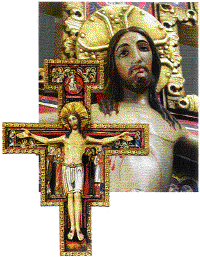
The Crucifix of San Damiano - A More Detailed Explanation

SanDam3.gif (58457 bytes)
The History of the San Damiano Crucifix
 
An unknown Umbrian artist painted the Crucifix Icon in the 12th Century. There is strong Syrian influence, and history tells us that there had been some Syrian monks in the area.

It is painted on wood (walnut) to which cloth had been glued. It is about 190 cm high, 120 cms wide and 12 cms thick. It is more than likely it was painted for San Damiano to hang over the Altar as the Blessed Sacrament was not reserved in non Parish Churches of those times and especially those that had been abandoned and neglected as we know San Damiano had been. In 1257 the Poor Clares left San Damiano for San Giorgio and took the Crucifix with them. They carefully kept the Cross for 700 years.

In Holy Week of 1957, it was placed on public view for the first time over the new Altar in San Giorgio's Chapel in the Basilica of St Clare of Assisi. 

The Icon of the Transfigured Christ
 
For Eastern Christians the Icon is a representation of the living God, and by coming into its presence it becomes a personal encounter with the sacred, through the grace of the Holy Spirit. The San Damiano Icon is then a personal encounter with the transfigured Christ - God made man. The Crucifix contains the story of the death, resurrection and ascension into glory. It expresses the total and universal Paschal Mystery of Christ. It invites us all to take part in it with a lively and lived faith, just as St Francis did. Christ's saving death is shown in John's Gospel in its serene majesty, and this Crucifix portrays this in picture form. It is not surprising that Saint Francis was attracted to this Icon and that the inspiration for his life came from this Christ who spoke to him "Go repair my Church ... ".
The Figure of the Christ
 
The central figure of the icon is Christ, not only because of the relative size, but because Christ is a figure of light dominating the scene and giving light to the other figures "I am the light of the world. Whoever follows me will not walk in darkness, but will have the light of life. " (John 8:12). Christ stands upright, not nailed. The eyes of Jesus are open: He looks out to the world, which He has saved. He is alive, the one who is eternal. Jesus' vestment is a simple loin cloth - a symbol of both High Priest and Victim. The chest, throat and neck are very strong, Jesus gives power of re-creation to His Disciples (John 22:23). He breathed on His Disciples (John 20:22), the Greek word used recalls the moment of Creation (Gen 2:7). The shadow over the face of Jesus is increased by the fact the halo and face are tilted forward on the original Icon. The humanity of Christ veils the true glory of the Word who lives in the super illuminous darkness of the Godhead. Behind the outstretched arms of Christ is His empty tomb, shown as a black rectangle. 

The Medallion and Inscription
 
The Ascension is portrayed within this circle of red: Christ is breaking out of the circle, holding a golden cross which is now His Royal Scepter. His garments are gold - a symbol of royalty and victory. His red scarf is a sign of His Dominion and Kingship; exercised in love. Angels welcome Him into Heaven. IHS are the first three letters of the name of Jesus. The little bracket above indicates it is shorthand. NAZARE is the Nazarene; REX is' king' and IUDEORUM is 'of the Jews', which is reported in St John's Gospel "Jesus the Nazarene, King of the Jews".
The Hand of the Father
 
From within the semi-circle at the very top of the Icon, He whom no eye has seen reveals Himself in a benediction. This blessing is given by the right hand of God with the finger extended - the Holy Spirit. The Father gives the gift of the Holy Spirit to all because of the merits of the Christ's Passion.
The Mystical Vine
 
Around the Cross are various calligraphic scrolls which may signify the mystical vine "I am the vine, you are the branches... " (John 15), which also contain the words "Greater love has no one than this, that one lays down one 's life for one friends ". At the base of the cross there seems to be a section that looks like a rock - the symbol of the Church. The seashells are symbols of eternity - a mystery hidden in the vast and timeless sea of eternity is revealed.
Mary and John
 
As in John's Gospel, Mary and John are placed side by side. Mary's mantle is white meaning victory (Rev 3:5), purification (Rev 7:14); and good deeds (Rev 19:8). The gems on the mantle refer to the graces of the Holy Spirit.

The dark red worn under the mantic indicate intense love, while the inner dress is purple - the Ark of the Covenant (Ex 26: 1-4).

Mary's left hand is raised to her cheek - her acceptance and love of John, and her right hand points to John while her eyes proclaim acceptance of Christ's words "Woman, behold your son... " (John 19:26). The blood drips on to John at this moment. John's mantle is rose color indicating eternal wisdom, while his tunic is white - purity. His position is between Jesus and Mary as is fitting for the disciple loved by both of them. He looks at Mary "Son, behold your Mother", but points to Christ. 

Numbers
 
There are 33 figures in the Icon - Two Christ figures, 1 Hand of the Father, 5 major figures, 2 smaller figures, 14 angels, 2 unknown at His hands, 1 small boy, 6 unknown at the bottom of the Cross and one rooster. There are 33 nail heads along the frame just inside the shells and seven around the halo. 

The Other Major Figures:
Mary Magdalene
 
Mary Magdalene is next to Christ making her very special; her hand is on her chin indicating a confided secret "He is risen ". She wears scarlet, which is a symbol of love; her mantle of blue deepens this. 
Mary Clopas
 
Some authorities make her the mother of James. She wears garments of an earthen color a symbol of humility, and her light green mantle - hope. Her admiration of Jesus is indicated by the gesture of her hand. 


The Centurion of Capernaum
 
He holds a piece of wood in his left hand, indicating his building of the Synagogue (Luke 7: 1 - 10). The little boy beyond his shoulder is his son healed by Jesus. The three heads behind the boy show "he and his whole household believed" (John 4: 45 - 54). He has extended his thumb and two fingers, a symbol of the Trinity, while his two closed fingers symbolize the hidden mystery of the two natures of Jesus the Christ. "Truly He is the Son of God" (Mark 15:39).

The Lesser Figures: Longinus
 
The Roman soldier who pierced Jesus' side with a lance. 

Stephen
 
Tradition gives this name to the soldier who offered Jesus a sponge soaked in vinegar wine after Jesus cried out "I thirst" (John 19: 28 -30).

The Unknown Saints
 
At the bottom of the Icon are six unknown saints whom Scholars postulate are STs Damian, Rufinus, Michael John the Baptist, Peter and Paul, all patrons of Churches in the Assisi area. St Damian was the Patron of the Church that housed the Cross and St Rufinus was the Patron Saint of Assisi. There is too much damage of that area to make a proper identification.

The Astonished Angels
 
There sat two groups of angels - animatedly discussing the scene unfolded before them.

"For God so loved the world that He gave His only begotten Son, that whosoever believes in Him shall not die but have life everlasting" (John 3:16). 

The Tomb


As mentioned before behind Christ is the open tomb; Christ is alive and standing over the tomb. The red of love overcomes the black of death. The gestures of the unknown saints at His hands indicate faith. Could these be Peter and John at the empty tomb? (John 20: 3 - 9). 

The Rooster

Firstly, the inclusion of the rooster recalls the denial of Peter who wept bitterly. Secondly, the rooster proclaims the new dawn of the Risen Christ 1 the true light (1 John 2:8). "But for you who revere my name, the Sun of Righteousness will rise with healing in its wings" (Malachi 4:2 or 3:20 depending on your translation). 

The Shape of the Cross
 
The shape of the Cross has changed to enable the artist to include all who participated in the drama of the Passion. Note that the arms of the cross lift to Christ's right indicating that the Good Thief (traditionally called Dismas) went to Heaven; while the left hand dips - the other thief did not.


(above from http://www.franciscanfriarstor.com/archive/stfrancis/stf_san_damiano_cross.htm)

San Damiano Cross - A Brief Explanation

                             
PRAYER BEFORE A CRUCIFIX

St. Francis of Assisi
We adore you,
Lord Jesus Christ,
here and in all your
churches in the whole world,
and we bless you,
because by your holy cross
you have redeemed the world.

A Brief Explanation
By: Fr. Michael Scanlon, T.O.R.
Most Sacred Heart of Jesus Province, USA

The San Damiano Cross is the one St. Francis was praying before when he received the commission from the Lord to rebuild the Church. The original cross presently hangs in Santa Chiara (St.Clare) Church in Assisi, Italy. All Franciscans cherish his cross as the symbol of their mission from God. The cross is called an icon cross because it contains images of people who have a part in the meaning of the cross. The tradition of such crosses began in the eastern Church and was transported by Serbian monks to the Umbria district of Italy.

The San Damiano Cross was one of a number of crosses painted with similar figures during the 12th century in Umbria. The name of the painter is unknown. The purpose of an icon cross was to teach the meaning of the event depicted and thereby strengthen the faith of the people. These conclusions have been reached based on a thorough study of the history of the cross and the literature concerning it. Very little literature is available in English. Most of it can only be read in Italian or French. The author also found it very helpful to compare the cross to similar crosses in Umbrian art. 

Finally, much of the English literature on the cross is faulty in its analysis since it dates back to sources prior to 1938 when the cross was restored to its original depiction. 

Reflections on The Cross of San Damiano
By Patrick McNamara, OFM,Cap

I look to the Cross, I gaze upon its figure,
I wait, I listen, I hope.

Will you speak, will you move, will I be moved.

Will you once again touch the heart of one who seeks.
Of one who questions, of one who seems so lost.

Will you embrace the soul, as you did that of Francis.
Will you take it to Yourself.

Will you give it peace, give it comfort, give it love

This soul waits, listens, prays for such grace.
This soul seeks the Love from the Lover.

It wavers. It stumbles. It falls.

Your gaze looks down, embraces all.
Takes all, Loves All. Your Grace heals, accepts.

Again you respond, Again you Love.
Again you speak to a searching and troubled heart.
I turn. I continue the journey. I continue in Hope.
I too have heard you Speak.


(above from http://www.franciscanfriarstor.com/archive/stfrancis/stf_san_damiano_cross.htm)