
She was the younger daughter of Count Favorino Scifi. Her saintly mother, Blessed Ortulana, belonged to the noble family of the Fiumi, and her cousin Rufino was one of the celebrated “Three Companions” of St. Francis. Agnes’s childhood was passed between her father’s palace in the city and his castle of Sasso Rosso on Mount Subasio.
 On
18 March, 1212, her eldest sister Clare, moved by the preaching and
example of St. Francis, had left her father’s home to follow the way of
life taught by the Saint. Sixteen days later Agnes repaired to the
monastery of St. Angelo in Panso, where the Benedictine nuns had
afforded Clare temporary shelter, and resolved to share her sister’s
life of poverty and penance. At this step the fury of Count Favorino
knew no bounds. He sent his brother Monaldo, with several relatives and
some armed followers, to St. Angelo to force Agnes, if persuasion
failed, to return home. The conflict which followed is related in detail
in the “Chronicles of the Twenty-four Generals.” Monaldo, beside
himself with rage, drew his sword to strike the young girl, but his arm
dropped, withered and useless, by his side; others dragged Agnes out of
the monastery by the hair, striking her, and even kicking her
repeatedly. Presently St. Clare came to the rescue, and of a sudden
Agnes’s body became so heavy that the soldiers having tried in vain to
carry her off, dropped her, half dead, in a field near the monastery.
Overcome by a spiritual power against which physical force availed not,
Agnes’s relatives were obliged to withdraw and to allow her to remain
with St. Clare. St. Francis, who was overjoyed at Agnes’s heroic
resistance to the entreaties and threats of her pursuers, presently cut
off her hair and gave her the habit of Poverty. Soon after, he
established the two sisters at St. Damian’s, in a small rude dwelling
adjoining the humble sanctuary which he had helped to rebuild with his
own hands. There several other noble ladies of Assisi joined Clare and
Agnes, and thus began the Order of the Poor Ladies of St. Damian’s, or
Poor Clares, as these Franciscan nuns afterwards came to be called. From
the outset of her religious life, Agnes was distinguished for such an
eminent degree of virtue that her companions declared she seemed to have
discovered a new road to perfection known only to herself. As abbess,
she ruled with loving kindness and knew how to make the practice of
virtue bright and attractive to her subjects.
On
18 March, 1212, her eldest sister Clare, moved by the preaching and
example of St. Francis, had left her father’s home to follow the way of
life taught by the Saint. Sixteen days later Agnes repaired to the
monastery of St. Angelo in Panso, where the Benedictine nuns had
afforded Clare temporary shelter, and resolved to share her sister’s
life of poverty and penance. At this step the fury of Count Favorino
knew no bounds. He sent his brother Monaldo, with several relatives and
some armed followers, to St. Angelo to force Agnes, if persuasion
failed, to return home. The conflict which followed is related in detail
in the “Chronicles of the Twenty-four Generals.” Monaldo, beside
himself with rage, drew his sword to strike the young girl, but his arm
dropped, withered and useless, by his side; others dragged Agnes out of
the monastery by the hair, striking her, and even kicking her
repeatedly. Presently St. Clare came to the rescue, and of a sudden
Agnes’s body became so heavy that the soldiers having tried in vain to
carry her off, dropped her, half dead, in a field near the monastery.
Overcome by a spiritual power against which physical force availed not,
Agnes’s relatives were obliged to withdraw and to allow her to remain
with St. Clare. St. Francis, who was overjoyed at Agnes’s heroic
resistance to the entreaties and threats of her pursuers, presently cut
off her hair and gave her the habit of Poverty. Soon after, he
established the two sisters at St. Damian’s, in a small rude dwelling
adjoining the humble sanctuary which he had helped to rebuild with his
own hands. There several other noble ladies of Assisi joined Clare and
Agnes, and thus began the Order of the Poor Ladies of St. Damian’s, or
Poor Clares, as these Franciscan nuns afterwards came to be called. From
the outset of her religious life, Agnes was distinguished for such an
eminent degree of virtue that her companions declared she seemed to have
discovered a new road to perfection known only to herself. As abbess,
she ruled with loving kindness and knew how to make the practice of
virtue bright and attractive to her subjects.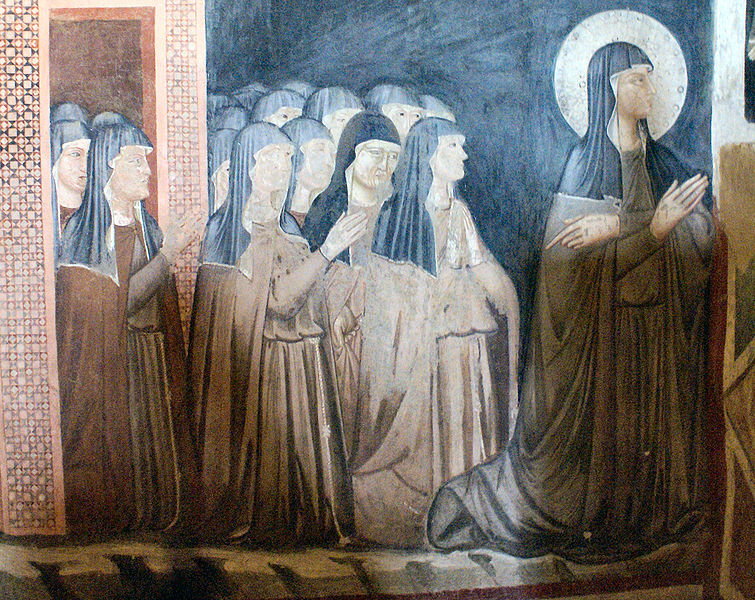
Fresco of Saint Clare and nuns of her Order, Chapel of San Damiano, Assisi

