Search This Blog

Friday, November 29, 2013

Nov. 30th, is the Feast of the Apostle St. Andrew and to Start His Christmas Novena

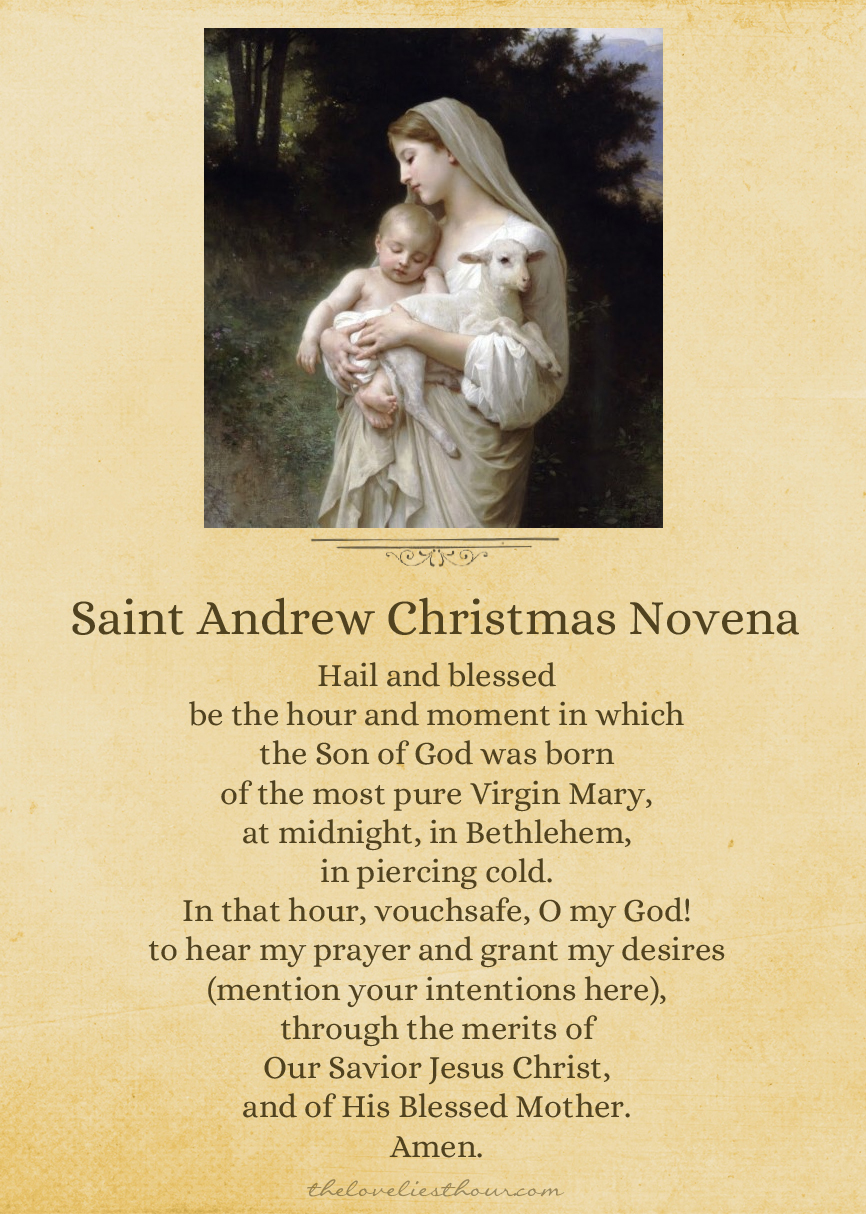
standrewnovenafromtheloveliesthour2

The above Christmas Novena is to be prayed starting November 30th straight through to Christmas Day and prayed 15 times a day.  You can divide it up: 5 in the morning, 5 at noon and 5 at night or all at once.  It is piously believed thta whoever recites St. Andrew's Christmas Novena 15 times a day from St. Andrew's feast day of Nov. 30th until Christmas Day will obtain what is asked.  Imprimatur: Michael Augustine, Archbishop of New York 2/6/1897.

The novena is not actually addressed to Saint Andrew but to God Himself, asking Him to grant our request in the honor of the birth of His Son at Christmas. It is attributed to Saint Andrew given the prayers traditionally begin on his feast day. It is also often called the Christmas Anticipation Novena.
The feast day of St. Andrew also marks the end of the liturgical year and the beginning of the new one on the first Sunday of Advent.  Prayer is an essential part of Advent. Reciting this special novena prayer each day is a simple yet beautiful way to celebrate the spiritual significance of the Advent season and to experience a deeper conversion to Jesus.  The St. Andrew Christmas novena is commonly found in many Advent prayer books which are also loaded with many other beautiful prayers and traditions for this time of year.


St. Andrew, the Apostle:


"The Apostle Andrew was born at Bethsaida, a town of Galilee, and was the brother of Peter.  He was a disciple of John the Baptist, and heard him say of Christ, Behold the Lamb of God, whereupon he immediately followed Jesus, bringing his brother also with him.   Some while after, they were both fishing in the Sea of Galilee, and the Lord Christ, going by, called them both, before any other of the Apostles, in the words, Follow me, and I will make you fishers of men.  They made no delay, but left their nets, and followed him.  After the death and Resurrection of Christ, Andrew was allotted Scythia as the province of his preaching, and, after labouring there, he went through Epirus and Thrace, where he turned vast multitudes to Christ by his teaching and miracles.  Finally he went to Patras in Achaia, and there also he brought many to the knowledge of Gospel truth.  Aegeas the Proconsul resisted the preaching of the Gospel, and the Apostle freely rebuked him, bidding him know that while he held himself a judge of his fellow men, he was himself hindered by devils from knowing Christ our God, the Judge of all.

Then Aegeas, being angry, answered him, Boast no more of this thy Christ.  He spake words even such as thine, but they availed him not, and he was crucified by the Jews.  Whereto Andrew boldly answered that Christ had given himself up to die for man's salvation ; but the Proconsul blasphemously interrupted him, and bade him look to himself, and sacrifice to the gods.  Then said Andrew, We have an altar, whereon day by day I offer up to God, the Almighty, the One, and the True, not the flesh of bulls nor the blood of goats, but a Lamb without spot: and when all they that believe have eaten of the Flesh thereof, the Lamb that was slain abideth whole and liveth.  Then Aegeas being filled with wrath, bound the Apostle in prison.  Now, the people would have delivered him, but he himself calmed the multitude, and earnestly besought them not to take away from him the crown of martyrdom, for which he longed and which was now drawing near.

Some short while after, he was brought before the judgment seat, where he extolled the mystery of the cross, and rebuked Aegeas for his ungodliness.  Then Aegeas could bear with him no longer, but commanded him to be crucified, in imitation of Christ.  Andrew, then, was led to the place of martyrdom, and, as soon as he came in sight of the cross, he cried out: O precious cross, made so fair and goodly by the sweet body of my Lord, how long have I desired thee! how warmly have I loved thee! how constantly have I sought thee!  And, now that thou art come to me, how is my soul drawn to thee!  Welcome me from amongst men, and join me anew to my Master, that as by thee he redeemed me, so by thee also he may take me unto himself.  So he was fastened to the cross, whereon he hung living for two days, during which time he ceased not to preach the faith of Christ, and, finally, passed into the Presence of him the likeness of whose death he had loved so well.  All the above particulars of his last sufferings were written by the Priests and Deacons of Achaia, who bear witness to them of their own knowledge.  Under the Emperor Constantine the bones of the Apostle were first taken to Constantinople, whence they were afterwards brought to Amalfi.  In the Pontificate of Pope Pius II, his head was carried to Rome, where it is kept in the Basilica of St. Peter."

-- From the 1911 Breviary of St Pius X (1955 ed)

Today is the Feast of All Franciscan Saints of the Seraphic Order (Franciscans)

(Above, Our Lady depicted with some Franciscan Saints)

“Father, all-powerful and ever-living God,
today we rejoice in the holy men and women
of every time and place.
May their prayers bring us your forgiveness and love.
We ask this through our Lord Jesus Christ, your Son,
who lives and reigns with you and Holy Spirit,
one God, for ever and ever.
– Amen.”


A FRANCISCAN LITANY OF ALL SAINTS

Lord have mercy! Lord have mercy!
Christ have mercy! Christ have mercy!
Lord have mercy! Lord have mercy!
God, the Father, have mercy on us!
God, the Son, have mercy on us!
God, the Holy Spirit, have mercy on us!
Holy Trinity, one God, have mercy on us!
Holy Mary, the Immaculate Conception, Queen of the Franciscan Order, pray for us!
Holy Father Francis, (1220 – Oct 4) pray for us!
* * *
All you holy martyrs of the Franciscan Order, pray for us!
Saints Berard, Accursius, Adjustus, Otto, and Peter, Protomartyrs (1220 – Jan 16) pray for us!

Saints Daniel, Angelo, Domnus, Hugolinus, Leo, Nicholas, and Samuel, Martyrs of Africa, (1227 – Oct 10) pray for us!

Saints Nicholas Tavelic, Deodat of Aquitaine, Peter of Narbonne, and Stephen of Cuneo, Martyrs of the Holy Land, (1391 – Nov 14) pray for us!

Saint Thomas More, Martyr of England, (1535 – Jun 22) pray for us!

Saints Nicholas Pick, Anthony Hornaer, Anthony of Weert, Cornelius, Francis, Godfrey, Jerome, Nicasius, Peter, Theodoric, Willehad, Martyrs of Holland, (1572 – Jul 9) pray for us!

Saints Peter Baptist Blasquez, Martin de Aquirre, Francis Blanco, Philip of Jesus of Mexico, Gonzalo Garcia of India, Anthony of Nagasaki, Bonaventure, Cosmas, Francis of Fahelante, Francis of Miyako, Gabriel, Joachim, John, Leo, Louis, Matthias, Michael, Paul Ibaraki, Paul Zuzuki, Peter, Thomas Danki, and Thomas Kosaki, Protomartyrs of Japan, (1597 – Feb 6) pray for us!

Saints John Jones and John Wall, Martyrs of England, (1598 and 1679 – Jul 12) pray for us!

Saint Fidelis of Sigmaringen, Protomartyr of the Sacred Congregation of the Propagation of the Faith, (1622 – Apr 24) pray for us!

Saints Gregory Grassi, Francesco Fogolla, Elia Facchini, Théodore Balat, Andreas, Antonio Fantosati, Giuseppe Maria Gambaro, Cesidio Giacomantonio, Marie Hermina of Jesus, Maria della Pace, Maria Chiara, Marie de Sainte Nathalie, Marie de Saint Just, Marie Adolfine, John Zhang Huan, Patrick Dong Bodi, John Wang Rui, Philip Zhang Zhihe, John Zhang Jingguang, Thomas Shen Jihe, Simon Chen Ximan, Peter Wu Anbang, Francis Zhang Rong, Matthew Feng De, Peter Zhang Banniu, James Yan Guodong, James Zhao, Peter Wang Erman, Martyrs of China, (1900 – Jul 8) pray for us!

Saint Maxmillian Kolbe, Martyr of Auschwitz, (1941 – Aug 14) pray for us!
All you holy priests of the First Franciscan Order, pray for us!

Saint Anthony of Padua, Doctor of the Gospel and Wonderworker, (1233 – Jun 13) pray for us!

Saint Bonaventure, Seraphic Doctor, (1274 – Jul 15) pray for us!
Saint Benvenute of Osimo, Bishop, (1282 – Mar 22) pray for us!
Saint Louis of Tolouse, Bishop, (1297 – Aug 19) pray for us!
Saint Bernardine of Siena, (1444 – May 20) pray for us!
Saint John Capistran, (1456 – Oct 23) pray for us!
Saint Peter Regalado, (1456 – Mar 30) pray for us!
Saint James of the March, (1476 – Nov 28) pray for us!
Saint John of Dukla, (1484 – Oct 3) pray for us!
Saint Peter of Alcantara, (1562 – Oct 19) pray for us!
Saint Francis Solano, (1610 – Jul 14) pray for us!
Saint Joseph of Leonissa, (1612 – Feb 4) pray for us!
Saint Lawrence of Brindisi, Doctor of the Church, (1619 – Jul 21) pray for us!
Saint Joseph of Cupertino, (1663 – Sep 18) pray for us!
Saint Pacificus of San Severino, (1721 – Sep 24) pray for us!
Saint Ignatius of Santhia, (1770 – Sep 22) pray for us!
Saint Thomas of Cori, (1792 – Jan 19) pray for us!
Saint John Joseph of the Cross, (1734 – Mar 5) pray for us!
Saint Theophilus of Corte, (1740 – May 19) pray for us!
Saint Francis Fasani, (1742 – Nov 27) pray for us!
Saint Leonard of Port Maurics, (1751 – Nov 26) pray for us!
Saint Antoino de Santa Ana, (1822 – Oct 25) pray for us!
Saint Leopold Mandic, (1942 – May 12) pray for us!
Saint Pio of Pietrelcina, (1968 – Sep 23) pray for us!
All you holy lay brothers of the First Franciscan Order, pray for us!
Saint Didacus of Alcala, (1463 – Nov 7) pray for us!
Saint Simon of Lipnica, (1482 – Jul 18) pray for us!
Saint Salvator of Horta, (1567 – Mar 18) pray for us!
Saint Felix of Cantalice, (1585 – May 18) pray for us!
Saint Benedict the Black, (1589 – Apr 3) pray for us!
Saint Paschal Baylon, (1592 – May 17) pray for us!
Saint Seraphin of Montegranaro, (1604 – Oct 12) pray for us!
Saint Umile de Bisignano, (1637 – Nov 27) pray for us!
Saint Bernard of Corleone, (1662 – Jan 12) pray for us!
Saint Charles of Sezze, (1670 – Jan 6) pray for us!
Saint Crispin of Viterbo, (1750 – May 19) pray for us!
Saint Felix of Nicosia, (1787 – Jun 2) pray for us!
Saint Ignatius Laconi, (1781 – May 11) pray for us!
Saint Giles Mary of St. Joseph, (1812 – Feb 8) pray for us!
Saint Francis Camporosso, (1866 – Sep 20) pray for us!
Saint Conrad of Parzham, (1894 – Apri 21) pray for us!
* * *
All you holy virgins of the Second Franciscan Order, pray for us!
Holy Mother Clare of Assisi, (1253 – Aug 11) pray for us!
Saint Agnes of Assisi, (1253 – Nov 19) pray for us!
Saint Agnes of Bohemia, (1282 – Mar 2) pray for us!
Saint Cunegunda, (1292 – Jul 23) pray for us!
Saint Colette of Corbie, (1447 – Feb 7) pray for us!
Saint Catherine of Bologna, (1463 – May 9) pray for us!
Saint Eustochia Calafato, (1485 – Jan 19) pray for us!
Saint Beatrice of Silva, (1490 – Sep 1) pray for us!
Saint Camilla Battista of Varano, (1524 – May 31) pray for us!
Saint Veronica Giuliani, (1727 – Jul 10) pray for us!
Saint Marianne Cope, (1980 – Jan 20) pray for us!
* * *
All you holy priests of the Third Franciscan Order, pray for us!
Saint Yves of Brittany, (1303 – May 19), pray for us!
Saint Charles Borromeo, Archbishop and Cardinal, (1584 – Nov 4) pray for us!
Saint Joseph Benedict Cottolengo, (1842 – Apr 30) pray for us!
Saint Vincent Palotti, Founder, (1850 – Jan 22) pray for us!
Saint John Mary Vianney, Patron of Parish Priests, (1859 – Aug 4) pray for us!
Saint Joseph Cafasso, (1860 – Jun 23) pray for us!
Saint Michael Garicits, (1863 – May 14) pray for us!
Saint Peter Julian Eymard, Founder, (1868 – Aug 3) pray for us!
Saint John Bosco, Founder (1883 – Jan 31) pray for us!
Saint Zygmunt Felinski, Archbishop and Founder, (1895 – Sep 17) pray for us!
Saint Pius X, Pope, (1914 – Aug 21) pray for us!

All you holy foundresses of religious congregations who were members of the Third Franciscan Order, pray for us!

Saint Bridget of Sweden, (1373 – Jul 23) pray for us!
Saint Jane of Valois, (1505 – Feb 14) pray for us!
Saint Angela Merici, (1540 – Jan 27) pray for us!
Saint Mary Batholomea Capitanio, (1833 – Jul 26) pray for us!
Saint Mary Magdalen Postel, (1846 – Jul 16) pray for us!
Saint Vincentia Gerosa, (1847 – Jun 28) pray for us!
Saint Joachima de Mas y de Vedruna, (1854 – May 22) pray for us!
Saint Mary Josepha Rossello, (1880 – Oct 3) pray for us!
Saint Frances Xavier Cabrini, (1917 – Nov 13) pray for us!
* * *
All you holy men of the Third Franciscan Order, pray for us!
Saint Ferdinand, King of Castile and Leon (1252 – May 30) pray for us!
Saint Louis, King of France, Patron of the Third Order, (1270 – Aug 25) pray for us!
Saint Elzear of Sabran, (1323 – Sep 26) pray for us!
Saint Roch of Montpellier, (1327 – Aug 16) pray for us!
Saint Conrad of Piacenza, Hermit, (1351 – Feb 19) pray for us!
Saint Pedro of San Jose Betancor, (1667 – Apr 25) pray for us!
Saint Albert Chmielowski, (1916 – Jun 17) pray for us!
* * *
All you holy women of the Third Franciscan Order, pray for us!
Saint Elizabeth of Hungary, Patroness of the Third Order, (1231 – Nov 19) pray for us!
Saint Veridiana, (1242 – Feb 1) pray for us!
Saint Rose of Viterbo, Virgin, (1252 – Sep 4) pray for us!
Saint Zita of Lucca, Virgin, (1278 – Apri 27) pray for us!
Saint Margaret of Cortona, (1297 – May 16) pray for us!
Saint Clare of Montefalco, Virgin and Religious, (1308 – Aug 17) pray for us!
Saint Elizabeth of Portugal, (1336 – Jul 4) pray for us!
Saint Joan of Arc, Virgin, (1431 – May 30) pray for us!
Saint Frances of Rome, (1440 – Mar 9) pray for us!
Saint Catherine of Genoa, (1510 – Sep 15) pray for us!
Saint Hyacintha Mariscotti, Virgin and Religious, (1640 – Jan 30) pray for us!
Saint Mariana of Jesus of Quito, Virgin, (1645 – May 28) pray for us!
Saint Crescentia Höss, Virgin and Religious, (1744 – Apr 5) pray for us!
Saint Mary Frances of the Five Wounds, Virgin, (1791 – Oct 6) pray for us!
Saint Alphonsa Muttathupaduthu, Religious, (1946 – Jul 28) pray for us!
* * *
All you holy Cordbearers of St. Francis, pray for us!
Saint Francis de Sales, Bishop, (1622 – Jan 24) pray for us!
Saint Joseph Calasanctius, Founder, (1648 – Aug 25) pray for us!
Saint Benedict Joseph Labre, (1782 – Apr 17) pray for us!
Saint Bernadette Soubirous, Virgin and Religious, (1879 – Apr 16) pray for us!
* * *
Lamb of God, you take away the sins of the world, have mercy on us!
Lamb of God, you take away the sins of the world, grant us peace!

Let us pray

Almighty everlasting God, we thank you for granting us the joy of honoring our holy Father Francis and his sainted followers and enjoying the protection of their unceasing prayers. Grant us also the grace to imitate their example and so attain their fellowship in eternal glory. We ask this through Christ our Lord. Amen.


Thursday, November 28, 2013

Today is the Feast of St. James of the March, Franciscan Priest


James was born in the March of Ancona. His parents raised him in the fear and love of God, and in due time he was sent to the University of Perugia, where he studied civil and canon law with such remarkable success that he received a doctor's degree in both subjects. Despite the fact that brilliant positions were already open to him, he soon recognized the vanity of the world and felt a singular attraction for the religious life. At first he thought of joining the contemplative Carthusians, but almighty God, who had destined him to labor for the salvation of thousands of souls in the active life, led him to the Order of St. Francis.

During his novitiate James distinguished himself by the practice of all virtues, so that he became a model of religious perfection. In order to preserve angelic purity, which he had kept unsullied from his youth, he led a most austere life. He never slept more than three hours, and that on the bare floor; the remainder of the night he spent meditating on the sufferings of Christ. He constantly wore a coat of mail having sharp points. and scourged himself daily; Like our holy Father St/ Francis, he observed a 40-day fast 7 times a year. Bread and water were his regular fare, although he sometimes added uncooked beans or vegetables. Some years later, St. Bernardin of Siena prevailed upon him to mitigate these austerities somewhat in order to conserve his strength.

Soon after his ordination, when he was 30 years old, he was sent out as a missionary. He undertook this high calling with untiring zeal. For more than 50 years he traveled through Italy, Dalmatia, Croatia, Albania, Bosnia, Austria, Bohemia, Saxony, Prussia, Poland, Denmark, Norway, Sweden, and Russia. During the years 1427 and 1428 he preached in Vienna, Augsburg, Ratisbon, Ulm, Limburg, Brandenburg, and Leipzig. Inspired by his apostolic example, more than 200 of the noblest young men of Germany were impelled to enter the Franciscan Order. The crowds who came to hear him were so great that the churches were no large enough to accommodate them, and it became imperative for him to preach in the public squares.

At Milan he was instrumental in converting 36 women of bad repute by a single sermon on St. Mary Magdalen. It is said that he brought 50,000 heretics into the bosom of the Church, and led 200,000 unbelievers to baptism. In addition, God granted St. James such wisdom, that popes and princes availed themselves of his services, seeking counsel from him. He possessed the gifts or miracles and of prophesy in great measure, yet his humility surpassed all those distinctions. He was offered the archepiscopal dignity of the see of Milan, but he declined with these words, "I have no other desire upon earth than to do penance and to preach penance as a poor Franciscan."

Worn out by his many labors as well as advanced age, he died at Naples, November 28, 1476, in the 85th year of his life, 60 years of which were consecrated to God in the religious state. He was entombed in the Franciscan church at Naples, where his body can still be seen in a crystal coffin, incorrupt, flexible, and emitting a fragrant perfume. Pope Benedict XIII canonized St. James in 1726.


PRAYER OF THE CHURCH
O God, who in order to save souls and to call back sinners from the abyss of vice and the path of virtue, didst make Thy confessor St. James a distinguished preacher of the Gospel, mercifully grant that through his intercession we may repent of all our sins and attain to eternal life. Through Christ our Lord. Amen.


from: The Franciscan Book of Saints, ed. by Marion Habig, ofm., © 1959 Franciscan Herald Press


Recently (1st to 3rd November 2008) his body which is preserved beneath an altar was subject to scientific investigation at the University of Pisa, below.


Tuesday, November 26, 2013

Today is the Feast of St. Francis Anthony Fasani, Franciscan Priest


Born in 1681 at Lucera, southeastern Italy, Francis Anthony was the son of very poor peasants; but he was a bright lad, and received a good education from the Conventual Franciscans in his native town. When he was 14 he received the habit of St. Francis among the Conventuals, and in 1705 he was ordained to the priesthood. He was then sent to the Sagro Convento, adjoining the basilica in Assisi where St. Francis is buried, for the purpose of continuing his studies. Two years later he received the doctorate in theology, and he was then appointed lector of philosophy in the college conducted by the Conventuals in his home town. He was promoted successively to regent of studies, guardian, and provincial, which latter office he held from 1721 to 1723. After that he served as master of novices, and then as pastor of the church of St. Francis in Lucera. A bishopric was offered to him, but he declined it.

From the process of beatification we learn that Francis Anthony was diligent in study, fervent in piety, prompt in his obedience to his superiors, devout in meditation, and most exact in the fulfillment of all his duties. He was also mortified and given to the exercises of penance even to bloodshed. From his youth he was an "angel in the flesh, more an angel than a man."

Among the devotions that he cherished there were especially a tender love for the Immaculate Mother of God, a childlike affection for the Infant Jesus, and fervent devotion, also night adoration, of the Holy Eucharist. Once, while he was absorbed in prayer, someone who happened to be in the church heard a voice saying: "This priest prays much for his people."

As a priest, he also became an eloquent preacher, a lover of the poor, a friend of the unfortunate. He was a missionary, a retreat-master, and a Lenten preacher. For hours he would sit in the confessional, hearing and absolving the sins of his penitents, consoling the afflicted, warning the hardened of heart. He spent much time in visiting the sick, the orphans, and the imprisoned. As a pastor he was a real father to his people.

After 35 years in the priesthood and a life of penance, union with God, and intense labor the salvation of souls, God called Father Francis Anthony to Himself on November 29, 1742. On that day the people of Lucera came hurrying to the church of St. Francis, exclaiming as did the children at the death of St. Anthony of Padua, "The saint is dead! The saint is dead!" And for 200 years since then, they have continues to kneel and pray at his tomb. The cause of his beatification was introduced in Rome in 1832; and in 1951 Pope Pius XII solemnly enrolled him among the blessed.

PRAYER OF THE CHURCH

Grant, we pray, O Lord, that Thy faithful people may ever rejoice in venerating Thy blessed servant Francis Anthony and all Thy saints and may be aided by their unceasing prayers. Through Christ our Lord. Amen.

from: The Franciscan Book of Saints, ed. by Marion Habig, ofm., © 1959 Franciscan Herald Press

Monday, November 25, 2013

Today is the Feast of Saint Leonardo de Porto Maurice, Franciscan Priest


Saint Leonardo de Porto Maurizio, Priest
Porto Maurizio, Imperia, 1676 – Rome, November 26, 1751 

 
It is this saint to whom we owe the credit for having conceived the Via Crucis. Ligure (1676-1751), was the son of a sea captain. Born in Porto Maurizio, Imperia today, he studied in Rome at the Collegio Romano, then entered the retirement of St. Bonaventure, on the Palatine Hill, where he would wear the Franciscan habit. Posted in Corsica by the Pope to restore harmony among the citizens, he was able to obtain, despite the serious divisions among the inhabitants, an unthinkable embrace. The theme of the Cross was at the center of his preaching drew crowds to repentance and Christian piety. Alfonso Maria de Liguori called him “the greatest missionary of our century.”

Roman Martyrology: In Rome in the convent of Saint Bonaventura on the Palatine Hill, St. Leonard of Port Maurice, Priest of the Order of Friars Minor, who, full of love for souls, engaged all his life in preaching, in publishing books of devotion and to visit in over three hundred missions in Rome, Corsica and Northern Italy.

Young Franciscan Leonardo had asked to be a missionary in China. Cardinal Colloredo had replied: “Your China will be Italy.”

And at the end of the seventeenth century, Italy had enough misery and misfortune enough to be considered mission territory.

Leonardo was a student in Rome, when a friend suggested going to hear a sermon. A few steps, they found that a hanged man dangling from the gallows. “This is the sermon,” said the two young men.

A few days later, the son of a sea captain of Porto Maurizio, Liguria, followed by two figures of monks who climbed to the convent of San Bonaventura on the Palatine Hill, where he donned the habit of the Franciscans called “the riformella” or “displaced”.

Devoting himself to preaching, perhaps remembering that torture hanging from the gallows, including Leonardo was always in mind the other execution, hanging on the Cross. Therefore, his favorite theme was that of the Via Crucis, typically Franciscan devotion to which he gave the largest spread.

His preaching had something dramatic and tragic, often by torchlight and voluntary torture, which underwent between Leonardo, now placing his hand on the torch lit, now scourging blood.

Immense crowds flocked to hear him and be impressed by his fiery speech, which re-called to repentance and Christian piety. “He is the greatest missionary of our century,”said St. Alphonsus de Liguori. Often, the entire audience, during his sermons, burst into sobs.

He preached throughout Italy, but the region of Tuscany was beaten because of the cold Jansenism, he wanted to fight first of all with the fervor of his heart, then with his themes more effective, namely the Name of Jesus, the Madonna and the Via Crucis.

In a visit to Corsica, the island’s troubled robbers fired their muskets into the air, shouting: “Viva friar Leonardo, long live peace.”

Back in Liguria, was launching a galley, named in his honor, San Leonardo. But he was gravely ill, the sailors said: “The boat is water.”

Consumed by the missionary labors, he was finally recalled to Rome, where, with his impassioned sermons, which also assisted the Pope, he prepared the spiritual climate for the Jubilee of 1750. On that occasion, he planted the Via Crucis at the Colosseum, declaring that place sacred to the martyrs.

Historians have also demonstrated that the Colosseum was never martyred Christians, but the preaching ~ in good faith – of San Leonardo prevented the further destruction of the monument, hitherto regarded as a quarry of good stone.

It was his last effort. He died the following year, and San Bonaventura al Palatino it took the soldiers to hold back the crowd who wanted to see the Holy priest and take away his relics. “We lose a friend on earth – the Pope Lambertini said – but we gain a protector in heaven.”

It was he who suggested the definition of the Marian dogma of the Immaculate Conception, through consultation letters with all the pastors of the Church.


Source: Parish Archives
Note: The site of the Compagnia di San Leonardo da Porto Maurizio
source: Santi e Beati

Tuesday, November 19, 2013

Today is the Feast of St. Agnes of Assisi, Virgin, Poor Clare and blood sister of St. Clare of Assisi


When St. Clare received the veil in 1212, she left behind her at home a young sister of 14 named Agnes. In answer to Clare's prayers and inspired by God, Agnes betook herself to the same convent where Clare was then staying only 16 days after her sister's departure from home.

Their father, much enraged, hastened to the convent in company with several relatives. He used force to remove her and was in the act of dragging her along by the hair, when Agnes suddenly became fixed to the spot. The united efforts of the entire company were powerless to move her. But he was seized with a violent pain in his arm and the weapon dropped from his hand. Overcome with fear, he and the rest of the band fled from the scene.

Agnes was overjoyed and returned to her sister Clare. St. Francis then led the two maidens to the convent of St. Damian, where he gave the holy habit also to Agnes. She now endeavored to imitate her saintly sister in everything, and devoted all her spare time to prayer and contemplation. She lived a very austere life, partaking only of bread and water, and wearing a coarse garb all her life.

St. Francis soon recognized the rich treasure of virtue hidden in this privileged soul. When a new convent of Poor Clares was to be founded at Florence in 1221, St. Francis sent Agnes, despite her youth, to act as superior there. Later he sent her also to Mantua and to several other cities in northern Italy to establish additional houses of the order. Wherever she went, she edified everybody by her holy life. Many devout young women renounced the world in order to consecrate themselves to God in monastic seclusion under her direction. She had the gift of infusing the Franciscan spirit into them, both by word and example.

She was favored with many extraordinary graces by God. In the great fervor of her devotion she was often raised above the earth, and once our Lord appeared to her in the form of an infant. From Holy Thursday until Holy Saturday she was once so rapt in the contemplation of the sufferings of Christ that she was under the impression she had spent an hour in this mystical state.

When St. Clare was about to die, she sent for Agnes to assist her in her final days. In her last moments Clare addressed her sister in these words, "My beloved sister, it is the will of God that I go, but be comforted, you will soon come and rejoin me with our Lord." Three months later Agnes followed her sister to eternity. It was on November 16, 1253. Her body rests in Assisi in a side chapel of the church of St. Clare. Numerous miracles occurred at her tomb, and Pope Benedict XIV canonized her.

ON THE FRANCISCAN SPIRIT

1. On the feast of St. Agnes, Holy Church has us pray for the seraphic or Franciscan spirit. In what does that spirit consist? The seraphic spirit consists in ardent holy love, in a heart which seeks and sees God in all things and is bent on spending itself for His honor and using all things to glorify Him. The seraphic spirit takes its name from the Seraphim, who are ever aflame with love for God. Our seraphic father St. Francis was all aglow with this love of God and, like the three young men in the fiery furnace, wished all creatures to join in praising God. St. Agnes was at times so inflamed with this love that she was bodily raised above the earth. This love of God is conspicuous in all the saints of the Franciscan Order, for which reason the order itself is often spoken of as the Seraphic Order. As in the material world everything is attracted to the sun and revolves around it, so should all rational creatures be drawn to God and all the desires of their hearts should tend towards Him. -- Do you possess this seraphic spirit?

2. Consider the obstacles that oppose this seraphic spirit in the heart of man. There is, above all, worldliness which makes us so attached to material goods, sensual pleasures, and earthly honors, and thus hinders us from rising to God. Christ spoke thus to the Jews: "You are from beneath -- that is, earthly-minded -- I am from above" (John 8:23). That is the reason, said He, why they could not come to Him, and would die in their sins. Sins for which atonement has not yet been made also stand in the way and prevent the flame of love from rising upwards. Finally, conceit and pride hold many people captive. Such pride cast Lucifer out of heaven, and it permits no human heart to ride to God. Therefore, detachment from material things, penance for sins committed, and sentiments of humility must prepare our hearts, otherwise they will not be in a condition to receive so much as a spark of true divine love. -- What is it that prevents you from truly loving God?

3. Consider that this fire of love, which fills the heart with the seraphic spirit, must come from the Father of Light. What we can do, is make ourselves receptive for this grace. But, if we do our part, God will give it to us, for He said; "I am come to cast fire on the earth, and what will I but that it be kindled?" (Luke 12:49). Let us, therefore, pray for the seraphic spirit and do what lies in us that it may not be weakened or stifled in us. Then, too, let us be mindful, especially during the month which is devoted to the souls in purgatory, of these souls who are filled with the seraphic spirit but suffer great anguish in their desire for God. Let us pray that God may satisfy their ardent longing.


PRAYER OF THE CHURCH

O Lord Jesus Christ, who didst set up Blessed Agnes before many virgins as a model and guide to evangelical perfection, grant, we beseech Thee, that the seraphic spirit, which she so wisely taught and confirmed by her holy example, may be preserved in us from all taint. Who livest and reignest forever and ever. Amen.

from: The Franciscan Book of Saints, ed. by Marion Habig, ofm., © 1959 Franciscan Herald Press


http://www.youtube.com/watch?v=_ByMlY-gg9U

Monday, November 18, 2013

Today is the Feast of Blessed Salome, Virgin and Poor Clare Nun


Salome was a daughter of the royal family of Prince Lescon V, and a sister of Boleslas the Chaste, the virginal spouse of Blessed Kinga (July 23). She was born at Crakow, the capital of Poland, in 1201. At the age of 3, according to the custom of the time, she was betrothed to Prince Colman of Hungary, a brother of St. Elizabeth of Thuringia (Nov 17), and was sent to the court of King Andrew II in order to be raised according to the customs of the country.

The little girl proved to be a child of grace and a model to all with whom she associated. When the day of her marriage arrived, both spouses resolved to preserve their virginity. They preserved their vow intact to the end of their lives.

The pious couple vied with each other in their practices of piety and penance. With the consent of her husband, Salome received the habit of the Third Order of St. Francis at the hands of her confessor, a Franciscan friar. Following her example, many of the ladies at court renounced worldly pomp and vanity, and the palace took on the appearance of a convent. Even when her husband became king of Galicia, and Salome, in addition to the crown that was here by birth, received a royal crown, she remained the simple daughter of St. Francis in the Order of Penance.

King Coleman fell in battle against the Tatars in 1225. Salome then resolved to consecrate herself to God, and used her wealth in supporting the poor and in building churches. In 1240 she entered the convent of the Poor Clares at Zawichost. The convent was later removed to the vicinity of Crakow, to protect it against the inroads of the Tatars, and it was known as St. Mary of the Stairs. Here Salome continued to live for 28 years, highly respected by her fellow sisters because of her virtue. On several occasions she was elected to the office of abbess.

When she was 67 years old, she was seized with an illness one day during holy Mass, and she predicted that her death would follow shortly. Admonishing those about her deathbed to practice charity and harmony, and faithfully observe the rule, she died November 17, 1268, favored and fortified in her last hour with a vision of our Lady and the Child Jesus. A heavenly sign that she was receiving a third crown, the best of them all, was the fact that her sisters in religion, at the moment of her death, saw a brilliant start rise from her lips and mount to heaven.

When her body was exhumed seven months after burial, it was found incorrupt and giving forth a sweet odor. She was then entombed in the Franciscan Church at Crakow beside her husband, King Colman. Many miracles occurred in testimony of her sanctity, whereupon Pope Clement X beatified her.


ON PURITY OF HEART

1. Consider how precious is the virtue of purity of heart, which shone so brightly in Blessed Salome. Christ pronounced Salome blessed in advance when He said: "Blessed are the clean of heart, for they shall see God" (Matt 5:18). Blessed are such souls even here on earth, for they possess that interior bliss which results from a good conscience and from the right order of things preserved despite the warring emotions of the heart. The pure of heart also win the affections of their fellowmen, just as little children are believed by everyone. The greatest blessing of purity, however, is the assurance of eternal happiness; for, says Eternal Truth, "they shall see God." -- Should we not be eager to acquire this precious virtue?

2. Consider what contributes purity of heart. It considers, not only in rejecting all indecent, impure desires and affections, but also in conquering all the other passions which stain the soul, especially injustice and avarice, pride and vanity, lying and deceit. In answer to the question as to who will be admitted to the vision of God, the Psalmist says: "The innocent in hands, and clean of heart, who has not taken his soul in vain, nor sworn deceitfully to his neighbor" (Ps 23:4). -- How do matters stand with you?

3. Consider how we can preserve purity of heart. Be ever mindful of the high origin of your soul. A person of high birth needs only to remember his distinguished extraction in order to refrain from doing anything unbecoming. Your soul is of utmost distinguished origin. It has been created by God Himself according to His image and likeness; it has come forth from baptism a child of God and an heir of heaven. If sensuality, pride, or avarice attack your soul and threaten to stain it, say with Blessed Salome: "I am of too noble an extraction, I am too distinguished in birth to yield to anything of that sort," and then banish the tempter with contempt. -- Mindful, however, of your weakness, so not fail to plead with the prophet: "Create a clean heart in me, O God!" (Ps 50:12).


PRAYER OF THE CHURCH

O God, who didst combine in Blessed Salome contempt of an earthly kingdom with the luster of virginity in the married state, grant, we beseech Thee, that imitating her example, we may serve Thee with a pure and humble heart and deserve to attain to the imperishable crown of glory in heaven. Through Christ our Lord. Amen.


from: The Franciscan Book of Saints, ed. by Marion Habig, ofm., © 1959 Franciscan Herald Press