Search This Blog

Tuesday, November 19, 2013

Today is the Feast of St. Agnes of Assisi, Virgin, Poor Clare and blood sister of St. Clare of Assisi


When St. Clare received the veil in 1212, she left behind her at home a young sister of 14 named Agnes. In answer to Clare's prayers and inspired by God, Agnes betook herself to the same convent where Clare was then staying only 16 days after her sister's departure from home.

Their father, much enraged, hastened to the convent in company with several relatives. He used force to remove her and was in the act of dragging her along by the hair, when Agnes suddenly became fixed to the spot. The united efforts of the entire company were powerless to move her. But he was seized with a violent pain in his arm and the weapon dropped from his hand. Overcome with fear, he and the rest of the band fled from the scene.

Agnes was overjoyed and returned to her sister Clare. St. Francis then led the two maidens to the convent of St. Damian, where he gave the holy habit also to Agnes. She now endeavored to imitate her saintly sister in everything, and devoted all her spare time to prayer and contemplation. She lived a very austere life, partaking only of bread and water, and wearing a coarse garb all her life.

St. Francis soon recognized the rich treasure of virtue hidden in this privileged soul. When a new convent of Poor Clares was to be founded at Florence in 1221, St. Francis sent Agnes, despite her youth, to act as superior there. Later he sent her also to Mantua and to several other cities in northern Italy to establish additional houses of the order. Wherever she went, she edified everybody by her holy life. Many devout young women renounced the world in order to consecrate themselves to God in monastic seclusion under her direction. She had the gift of infusing the Franciscan spirit into them, both by word and example.

She was favored with many extraordinary graces by God. In the great fervor of her devotion she was often raised above the earth, and once our Lord appeared to her in the form of an infant. From Holy Thursday until Holy Saturday she was once so rapt in the contemplation of the sufferings of Christ that she was under the impression she had spent an hour in this mystical state.

When St. Clare was about to die, she sent for Agnes to assist her in her final days. In her last moments Clare addressed her sister in these words, "My beloved sister, it is the will of God that I go, but be comforted, you will soon come and rejoin me with our Lord." Three months later Agnes followed her sister to eternity. It was on November 16, 1253. Her body rests in Assisi in a side chapel of the church of St. Clare. Numerous miracles occurred at her tomb, and Pope Benedict XIV canonized her.

ON THE FRANCISCAN SPIRIT

1. On the feast of St. Agnes, Holy Church has us pray for the seraphic or Franciscan spirit. In what does that spirit consist? The seraphic spirit consists in ardent holy love, in a heart which seeks and sees God in all things and is bent on spending itself for His honor and using all things to glorify Him. The seraphic spirit takes its name from the Seraphim, who are ever aflame with love for God. Our seraphic father St. Francis was all aglow with this love of God and, like the three young men in the fiery furnace, wished all creatures to join in praising God. St. Agnes was at times so inflamed with this love that she was bodily raised above the earth. This love of God is conspicuous in all the saints of the Franciscan Order, for which reason the order itself is often spoken of as the Seraphic Order. As in the material world everything is attracted to the sun and revolves around it, so should all rational creatures be drawn to God and all the desires of their hearts should tend towards Him. -- Do you possess this seraphic spirit?

2. Consider the obstacles that oppose this seraphic spirit in the heart of man. There is, above all, worldliness which makes us so attached to material goods, sensual pleasures, and earthly honors, and thus hinders us from rising to God. Christ spoke thus to the Jews: "You are from beneath -- that is, earthly-minded -- I am from above" (John 8:23). That is the reason, said He, why they could not come to Him, and would die in their sins. Sins for which atonement has not yet been made also stand in the way and prevent the flame of love from rising upwards. Finally, conceit and pride hold many people captive. Such pride cast Lucifer out of heaven, and it permits no human heart to ride to God. Therefore, detachment from material things, penance for sins committed, and sentiments of humility must prepare our hearts, otherwise they will not be in a condition to receive so much as a spark of true divine love. -- What is it that prevents you from truly loving God?

3. Consider that this fire of love, which fills the heart with the seraphic spirit, must come from the Father of Light. What we can do, is make ourselves receptive for this grace. But, if we do our part, God will give it to us, for He said; "I am come to cast fire on the earth, and what will I but that it be kindled?" (Luke 12:49). Let us, therefore, pray for the seraphic spirit and do what lies in us that it may not be weakened or stifled in us. Then, too, let us be mindful, especially during the month which is devoted to the souls in purgatory, of these souls who are filled with the seraphic spirit but suffer great anguish in their desire for God. Let us pray that God may satisfy their ardent longing.


PRAYER OF THE CHURCH

O Lord Jesus Christ, who didst set up Blessed Agnes before many virgins as a model and guide to evangelical perfection, grant, we beseech Thee, that the seraphic spirit, which she so wisely taught and confirmed by her holy example, may be preserved in us from all taint. Who livest and reignest forever and ever. Amen.

from: The Franciscan Book of Saints, ed. by Marion Habig, ofm., © 1959 Franciscan Herald Press


http://www.youtube.com/watch?v=_ByMlY-gg9U

Monday, November 18, 2013

Today is the Feast of Blessed Salome, Virgin and Poor Clare Nun


Salome was a daughter of the royal family of Prince Lescon V, and a sister of Boleslas the Chaste, the virginal spouse of Blessed Kinga (July 23). She was born at Crakow, the capital of Poland, in 1201. At the age of 3, according to the custom of the time, she was betrothed to Prince Colman of Hungary, a brother of St. Elizabeth of Thuringia (Nov 17), and was sent to the court of King Andrew II in order to be raised according to the customs of the country.

The little girl proved to be a child of grace and a model to all with whom she associated. When the day of her marriage arrived, both spouses resolved to preserve their virginity. They preserved their vow intact to the end of their lives.

The pious couple vied with each other in their practices of piety and penance. With the consent of her husband, Salome received the habit of the Third Order of St. Francis at the hands of her confessor, a Franciscan friar. Following her example, many of the ladies at court renounced worldly pomp and vanity, and the palace took on the appearance of a convent. Even when her husband became king of Galicia, and Salome, in addition to the crown that was here by birth, received a royal crown, she remained the simple daughter of St. Francis in the Order of Penance.

King Coleman fell in battle against the Tatars in 1225. Salome then resolved to consecrate herself to God, and used her wealth in supporting the poor and in building churches. In 1240 she entered the convent of the Poor Clares at Zawichost. The convent was later removed to the vicinity of Crakow, to protect it against the inroads of the Tatars, and it was known as St. Mary of the Stairs. Here Salome continued to live for 28 years, highly respected by her fellow sisters because of her virtue. On several occasions she was elected to the office of abbess.

When she was 67 years old, she was seized with an illness one day during holy Mass, and she predicted that her death would follow shortly. Admonishing those about her deathbed to practice charity and harmony, and faithfully observe the rule, she died November 17, 1268, favored and fortified in her last hour with a vision of our Lady and the Child Jesus. A heavenly sign that she was receiving a third crown, the best of them all, was the fact that her sisters in religion, at the moment of her death, saw a brilliant start rise from her lips and mount to heaven.

When her body was exhumed seven months after burial, it was found incorrupt and giving forth a sweet odor. She was then entombed in the Franciscan Church at Crakow beside her husband, King Colman. Many miracles occurred in testimony of her sanctity, whereupon Pope Clement X beatified her.


ON PURITY OF HEART

1. Consider how precious is the virtue of purity of heart, which shone so brightly in Blessed Salome. Christ pronounced Salome blessed in advance when He said: "Blessed are the clean of heart, for they shall see God" (Matt 5:18). Blessed are such souls even here on earth, for they possess that interior bliss which results from a good conscience and from the right order of things preserved despite the warring emotions of the heart. The pure of heart also win the affections of their fellowmen, just as little children are believed by everyone. The greatest blessing of purity, however, is the assurance of eternal happiness; for, says Eternal Truth, "they shall see God." -- Should we not be eager to acquire this precious virtue?

2. Consider what contributes purity of heart. It considers, not only in rejecting all indecent, impure desires and affections, but also in conquering all the other passions which stain the soul, especially injustice and avarice, pride and vanity, lying and deceit. In answer to the question as to who will be admitted to the vision of God, the Psalmist says: "The innocent in hands, and clean of heart, who has not taken his soul in vain, nor sworn deceitfully to his neighbor" (Ps 23:4). -- How do matters stand with you?

3. Consider how we can preserve purity of heart. Be ever mindful of the high origin of your soul. A person of high birth needs only to remember his distinguished extraction in order to refrain from doing anything unbecoming. Your soul is of utmost distinguished origin. It has been created by God Himself according to His image and likeness; it has come forth from baptism a child of God and an heir of heaven. If sensuality, pride, or avarice attack your soul and threaten to stain it, say with Blessed Salome: "I am of too noble an extraction, I am too distinguished in birth to yield to anything of that sort," and then banish the tempter with contempt. -- Mindful, however, of your weakness, so not fail to plead with the prophet: "Create a clean heart in me, O God!" (Ps 50:12).


PRAYER OF THE CHURCH

O God, who didst combine in Blessed Salome contempt of an earthly kingdom with the luster of virginity in the married state, grant, we beseech Thee, that imitating her example, we may serve Thee with a pure and humble heart and deserve to attain to the imperishable crown of glory in heaven. Through Christ our Lord. Amen.


from: The Franciscan Book of Saints, ed. by Marion Habig, ofm., © 1959 Franciscan Herald Press

Sunday, November 17, 2013

Today is the Feast of St Elizabeth of Hungary 1207-1231, Patroness of the Third Franciscan Order

In 1207 a daughter was born to pious King Andrew II of Hungary. She received the name of Elizabeth in baptism. The child was so lovable that the wealthy landgrave of Thuringia and Hesse sought her as the bride of his eldest son Louis. His request was granted, and a solemn embassy went to get Elizabeth, then only three years old, so that she could be raised at her future husband's castle.

The two children loved each other like brother and sister, and vied with each other in acts of piety and charity. Those who beheld Elizabeth at prayer might well have believed they saw an angel. Her greatest joy was to give things to the poor. When she grew a little older, she visited the poor and the sick, and waited on them with as much reverence as if she were serving Christ Himself.
The proud dowager Landgravine Sophia was displeased with Elizabeth's conduct and endeavored to talk her son into sending Elizabeth back to Hungary and choosing a bride of more princely ways. But Louis was aware of the treasure he possessed in Elizabeth. Succeeding his father at the age of 18 he took over the government and married Elizabeth. Their marriage was unusually happy, and Louis gave his wife full liberty to do all the good her heart desired.
At Eisenach Elizabeth built a large hospital. During a famine she daily fed nine hundred needy people. The story is told that once when she was on her way with her cloak full of good things for her dear poor and sick, she met her husband, who teasingly blocked her path until she would show him what she was carrying away this time. How astonished was he to behold fresh, fragrant roses in midwinter. Reverently he permitted his spouse to go on her charitable way.

When Louis was away, it was Elizabeth's duty to take over the regency, and this she did with great prudence and care. Whatever spare time she had, she spent on the poor, the sick, and especially the lepers. It is related that once she took in a little leper boy whom no one cared to have about, and after caring for him as if he were her own child, placed him in the royal bed. But Louis returned unexpectedly at this time, and the angry dowager ran to tell him what Elizabeth had done and how she would surely cause him to be infected. Quite stirred, Louis went to the bed and tore aside the covers. But he was amazed and moved to tears when he beheld there the form of the Crucified. Turning to his wife he said, "Dear Elizabeth, you may always receive guests like that. I shall even thank you for it."

But Elizabeth, too, was to be tried by the crucible of suffering. Emperor Frederick II set out on a crusade to the Holy Land in 1227, and pious Landgrave Louis joined the expedition. But he died on the way, in southern Italy. When the news reached Thuringia, Louis' brothers rose up against Elizabeth. She was driven out of the palace; only two faithful maids went with her. In Eisenach the people dared not give her shelter fearing the resentment of the new masters. It was midwinter and night was at hand. The daughter of a king, a widowed princess, with four little children, the youngest scarcely 2 months old was completely destitute and homeless.

A man finally offered her shelter in a stable. Grateful for the kindness. Elizabeth thought of how the Son of God on coming down from heaven, was refused admittance at all doors of Bethlehem and found refuge in a stable. The thought filled her with greater joy than she had ever experienced in her palace. At midnight, when the bells of the nearby Franciscan convent, which she had built, announced the chanting of the Divine Office, she begged the friars to sing the Te Deum in thanksgiving for the favor that she and her children were made so like Jesus.

With her faithful servants, Elizabeth now arranged things as best she could. She spun flax for a livelihood, saving something from the meager income to give to the poor.

Later Elizabeth was reinstated in the Wartberg, and Emperor Frederick II, whose wife had died, asked her hand in marriage. But Elizabeth had so learned to love poverty and seclusion that she had no desire for worldly greatness. Her children were given the education due to princes, but she and her two maids repaired to a small house near the Franciscan church in Marburg. Elizabeth had joined the Third Order of St. Francis during the lifetime of her husband. Indeed, she was the first member in Germany, and received a message from St. Francis himself. Now, vested with the habit and the cord, she led a quiet religious life, meanwhile nursing the sick in the hospitals, and submitting her whole life to the direction of the learned and devout Friar Conrad.

Our Lord announced to her that He would soon call her to heaven. She told her Father Confessor, who had fallen seriously ill, that he would recover, but that she would die soon. Within 4 days she became ill, and was prepared for her final hour by her confessor, who had recovered.

Elizabeth was admitted into heaven on November 19, 1231, when she was only 24 years old. The miracles that took place at her tomb were so numerous that Pope Gregory IX canonized her already in 1235. She is the special patroness of the sisters of the Third Order Secular of St. Francis, and also of some religious sisterhoods of the Third Order Regular. Pope Leo XIII placed all charitable organizations of women under her patronage.


ON NOBILITY OF SOUL
1. Consider how noble Elizabeth was by birth: the daughter of a king, the wife of a prince who governed a beautiful and wealthy country. But nobility of soul meant more to her who was God's child, destined to serve the Most High here on earth, and to be an heir of the heavenly kingdom. Filled with the spirit of God, Elizabeth appreciated her dignity from childhood on. She found her sweetest delight in being united with God by prayer and pious practices, and her favorite occupation was to serve God in His poor and sick members. She did this with such holy sentiments that our Lord deigned to take the place of the leper she was nursing. She was always aware of the nobility of her own soul and acted accordingly. -- Is your soul not equally noble? Are your sentiments and conduct in keeping with your no nobility?


2. Many people believe that the way to maintain their dignity is by proud and domineering manners and by exterior pomp and finery. Elizabeth thought otherwise. She looked upon vain pomp as a form of slavery in which the soul basely serves the detestable vice of pride, the sin through which our first parents lost their nobility in Paradise. The Son of God gave His own blood to atone for that sin; and only by means of that royal purple have we been restored to the position of children of God. That is why Elizabeth loathed everything that savored of pride, always remaining as humble and submissive as a child. -- Do you permit the nobility of your soul to be sullied by pride and vanity?

3. Consider how almighty God prepares the soul, which He has endowed with such nobility, for its destiny in eternity. In company with all the angels and saints the soul is to enjoy the most intimate union with God. That is why God permits many trials and hardships to come upon human beings, so that their fidelity may be proved and everything unworthy may first be removed. But he who tries to escape the test of the cross and seeks sensual pleasures makes himself unworthy of nobility of soul and exposes himself to the danger of losing it. He who wants to be faithful to God but submits only imperfectly to His ordinances must pass through a severe purification in purgatory before he can enter heaven. Only the soul that has been thoroughly purified here on earth can be admitted to heaven immediately after death. When Elizabeth departed from this life, her soul was radiant in the full brilliance of its nobility. In trials she had thanked God in the words of the Te Deum; and then she submitted to the strict guidance of a confessor who completed the preparation of her soul for heaven. -- While there is time, prepare your soul so that, when you die, it may be ready for heaven.


PRAYER OF THE CHURCH 
 
Enlighten, O God of mercy, the hearts of the faithful, and through the prayers of St. Elizabeth, do Thou cause us to think little of worldly prosperity and ever to be gladdened by the consolation which is of heaven. Through Christ our Lord. Amen.


from: The Franciscan Book of Saints, ed. by Marion Habig, ofm., © 1959 Franciscan Herald Press


Wednesday, November 13, 2013

Today is the Feast of Saints Nicholas Tavelic, Stephen of Cuneo, Deodato Aribert from Ruticinio and Peter of Narbonne Franciscan Priests, Martyrs

Above Sts Nicholas Tavelic, Stephen of Cuneo, Deodato Aribert from Ruticinio and Peter of Narbonne Franciscan Priests, Martyrs


Roman Martyrology: In Jerusalem, the Holy Nicholas Tavelic, Deodato Aribert, Stephen of Cuneo and Peter of Narbonne, Priests of the Order of Friars Minor and Martyrs who were burned in the fire for preaching boldly in the public square in front of the Saracens, the Christian religion, professing Strongly Christ Son of God.

The personal stories of these Franciscan missionaries, are intertwined in 1383, when, coming from different places in Europe, they flowed into the Franciscan convent of Mount Zion in Palestine, where the Order of St. Francis has been for centuries the Custodian of the Holy Places of Christianity.

The Friars Minor, Nicholas Tavelic, Deodato by Aribert Ruticinio, Stephen of Cuneo and Peter of Narbonne found themselves in that Franciscan monastery, where they lived for eight years, according to the Rule of St. Francis, performing their duties, for the care of Places sanctity of life and death of Jesus, and trying to do apostolate in the Muslim world, where Mount Zion was almost like an island amid a sea of Muslims.
With Muslims, the apostolate was almost fruitless, since the deepening of their faith, they were not open to interreligious dialogue.

Nevertheless, the four Friars Minor, decided to bring the Gospel to the Mohammedans, publicly exposing the arguments of Christianity and Islam and comparing them with those after consultation with two theologians, prepared a memorandum in which, in a detailed and rich in historical references and theological, meticulously exposed the Christian doctrine by refuting Islam.
On November 11, 1391, they went before the Cadi (judge) of Jerusalem in the presence of many Muslims, they were exposed reading this, they worked out with great courage. While they listened carefully, it was not accepted by those present, in the end they went into a rage and then the monks were asked to recall what they said; the four monks refused and so were sentenced to death for three days were put behind bars where they suffered abuse.

On November 14, they were brought back to the streets, again asked to recant what was said against Islam, after rejection this they were killed, blown to pieces and burned, the Muslims did disappear any remains, even the ashes, so that they were not honored by Christians.

Their martyrdom was described in detail in a report by the Guardian of the Holy Land, Father Gerald Calvet, two months after their death.
Their Cult was recognized by the Franciscan Order, dating from the fifteenth century; Pope Leo XIII, in 1889, confirmed only the cult of Nicholas Tavelic, the leader, who had great reverence in his native Yugoslavia.

In 1966, Pope Paul VI confirmed the cult for the other three Franciscan Martyrs, staring at their feast to November 17, but in the Franciscan Martyrology they were remembered on the date of their death (dies natalis) that November 14.

Pope Paul VI, on June 21, 1970, in Rome, elevated them to the altars, proclaimed them saints, and their liturgical celebration was extended to November 14 for all, and inserted into the Roman Martyrology on the same date; they are the first martyrs and saints the Custody of the Holy Land.

Nicola Tavelic:

First saint of the Croatian nation, Nicola Tavelic, was born about 1340 in Šibenik, Dalmatia; as a teenager he walked among the Friars Minor of St. Francis, became a priest, was a missionary in Bosnia, along with his father by Deodato Ruticinio, where for nearly 12 years he preached against the Bogomil, a heretical sect that had its stronghold in Bosnia (they contrasted the spirit world than that of matter, considered an expression of force of evil, they denied the Trinity, the human nature of Christ, the Old Testament, did not recognize the rites and sacraments of baptism and marriage, nor the church hierarchy).

Then in 1383, along with the French father of Aribert Ruticinio Deodato, he was sent to the Mission of Palestine Mont Sion in Jerusalem, where he met the other two future fellow martyrs, Father Stephen of Cuneo and Father Peter Narbonne, France.

Deodato Ruticinio (diode Aribert):

Was from the Franciscan Province of Aquitaine. We do not know his date of birth, which was probably around 1340. His country of birth, which in Latin is called Ruticinio was identified by some with the modern French city of Rodez, while some other shows the Roussillon, the historical region of southern France, but at that time depended on Catalonia. In 1372 he was sent as a missionary in Bosnia, where he met Father Nicola Tavelic, to whom he was bound by sincere friendship, all preaching against the Bogomil; in 1383 with his brother he was assigned to the Franciscan convent of Mount Zion in Jerusalem, where he also met the Fathers by Stefano Cuneo and Peter of Narbonne outfit.

Peter of Narbonne:

All that is known of this Franciscan Martyr from the Franciscan Province of Provence in southern France, where at one point,he went down into Italy, attracted by the Franciscan Observance Reform, launched in Umbria in 1368, by Blessed Paul or Paoluccio Trinci of Foligno (1309-1391). He was at the hermitage Umbrian Brogliano, located between Foligno and Camerino, fifteen years, living in prayer and meditation on the spirituality of St. Francis. In 1381 he left as a missionary to the Holy Land, received into the convent of Mount Zion in Jerusalem where he met Nicola Tavelic in 1383, Deodato from Ruticinio, his compatriot and Stephen of Cuneo, with whom he will later be martyred so horribly, on November 14, 1391.

Stephen of Cuneo: 
 
Very little is known about the Franciscan Saint Martyred in Jerusalem, Stephen of Cuneo, made from precious ‘report’ made by the Father Superior of the convent of Mount Sion, on the martyrdom of the four priests belonging to the convent of the Custody of the Holy Land. Father Stephen of Cuneo, was of the Franciscan Province of Genoa and spent eight years in the vicarious in Corsica, before being transferred to Jerusalem in 1383, where he could fulfill his apostolic activity among the Muslims for another eight years before his martyrdom, suffered along with fellow French by Deodato Ruticinio and Peter of Narbonne and the Croatian Nicola Tavelic. The city of origin of the Franciscan saint, Cuneo, seems doubtful, since an historic renaissance, claimed to have collected a local tradition, which made him a native of Fiumorbo in Corsica, with a separate family Prunelli.

Be well, but the martyr is well known for 600 years as Stephen of Cuneo.

Author: Antonio Borrelli
Source: Santi e Beati


++++++++++++++++++++++++++++++++++++++++++++++

Nicholas was the son of a noble and wealthy family of Dalmatia. His illustrious parents gave him a good education, and his progress in learning was marvelous. But no less marvelous was his progress in virtue. 
 
When Nicholas finished his studies, a bright future smiled upon him. Everything the world could give was at his command and awaited his pleasure. However, he resolved to quit the world and enter the Order of St. Francis. In spite of the great obstacles and the stubborn opposition he met, he received the humble habit of St. Francis and made his novitiate with the simplicity and docility of a child. 
 
Manual labor, study, power, and mortification were his delight and chief employment. After he was ordained a priest, his fervor in saying Mass caused edification and all were impressed by his sermons. 
 
Due to his great learning and piety, he was sent as a missionary to Bosnia, a most difficult field of labor. Undaunted, Nicholas labored with ardent zeal among the heretics. refuting their false doctrines, repaying insult with blessing, visiting the sick, comforting the afflicted. He gained innumerable souls for Christ by his extreme kindness and charity.

Many esteemed him another Christ, while others persecuted him with relentless hatred. At heart he loved the latter more, for he desired martyrdom and thought they might procure for him the coveted crown. This thought gave him tremendous supernatural strength. It increased his charity and zeal, his spirit of prayer, meditation and penance. But, after 12 years of tireless labor in Bosnia, all opposition died down, and Nicholas was convinced he must seek martyrdom elsewhere.

He now asked for permission to go to the Holy Land, where so many of his brethren had already attained the martyr's crown. The permission was granted to him, and he was sent to Jerusalem. Once more he led a hidden life of prayer, penance, and study, but more than ever he yearned to die the death of a martyr, desiring, like Christ, to be an oblation of love for the salvation of others.

On November 11, 1391, he entered the Turkish mosque and with the zeal of a Saint Paul preached to a vast assembly there. He pleaded with tact and eloquence that Christ and His religion be accepted by the Turks in their hearts and homes. Before he had finished, he was apprehended and taken to the magistrates.

Questioned as to his faith, Nicholas joyfully professed his belief in the one true Church of Christ, defending it against every objection. This incensed the court to such an extent that he was knocked to the ground and attacked with great fury. Beaten almost to death, he was dragged into a dungeon, chained hand and foot, and kept for three days without food or drink. 
 
On the fourth day he was taken out into the street, where he died the glorious death of a martyr, slashed to pieces with scimitars. God glorified His martyr by miracles, and Pope Leo XIII solemnly confirmed the veneration paid to him from time immemorial. 
 
ON ETERNAL GOODS

1. Eternal goods should be treasured above all things. Reflecting on the permanence of heavenly goods, Blessed Nicholas left everything the world offered him and became a poor Franciscan. He followed the admonition of our Lord: "Lay not up to yourselves treasures on earth, where the rust and the moth consume, and where thieves break through and steal. But lay up to yourselves treasures in heaven, where neither the rust nor the moth consume, and where thieves do not break through nor steal" (Matt 6:19-20). -- Which treasures do you seek to acquire?


2. Eternal goods are not properly evaluated. Most people are bent on acquiring temporal goods, money, possessions, distinctions, honor, and pleasure. They put themselves to much trouble by day and by night to acquire them. How many there are who ignore the goods of eternity for the sake of some temporal benefit, a momentary pleasure! The words of our Lord are directed to them: "I have sworn in My wrath! They shall not enter into My rest" (Heb 3:11). -- Which goods are you trying to acquire?


3. Temporal goods are quite worthless. They are transient and cannot satisfy the heart of man. Solomon reveled in worldly luxury, and in the end he was forced to admit: "I was weary of my life when I saw that all things under the sun are evil, and all vanity and vexation of spirit" (Eccl 2:17). -- Do you permit yourself to be dazzled by the things of this world? 

 
PRAYER OF THE CHURCH

O God, who didst glorify Thy confessor Blessed Nicholas by spreading the Gospel and by the palm of martyrdom, grant in answer to our prayer, that we may merit to walk in his footsteps and through his intercession deserve to receive the victor's reward of eternal life. Through Christ our Lord. Amen.


from: The Franciscan Book of Saints, ed. by Marion Habig, ofm., © 1959 Franciscan Herald Press

Tuesday, October 22, 2013

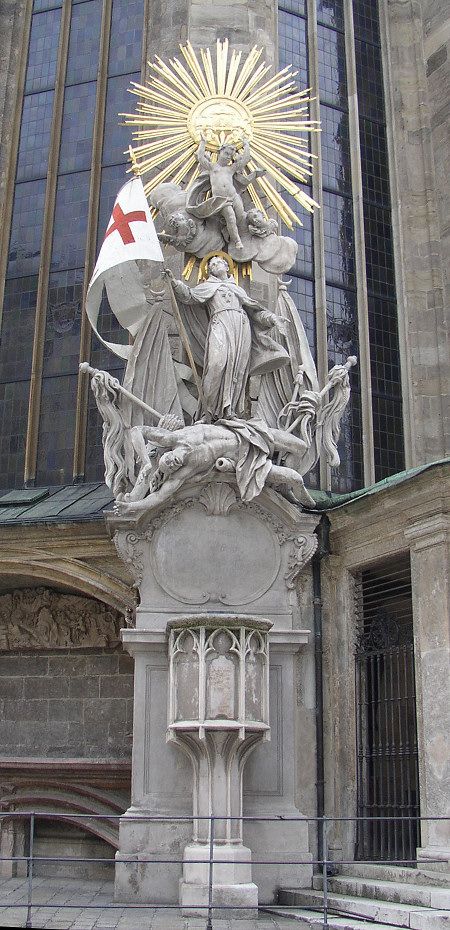
For the Feast of St. John of Capistrano's today


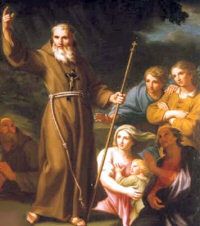
St John Capistrano was known as the defender of the rights of God preaching throughout Europe and fought many heresies and led the Christians troops against the invading Muslims. Ave Maria!


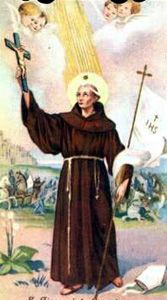
Today, Oct. 23rd, is the Feast of St. John Capistrano, Franciscan priest, the Soldier Saint


Today, October 23, we celebrate the feast day of Saint John of Capistrano (1386-1456), “the Soldier Saint,” confessor, acclaimed preacher, miracle worker, and crusader. Saint John lived at a time of difficulty and despair across Europe, having just suffered the plague, currently embattled in several wars, and attacks from Muslim forces of the East. Similarly, the Church was embroiled in battles regarding the identity of the pope (as schisms had created three separate individuals identified as pope), and the Franciscan Order was similarly divided. Saint John was a man of hope and action. His deep Christian optimism and complete faith in the Lord drove him to attack problems at all levels with the confidence engendered by trust in Christ.


John was born at Capistrano in the Italian Province of the Abruzzi. His father, who died while John was quite young, had been a well-respected German knight. John received a thorough education, seen to by his mother. As a student, John excelled, leading to immediate career successes. He became a lawyer and was granted the position of governor of Perugia at the young age of 26. He fought corruption and bribery and became renowned for his high ethical standards and commitment to justice.

When war broke out between Perugia and Malatesta in 1416, John tried to broker peace between the regions. Unfortunately, his efforts led only to his imprisonment. During his time in prison, while he had plenty of time for contemplation, John felt a deep spiritual stirring within in, vowing to change his life for the better upon his release. Shortly thereafter, following the death of his wife, he entered the order of Friars Minor, was ordained a priest, and began to lead a very penitential life.

John became a disciple of Saint Bernadine of Siena and was immediately recognized for his sermons and ability to touch the hearts of those who listened to him. As an Itinerant priest throughout Italy, Germany, Bohemia, Austria, Hungary, Poland, and Russia, Saint John preached to tens of thousands. He reportedly healed the sick by making the Sign of the Cross over them. He also wrote extensively, mainly against the heresies of the day. His preaching attracted great throngs at a time of religious apathy and confusion. He and 12 Franciscan brethren were received in the countries of central Europe as angels of God. They were instrumental in reviving a dying faith and devotion. Together with Saint Bernadine of Siena, Saint John spread devotion to the Sacred Heart of Jesus, and Mary, Mother of God.

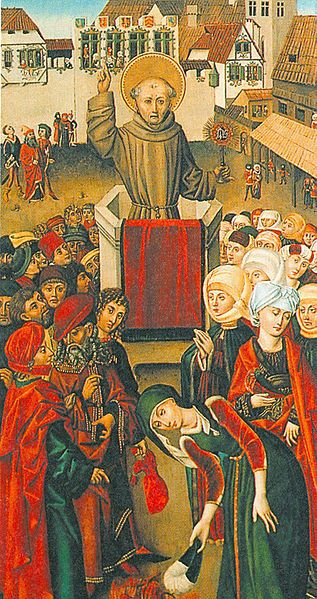
History tells us, “Saint John traversed the whole of Italy; and so great were the crowds who came to listen to him that he often had to preach in the public squares. At the time of his preaching all business stopped. At Brescia, on one occasion he preached to a crowd of one hundred and twenty-six thousand people, who had come from all the neighboring provinces. On another occasion during a mission over two thousand sick people were brought to him that he might sign them with the Sign of the Cross, so great was his fame as a healer of the sick.”

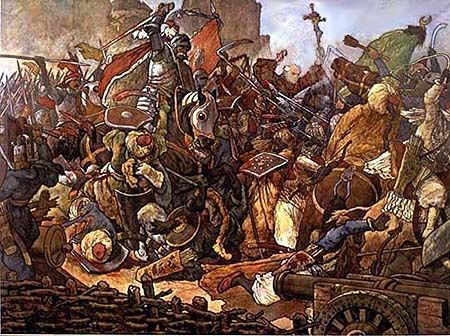
When the Turks captured Constantinople in 1453, Saint John was commissioned (at age 70) by Pope Callistus II to preach a crusade for the defense of Europe. Barefoot and dressed in his humble robe, Saint John visited the kings of Europe, uniting them and their armies against the invading forces. He led an army of 70,000 Christian soldiers to Belgrade, and when it appeared that they were outmatched by the Muslim army, he ran to the front lines. Holding his crucifix up high, this thin, small old man kept crying, "Victory, Jesus, victory!" Full of courage in Christ, the Christian army won an overwhelming victory and freeing the city from siege. Worn out by his age and efforts, Saint John succumbed to the infections present on the battlefield and died several months later. “An infinity of miracles” followed his death.

Saint John of Capistrano was a man of action, who gave up a successful and lucrative career and life to follow Christ. His commitment to the Word of God reminds us that the highest goal of this life is not worldly honors, but union with God in heaven. On his tomb in the Austrian town of Villach, the following message is inscribed: "This tomb holds John, by birth of Capistrano, a man worthy of all praise, defender and promoter of the faith, guardian of the Church, zealous protector of his Order, an ornament to all the world, lover of truth and religious justice, mirror of life, surest guide in doctrine; praised by countless tongues, he reigns blessed in heaven."


From the writings of Saint John of Capistrano:

“Those who are called to the table of the Lord must glow with the brightness that comes from the good example of a praiseworthy and blameless life. They must completely remove from their lives the filth and uncleanness of vice. Their upright lives must make them like the salt of the earth for themselves and for the rest of mankind. The brightness of their wisdom must make them like the light of the world that brings light to others. They must learn from their eminent teacher, Jesus Christ, what he declared not only to his apostles and disciples, but also to all the priests and clerics who were to succeed them, when he said, “You are the salt of the earth. But what is salt goes flat? How can you restore its flavor? Then it is good for nothing but to be thrown out and trampled underfoot.” Jesus also said: “You are the light of the world.” Now a light does not illumine itself, but instead it diffuses its rays and shines all around upon everything that comes into its view. So it must be with the glowing lives of upright and holy clerics. By the brightness of their holiness they must bring light and serenity to all who gaze upon them. They have been placed here to care for others. Their own lives should be an example to others, showing how they must live in the house of the Lord.”


Lord,
you raised up Saint John of Capistrano
to give your people comfort in their trials.
May your Church enjoy unending peace
and be secure in your protection.
We ask this through our Lord Jesus Christ, your Son,
who lives and reigns with you and the Holy Spirit,
one God, for ever and ever. Amen.


The letter of St John Capistrano to St Colette
November 1442
StJohnCapistranoFulda school 1766
It can be your greatest friends that cause you the greatest anguish. St John wanted Colette to join his reform of the Franciscan order, accept his constitutions and submit to the jurisdiction of the friars he would appoint as visitators. He was full of sincere enthusiasm for the restoration of the Franciscan order - but he was not a Poor Clare and he had never lived the life Colette professed. Colette and her sisters prayed desperately to God that God would enlighten John’s heart and mind. And God did. John completely reversed his position. Not only did he not interfere with the life of the Sisters he place the Friars who had joined Colette’s reform under her jurisdiction and empowered her to appoint her own visitators. This is unique in Church legislation!


To Sister Colette of the Order of St. Clare, entirely devoted to Christ our Lord, our very dear daughter in the heart of the Spouse of virgins, John Capistran of the Order of Minors, on the part of the Apostolic See and the Most Reverend Father General wishes health and everlasting peace in the Lord.

Desiring, with a father’s affection, to console you in the Lord, I ratify and I confirm by these letters present, and declare ratified and confirmed all the favours which the Most Reverend Minister-General has accorded you and your chaplain, Pierre de Vaux, and the chaplains of the convents of nuns which you have built and will build

I declare that you have power to appoint one or more friars of our Order to fill the office of Visitator of the nuns in the said convents, or of friars who live in monasteries (of your way of life). To these friars so chosen, in virtue of these letters present, I accord and declare accorded the same faculties and the same power that preceding Ministers General have heretofore given these Visitators.

I ordain, in virtue of holy obedience, that the friars so named accept, the office of Visitator with respect, and that they fulfil it with diligence and devotion.

Given by me, at Besançon,
the eighth day of the month of November,
in the year of our Lord, 1442.

Brother John Capistrano, Commissary General

St. Anthony in Frescoes


By the Poor Clare nuns of Galway, Ireland. A beautiful video on frescoes of St. Anthony of Padua and a short description of the event and/or miracle.