Search This Blog

Saturday, May 18, 2013

Belated - Feast of St. Margaret of Cortona, May 16th


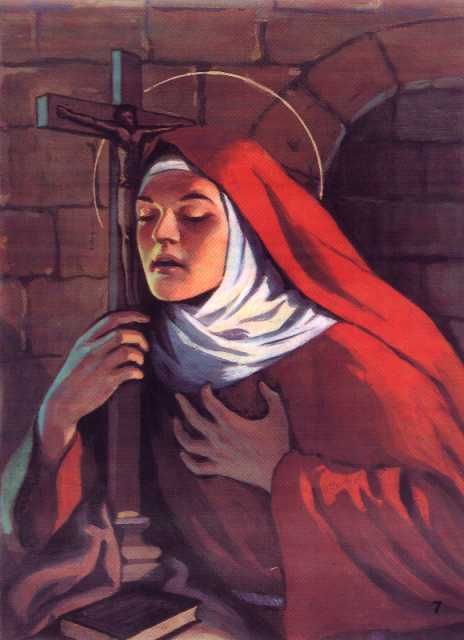
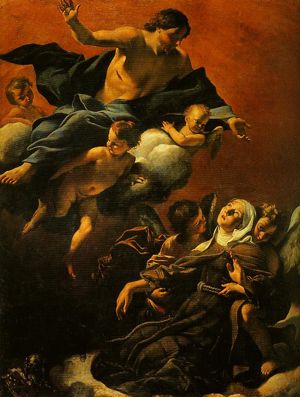
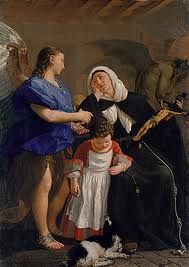
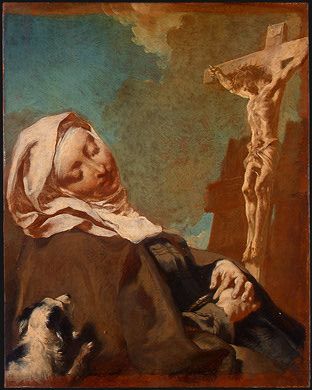
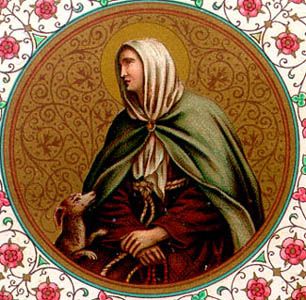
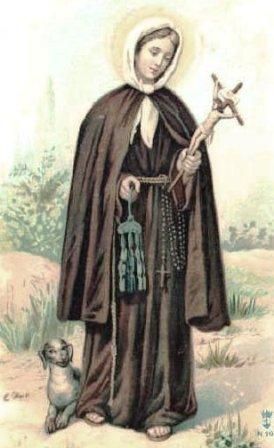
May 16th the Poor Clare Colettines and Franciscans celebrate the feast day of Saint Margaret of Cortona (1247-1297), a model of Christian redemption and conversion. Saint Margaret is sometimes referred to as the Second Mary Magdalene, recognized for her turn from sin to exemplary holiness. For more on the life and sainthood of Saint Margaret of Cortona.


Pope John Paul II prayed to Saint Margaret, while on pilgrimage, in 1999. The text of his prayer follows:

O Saint Margaret of Cortona, I too come today as a pilgrim and I pause to pray with you at the feet of the image of Christ Crucified and Risen, whom, as a penitent, you contemplated at length. Lord Jesus, crucified for us, in offering yourself on Calvary for all humanity, you have revealed to us the wellsprings of everlasting life. May the mystery of your Passion enlighten our life making us ready to follow you on the way of holiness and love. Rekindle our faith; teach us to recognize and welcome in our everyday life the plans of your mysterious Providence. Give us the courage to confess our sins and open our hearts to sorrow, in order to receive the gift of your mercy. Empower us to forgive our brethren following the example of your love that knows no bounds. Help us to be humbly disposed to repair the harm we have done by actively and generously serving the poor, the sick, and all who are marginalized and without hope. Give everyone the joy of persevering faithfully, in full harmony with the Church, along the way of the particular calling. Above all others, show the young the splendid plan of love that you intend to bring about for them and with them at the threshold of the new millennium. Enable us to be peacemakers, tenacious weavers of daily relationships of fraternal solidarity, artisans of reconciliation, witnesses and apostles of the civilization of love. O glorious Saint Margaret of Cortona, present this request to your Crucified Lord and ours. Guide us with the strength of your example, support us with your constant protection, be our companion we beg you, till we reach our Father's house. Amen.


Today, we pray to Saint Margaret of Cortona for the grace of conversion, sincere repentance, and the ability to both discern and follow the voice of Jesus. Saint Margaret of Cortona, Pray for us!


O holy Margaret of Cortona, I am here before this image of Jesus crucified which has spoken to you so many times. Obtain for me, too, the grace of hearing His voice: Through His Word, Through prayer, And the events of life.


O Jesus Crucified, increase my faith and grant me, as you granted to holy Margaret, the grace of a sincere repentance from my sins;
make me at one with the most needy
and accompany me, I ask you, to the Father's house. Amen

 
Prayer to St. Margaret of Cortona


The following prayer was printed in the February 2002 "Santa Margherita da Cortona" booklet sent out by the Basilica. I wrote to them last year, and they started sending me these wonderful Italian newsletters. It has been translated from Italian into English.

"O holy Margaret of Cortona, I am here before this image of Jesus crucified which has spoken to you so many times. Obtain for me, too, the grace of hearing His voice: Through His Word, Through prayer, And the events of life.  O Jesus Crucified, increase my faith and grant me, as you granted to holy Margaret, the grace of a sincere repentance from my sins; make me at one with the most needy and accompany me, I ask you, to the Father's house.  Amen." 


This crucifix is the one that spoke to St. Margaret. It was sculpted around the year 1200, and is nearly life-size.


PRAYER TO ST MARGARET OF CORTONA FOR ANY NEED 

O Saint Margaret of Cortona, admirable model of charity and goodness, because you loved Jesus so much and he enriched you with many privileges, I beg you to help me in my many needs and particularly to obtain from God the favor I ask through your intercession…
Have pity on me in my sadness. I place all my confidence and hope in you. Dear Saint Margaret, you were so singularly blessed by Jesus in this life! Help me through your powerful intercession, to be heard so that I may live on Earth as a true follower of Jesus Christ and then have the happiness of enjoying Him with you in heaven. Amen.


St. Catherine of Bolgona Quote


Belated - Feast of St. Catherine of Bolgona, May 9th - Poor Clare nun, Mystic and Miracle Worker

(A belated post on St. Catherine of Bologna, Poor Clare - mystic and miracle worker.  The Poor Clare Colettines and Franciscans celebrate her day on May 9th.)

May 9th: Saint Catherine of Bologna


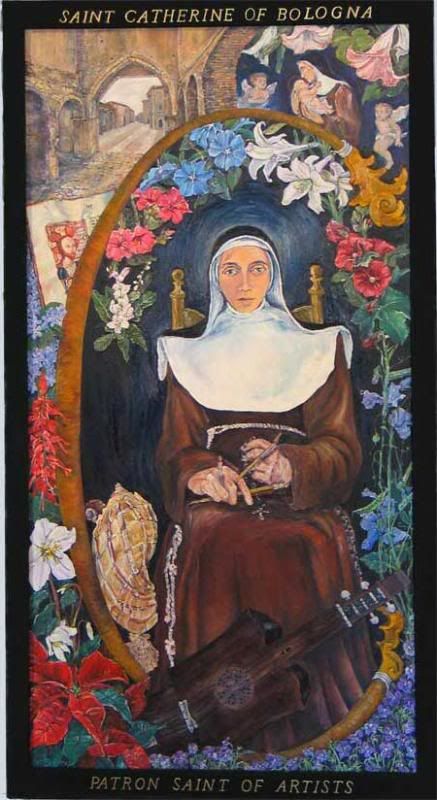
May 9th commemorates the feast day of Saint Catherine of Bologna (1413-1463), virgin of the Church, mystic, and patron saint of artists and those who are tempted. Saint Catherine was born in Bologna, and appointed as the maid of honor to the daughter of the Marquis of Ferrara, for whom her father served as an aide. Catherine moved into the palace, and became best friends with her mistress, Margaret. Upon the engagement of Margaret, who wished Catherine to remain with her, Catherine instead entered the religious life. At age 14, she joined the third order of the Franciscans, who lived a semi-monastic life.

Eventually, the community to which Catherine belonged adopted the second rule of the Franciscans, joining the Order of the Poor Clares. There, Catherine lived in poverty and obedience, joyfully serving the Lord. However, Catherine felt that the rule was not strict enough in the community she served, and eventually was moved to a more austere community, where she reluctantly agreed to be Abbess.


Saint Catherine was graced with many spiritual gifts, beginning early in her religious life, and persisting until the end of her days. A mystic, she frequently experienced visions of the Blessed Mother, Christ at the hour of His crucifixion, and was tormented by visions and temptations of the Devil. All of these she passed along to her sisters, for their spiritual direction, and some she recorded in Latin, having been schooled in Latin at the court of the Marquis.


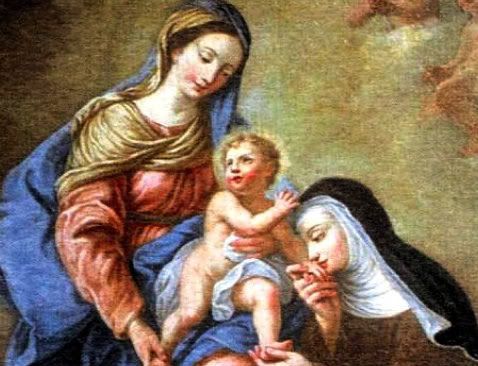
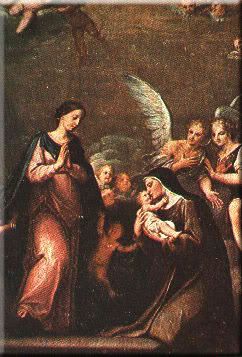
The most remarkable of her visions occurred on Christmas Eve. She had asked permission, at that time, to spend Christmas Eve alone in the convent chapel, intending to pray one thousand Hail Marys in honor of the Blessed Mother and the Nativity of Our Lord. As she later recounted, at approximately midnight, the dawning of Christmas morning, the Blessed Virgin appeared to Catherine with the swaddled baby Jesus in her arms. The Mother of God handed the Infant to Saint Catherine, who joyously held Him and kissed His cheek. Following that worship, He disappeared, but her heart was left changed forever.


Under the direction of Saint Catherine, the community became known for austerity, service to the poor, and holiness. But Catherine, led by her joyous heart, was also a woman filled with joy, which she passed along to her sisters. They suffered gladly for Christ, eschewing wealth and comfort, but their hearts leapt and danced for joy. Saint Catherine wrote in her book Le sette armi spirituali (The Seven Spiritual Weapons):
"In the name of the eternal Father and of his only begotten Son Christ Jesus, of the splendor of the Father's glory, for love of whom, with jubilation of heart, I cry, saying to his refined servants and spouses:
Let every lover who loves the Lord
Come to the dance singing of love,
Let her come dancing all afire
Desiring only him who created her
And separated her from the dangerous worldly state."


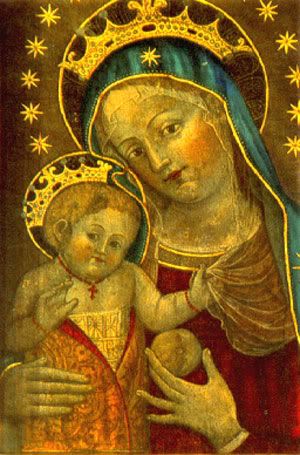
Saint Catherine is also known as a talented artist and musician, her love and joy in the Lord spilling forth in whatever artistic medium she chose. (See picture of Mary and Jesus, Mother and Child, left, painted by Saint Catherine).

Saint Catherine strove to live a life of perfection. She instructed her community in the ways of holiness, including penance and suffering. In preparation for loving Christ, Catherine enumerated seven spiritual weapons of use to the faithful:

“Whoever from deep within her noble and zealous heart wished to take up the cross..., let her first take up the arms necessary for such battles...: first is diligence; second, distrust of self; third, confidence in God; fourth, memory of his passion; fifth, memory of one's own death; sixth, memory of the glory of God; seventh and last, the authority of Holy Scripture as it gives the example of Christ Jesus in the desert.”


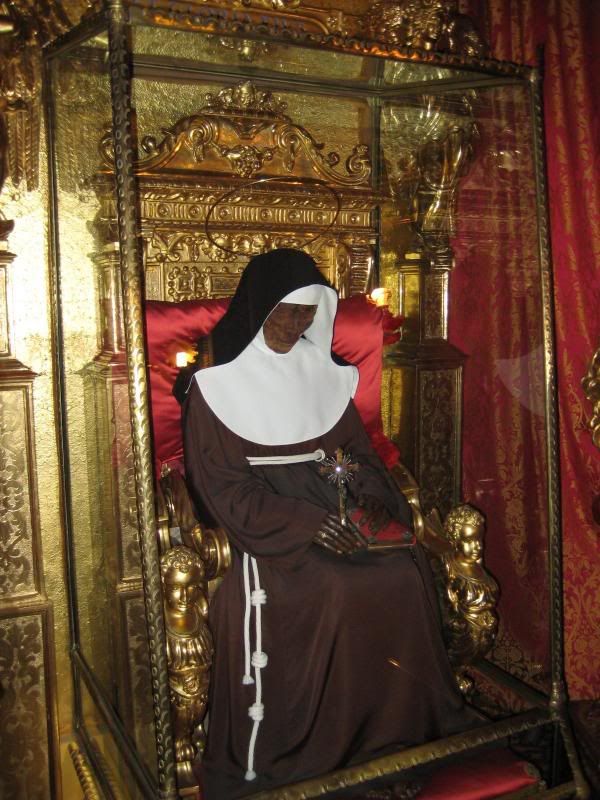
While she was frail throughout her days, Catherine lived a relatively healthy life until shortly before her death due to a terminal illness. Upon her deathbed, her sisters observed that her aged face had been restored to the smooth youth of her teen years when she had entered the order. Buried without a coffin, her body was exhumed 18 days later, due to the overpowering sweet fragrance emanating from the gravesite. Found incorrupt, Saint Catherine was seated in a golden throne, in the small chapel of Cheisa della Santa, where she remains today. Her incorrupt body and face appear smooth and featureless, although somewhat blackened by the soot of 500 years of burning candles.


Saint Catherine’s search for perfection, her faith, and her piety are worthy of aspiring to. But more than that, the joy that Saint Catherine found, even in her suffering and death, is remarkable. She was confident in the love of Christ, confident that He would never stop caring for her, confident in His grace and mercy. During Lent, we often feel as if we should be morose and gloomy, fasting, abstaining, and enacting other mild forms of mortification and penance. Saint Catherine understood these physical acts of repentence as well, but did so with a joyful heart, dancing and singing of the love of the Lord. This Lent, perhaps it is our turn to join in this glorious dance, hearts afire, desiring only Him who created us!


Photo below, photos of St. Catherine's uncorrupted body.


(The above from: http://365rosaries.blogspot.com/2010/03/march-9-saint-catherine-of-bologna.html)


Prayer to St. Catherine of Bologna

Dear saintly Poor Clare, so rich in love for Jesus and Mary, you were endowed with greatly talents by God and you left us most inspiring writings and paintings of wondrous beauty. You were chosen Abbess in the monastery of Poor Clares at Bologna. You did all for God's greater glory, and in this you are a model for all. Make artists learn lessons from you, and use their talents to the full.
Amen.

Today is the Feast of St. Felix of Cantalice - Known as "Brother Deo Gratias"

St. Felix of Cantalice, OFM Cap
(1515-1587)


His feast is celebrated on May 18. Felix was born at Cantalice, Italy, in 1515. His parents, Santi and Santa Porri, were farmers, struggling to make ends meet. Felix had two older brothers, Blase and Charles, and two younger brothers, Potenza and Peter Marino. The latter perished in one of the many battles between Cantalice and Rieti. When he was about 10 years old, Felix was hired out as a farmhand for the Picchi family at Cittaducale. Farmhands were rustic, "untamed" people, raised in the outdoors. Vegetarians, they learned how to survive in the wild. Their job was grueling. After a hard day's work, Felix found relaxation in wrestling. As a youngster, Felix' cousin would read to him the lives of the desert ascetics. Descriptions of their penances had enthused Felix and sparked in him a desire to imitate their austerity. Felix had a dream in which an angel directed him to go to Leonessa to join the Capuchins. In pursuit of his dream, Felix set out for Leonessa where the Capuchin local minister redirected him to the provincial vicar. Not knowing where to find him, Felix returned to work in the fields. He was not accustomed to receiving messages from angels and was even less inclined to waste his time searching for what was elusive. The angel returned a second time, telling Felix to go to the Capuchin Friary at Rieti. Again, nothing came of the trip, so Felix returned to working the land. One day, an Augustinian friar invited Felix to consider joining the Augustinians. Felix replied, "Either a Capuchin or nothing."

He persisted in his desire to become a Capuchin and presented himself at the Capuchin Friary at Cittaducale. The local minister led him into the church, before a large crucifix, asking that he pray to be enlightened. The corpus on the cross was bruised, bloodied, and disfigured. Moved by the sight, Felix experienced the depth of God's love for him. That evening, the local minister (having forgotten about Felix) returned to the chapel to pray. Felix was still there. The local minister remarked, "Son, what are you doing? Still here? You are a good person; we will accept you among us. Jesus will no longer be alone. You will help him carry the cross." Ten days later, toward the end of the autumn of 1543, the 20-year-old Felix was received. He immediately set out for Rome to present himself to the elusive provincial vicar. At the Roman friary of St. Nicholas de Portiis, Felix was received by Bernardine of Asti, who was both the Roman local minister and procurator for the Capuchin Order before the Roman Curia. Bernardine introduced Felix to Raphael of Volterra, the Capuchin Provincial Vicar of the Roman Province, who officially received Felix into the Order.


On a rainy morning in early 1544, Felix set out for the Fiuggi friary where the provincial vicar had determined his year of novitiate would be spent under the guidance of Boniface. During the harsh days of novitiate, Felix suffered debilitating fevers. The friars were considering asking him to return to secular life. As a last resort, they transferred Felix to Monte San Giovanni Campano where Felix recovered. Before the public notary, James of Mastrantonio, Felix relinquished his worldly possessions to his siblings and waived all claim to any future inheritance. He professed vows on May 18, 1545.

Lover of nature that he was, the rustic Felix had become a Capuchin hoping to be able to live the rest of his days in one of the many friaries located in secluded forests. In reality, only the first few years of his religious life were spent in such locations at Fiuggi, Monte San Giovanni, Tivoli, and Viterbo. Then, in 1547, Felix was introduced to the frenzied life of Rome. In his younger years, in imitation of the desert ascetics, Felix had vowed never again to touch bread. Ironically, his Roman assignment was to quest for bread and wine. Despite his desire for seclusion, Felix' ministry placed him in direct, daily contact with a multitude of people. Following then current Capuchin custom, Felix always made his quest barefoot, with eyes cast down. His response to every benefactor was always a humble yet confident "Thank God" ("Deo gratias"). So often was it repeated that Felix became known as "Brother Deo Gratias." Not only did Felix provide the friars with food, but he also furnished food for the hungry. He received permission from the ministers to help the needy, especially widows with many children. It is said that his begging sack was as bottomless as his heart. He never refused a request for help. Felix would dispense oil, bread, wine, and meat. When he could not provide the required aid himself, he would solicit the help of the wealthy, including church dignitaries. Felix always reminded people, benefactors and beneficiaries alike, of divine providence and urged them to give thanks to God. He would visit the sick at the friary, in private homes, at the hospitals of St. James of the Incurables, of the Holy Spirit, and of St. John Lateran. Felix spoke in simple language, exhorting the sick to trust, and to accept sickness as a graced moment.

Felix' reputation as a healer of peoples' ills spread. He would often bless the sick with a crucifix and they would be healed. At other times, he would give away some of the alms he had collected, which, in turn, became channels of healing. Felix healed Constance, the mother of the Cardinal Bishop of Orvieto, Peter Crescenzi, by bathing her eyes with wine he had received as an alms. Similarly, at the hospital of St. John, a patient was healed instantaneously after Felix had given him some donated wine. Friends began to tease Felix saying, "Brother Felix, when I get sick, bring me a little of your wine!" Felix exhorted everyone in his rustic Sabine dialect, always using the informal form of address. He treated every individual with the greatest respect, whether giving alms or receiving them. Felix was a person who had difficulty saying "no," and benefactors knew this. If someone asked for something, Felix always provided.

His upbringing prevented him from putting on airs. A person's social or ecclesiastical position notwithstanding, Felix would directly (and unceremoniously) confront those in need of conversion. Stories of Felix' life read like incidents out of the Fioreffi. One day, Felix, seeking food for the poor, knocked at the door of a lawyer who was immersed in reading a legal treatise. The lawyer, indignant over the intrusion, made it known that he was involved in something far more important than any trivial affair in which the brother was involved. Felix's eyes filled with tears and he asked, "Is there perhaps some law more important than God's?" The lawyer soon abandoned his law career to pursue a life of ministry in the church. On another occasion, Felix confronted the illustrious lawyer, Bernardine Biscia, by placing a crucifix on top of some legal tomes Biscia was perusing. Felix pointed to the Crucified One and said, "Look, Sir Bernardine, all these books were made for you to better understand him."

Felix normally spoke little outside the friary. Even within the friary, what he had to say was more often than not an exhortation for others to give good example. His style was frank and direct. He might tell someone, "I want to correct you." He often reminded Capuchin preachers, "Preach in order to convert people, not to make a name for yourself." At times, he would quote Brother Giles' quip: "Bo, bo, bo, assai dico e poco fo!" ("Tsk, tsk, tsk, a lot of talk, but no action.") To Cardinal Julius Anthony Santori, the Capuchin cardinal protector, Felix once said: "My lord cardinal, you were designated to protect us, not to interfere with matters that pertain to the superiors of the Order." He advised the future Sixtus V, "When you become pope, be pope for the glory of God and the good of the church. Otherwise, it would be better for you to remain a simple friar." The same pope would occasionally encounter Felix questing and would ask for a piece of bread. One day, Felix gave him a piece of stale black bread and remarked to the Franciscan pope, "Excuse me, Holy Father, but you're still a friar."

For his personal devotion and meditation, Felix memorized prayers and liturgical and biblical texts. Despite being illiterate, Felix prayed from the heart and occupied his mind with spiritual reflections. Whether he was walking the streets of Rome, in his cell or in chapel, he was absorbed in contemplation. He would recall the words of the gospel for inspiration. After everyone else had gone to bed, Felix would spend long hours before the Blessed Sacrament entrusting to God's care the people he had met in the course of the day.
He had a curiosity about subjects of which he had no formal education. Often he would seek counsel from the famous Spanish priest, Alphonse Lupo. Felix was a personal friend of Philip Neri and an acquaintance of Charles Borromeo. Felix recognized that authentic holiness was both enlightened and enlightening. Thus, by seeking the advice of knowledgeable people, the "saint of the streets of Rome" was enabled in turn to advise or admonish the people who sought counsel from him.


Felix was an institution for two generations of Roman youth. Youngsters would affectionately call him "Papa," causing some raised eyebrows among those who were unfamiliar with the esteem in which the Capuchin was held. People brought their cares immediately to Felix for help. Even before going to the doctor, they would call on Felix. He would go to their side, kneel, and say an "Our Father" and a "Hail Mary," and then return to the friary confident that providence would take care of the rest. At other times, Felix would exhort the sick to acceptance, saying, "Heaven, heaven," or, "Allow yourself to go to paradise." Felix had an intense fondness for mothers and babies. He would always take a moment to dedicate the infants and to teach the young to repeat, "Jesus, Jesus," or, "Deo gratias." Felix had a talent for spontaneously creating and singing spiritual hymns. People would often ask him to sing. His devotion to the Virgin Mary was not apparent, except in these free verse songs and from the testimony of Alphonse Lupo who knew Felix well. Felix carried out his ministry until just days before his death. Cardinal Santori had offered to use his influence to have the elderly Felix relieved of the difficult task of questing, but Felix refused.

On April 30, 1587, Felix fell ill. He knew he was about to die. To the friars he remarked, "This little ass has dropped; it will not rise again." With Urban of Prato at his bedside, Felix raised his hands and his face became resplendent. Urban asked him what was happening and Felix responded, "I see the Virgin Mary surrounded by a throng of angels." As the local minister was bringing Eucharist as Viaticum, Felix began to sing, "O Sacrum Convivium." He died on May 18, 1587. Felix' remains are enshrined in the Capuchin church of the Immaculate Conception on Rome's exclusive via Veneto.

Sixtus V was determined to proceed to canonization, by Roman acclamation if necessary, but the process was not concluded. After Sixtus V died, the momentum of the process dissipated. Finally, on October 1, 1625, Urban VIII beatified Felix and Clement XI canonized him on May 22, 1712, the first Capuchin to be so honored.


Homily from the mass on St. Felix by the Franciscan Friars:


St. Padre Pio Quote


Tuesday, April 23, 2013

THE TINIEST CRUCIFIXION


"THE TINIEST CRUCIFIXION "

Lord Jesus, could you rock him for a while?
He has no mother's breast, no father's smile.
No downy silky pillow for his head,
They placed him in the bloody basin --dead.
 
He was so small, this baby doomed to die,
His mother's rights, the only reason why,
From somewhere safe and warm, they tore the child,
Lord Jesus, could you rock him for a while?
Poor little one, who was it took your breath?
Who made the healers hand a thing of death?
Who was your Judas?- Mother? Doctor? State?
Or was it we who fought your cause too late?
Please Jesus, rock the other babies too,
Forgive us Lord, we don't know what we do.
He has no cradle, cross, no grave, no tomb,
This baby crucified in the womb.


~~Anonymous~~

Today is the Feast of Blessed Giles of Assisi


Two companions from Assisi had already joined St. Francis when Giles, a well-to-do young man of the town, heard about it. He repaired to the poor hermitage yard by Assisi, which the three occupied, and prostrate upon his knees, he begged St. Francis to accept him into his company. Francis presented him to the other two, saying: "See here a good brother whom almighty God has sent us." This was on April 23, 1209. On the same day, both went to Assisi, where Giles begged in God's name for a bit of cloth to make a habit. Giles divided his entire fortune among the poor. He was plain and simple in mind, of a mild temperament, but also full of power and energy when it served to accomplish anything good.

Recognizing humility as the necessary foundation for perfection, Giles sought humiliation and contempt, but fled from honors. Once when he was passing through the March of Ancona with the holy Founder and at some places special honor was shown to them, he said, "O my Father, I fear we shall lose the true honor if we are honored by men."

Giles entertained a great desire to make a pilgrimage to the Holy Places, and since Francis knew that he did much good everywhere by his holy example, he gladly granted his desire. The Apostle James at Compostela in Spain, then to the Holy Places of the Passion of Christ in Jerusalem. He also visited the sanctuary of the holy Archangel Michael on Mt. Gargano in Italy, and the town of Bari, there to honor St. Nicholas.

His whole appearance preached poverty, humility, and piety. He also utilized every opportunity to encourage penance and love of God. He endeavored to earn his livelihood mainly through manual work; whatever he obtained over and above his immediate needs, he at once gave to the poor; if he lacked necessities, he begged them for God's sake. Once a poor woman who was dressed in the barest necessaries asked Brother Giles for an alms. As he had nothing to offer her, he compassionately took off his capuche and gave it to her.


In the year 1219, at the great chapter of 5,000 brothers, St. Francis commissioned Giles to go to Africa with several companions, to preach the gospel to the Mohammedans. But they did not achieve their purpose. As soon as they landed in Africa, the Christians there, who feared a general persecution, led them by force to another ship which brought them back to Italy.

At this time Brother Giles was sent to the quiet convent of Perugia, which remained his abode until his death. He lived practically only for God. Even at his work, thoughts of the last judgment, of eternity, and of the glory of heaven constantly occupied his mind. Once when two distinguished gentlemen asked him to pray for them, he said: "Oh you do not need my prayers." "Why not?" they asked. Giles answered, "You live among all the comforts of the world and still believe that you will get to heaven; but I, a poor human being, spend my days in labor and penance, and yet I fear I will be damned." When he reflected on the joys of heaven, he was beside himself with longing. Often when the children in the street called out to him the mere word "paradise," he was rapt in ecstasy.

Pope Gregory IX had heard of the contemplative gift of Brother Giles, and being just then in the neighborhood of Perugia, he sent for him. When the pope began to speak to Giles about divine and heavenly matters, Giles at once went into an ecstasy. When he came to again, he humbly begged the Holy Father's forgiveness -- it was his weakness, he said, that he was immediately beside himself. The pope required that he give him some good advice for the administration of his burdensome duties. Quite confounded, Giles excused himself saying that he could not advise the head of the Church. But when the pope commanded him in obedience, he said, "Holy Father, you must have two eyes in your soul. The right eye must be kept on heavenly things; the left one, on the things of this earth, which you must regulate."

St. Bonaventure considered himself fortunate to have lived at the time when he could still see and speak with Brother Giles. When he came to Perugia as provincial of the order, Giles said to him one day," My Father, God has accorded you great kindness, since you are so learned and can, therefore, serve God so perfectly; but we unlearned ones, how shall we correspond to the goodness of God and arrive at heaven?" The learned general of the order answered him: "My brother, in order to get to heaven, it suffices that one love God, and a poor unlearned woman can love God as well as, maybe even better than, a great theologian." Thereupon Giles ran out into the garden that led to the street, and filled with joy, cried aloud, "Come, ye simple and unlearned men, and ye poor women! You can love God as well as, and perhaps even more than, Brother Bonaventure and the greatest theologians."

A religious of great learning, who, however, was much troubled with doubts concerning the virginity of Mary, came to Brother Giles for advise. The holy brother cried out, as he struck the earth with a stick, "Yes! yes! She was a virgin before the birth of Jesus!" and immediately a beautiful lily sprouted forth. Giles struck anew and said, "She was a virgin during the birth," and again a lily sprouted forth. Then he beat a third time upon the earth, saying the words, "She was a virgin after the birth," and the third lily sprouted forth.

Finally, pure as a lily, the soul of Brother Giles went to the vision of things divine, which he had so often contemplated. He died on April 22, 1262, on the anniversary of his entrance into the order, to which he had belonged for 53 years. His grave in the Franciscan church at Perugia is highly venerated. Pope Pius VI sanctioned the veneration accorded him from time immemorial.


CONCERNING THE GOOD INTENTION

1. What the divinely enlightened brother said to the pope and observed so faithfully himself, we, too, must observe. The right eye of our soul must be directed to things of heaven, while the left eye looks at the things of this earth which we have to deal with, that is, amid all our occupations the higher regard of our soul should be directed towards God, so that we may do everything according to His good pleasure and with good intention. Yes, the Apostle warns us always to bear about in our hearts the best, the most perfect intention, which desires nothing but the honor of God: "whether you eat or drink, or whatsoever else you do, do all to the glory of God" (1 Cor 10:31). If we do everything as God wants it, and because it pleases God, we thereby promote His honor. Have you always been thus minded at your work?

2. Consider how precious in the sight of God our dealings become through our good intention. In order to make our good intention most perfectly, we should unite it with that of the Sacred Heart of Jesus. The first thing in the morning it is well to make the intention which Pope Leo XIII prescribed for the members of the Apostleship of Prayer, offering up all our works, prayers, and sufferings of the day, and everything else we do, for the purpose with which the Son of God, Jesus Christ, offers Himself to the heavenly Father in all the holy Masses of the day. What value our works must thereby acquire in the sight of God! United with the sacrifice of His Divine Son, they appear as a part of the holy sacrifice of His Divine Son, they appear as a part of the holy Sacrifice itself, and as He once assured St. Gertrude, God hardly knows how to reward such gifts sufficiently. Should that not inspire us never to forget this good intention and to renew it often during the day?

3. Consider how a good and pure intention in our actions preserves us in tranquility of heart and interior peace. That is it, in fact, that makes so many people restless and tortures them at their work but the thought of what people will say about them, or what success they will have in the eyes of the world. "If God were always the only object of our desires we should not easily be disturbed," says Thomas a Kempis (1.14). Let people think of us what they may, and let us not be fearful about the results which so often are not in our control. Doing what is assigned to us, and directing our whole intention towards God, we shall always preserve interior peace.

PRAYER OF THE CHURCH

O God, who didst deign to raise Thy blessed confessor Giles to the height of extraordinary contemplation, grant through his intercession that in our actions we may always direct our intention to Thee, and through it arrive at the peace which surpasses all understanding. Through Christ our Lord. Amen.

from: The Franciscan Book of Saints, ed. by Marion Habig, ofm., © 1959 Franciscan Herald Press


Fr. David Mary of the Franciscan Brothers Minor's (also chaplains to the Poor Sisters of Saint Clare) homily on Bl. Giles:
 
http://www.youtube.com/watch?v=HlDrCVJitHk