St. Clare is the little plant of St. Francis, as she called herself. A blog to my call to become a Poor Clare Colettine. If St. Clare was a "little plant", I am a scraggly weed.
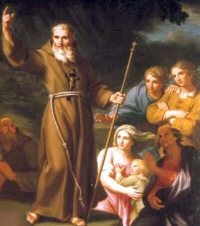
Above Sts Nicholas Tavelic, Stephen of Cuneo, Deodato Aribert from Ruticinio and Peter of Narbonne Franciscan Priests, Martyrs
Roman Martyrology: In Jerusalem, the Holy
Nicholas Tavelic, Deodato Aribert, Stephen of Cuneo and Peter of
Narbonne, Priests of the Order of Friars Minor and Martyrs who were
burned in the fire for preaching boldly in the public square in front
of the Saracens, the Christian religion, professing Strongly Christ
Son of God.
The personal stories of these Franciscan missionaries,
are intertwined in 1383, when, coming from different places in
Europe, they flowed into the Franciscan convent of Mount Zion in
Palestine, where the Order of St. Francis has been for centuries the
Custodian of the Holy Places of Christianity.
The Friars Minor, Nicholas Tavelic, Deodato by Aribert
Ruticinio, Stephen of Cuneo and Peter of Narbonne found themselves in
that Franciscan monastery, where they lived for eight years,
according to the Rule of St. Francis, performing their duties, for
the care of Places sanctity of life and death of Jesus, and trying to
do apostolate in the Muslim world, where Mount Zion was almost like
an island amid a sea of Muslims.
With Muslims, the apostolate was almost fruitless, since the
deepening of their faith, they were not open to interreligious
dialogue.
Nevertheless, the four Friars Minor, decided to bring the Gospel
to the Mohammedans, publicly exposing the arguments of Christianity
and Islam and comparing them with those after consultation with two
theologians, prepared a memorandum in which, in a detailed and rich
in historical references and theological, meticulously exposed the
Christian doctrine by refuting Islam.
On November 11, 1391, they went before the Cadi (judge) of
Jerusalem in the presence of many Muslims, they were exposed reading
this, they worked out with great courage. While they listened
carefully, it was not accepted by those present, in the end they went
into a rage and then the monks were asked to recall what they said;
the four monks refused and so were sentenced to death for three days
were put behind bars where they suffered abuse.
On November 14, they were brought back to the streets, again asked
to recant what was said against Islam, after rejection this they were
killed, blown to pieces and burned, the Muslims did disappear any
remains, even the ashes, so that they were not honored by Christians.
Their martyrdom was described in detail in a report by the
Guardian of the Holy Land, Father Gerald Calvet, two months after
their death.
Their Cult was recognized by the Franciscan Order, dating from the
fifteenth century; Pope Leo XIII, in 1889, confirmed only the cult of
Nicholas Tavelic, the leader, who had great reverence in his native
Yugoslavia.
In 1966, Pope Paul VI confirmed the cult for the other three
Franciscan Martyrs, staring at their feast to November 17, but in the
Franciscan Martyrology they were remembered on the date of their
death (dies natalis) that November 14.
Pope Paul VI, on June 21, 1970, in Rome, elevated them to the
altars, proclaimed them saints, and their liturgical celebration was
extended to November 14 for all, and inserted into the Roman
Martyrology on the same date; they are the first martyrs and saints
the Custody of the Holy Land.
Nicola Tavelic:
First saint of the Croatian nation, Nicola Tavelic, was born about
1340 in Šibenik, Dalmatia; as a teenager he walked among the Friars
Minor of St. Francis, became a priest, was a missionary in Bosnia,
along with his father by Deodato Ruticinio, where for nearly 12 years
he preached against the Bogomil, a heretical sect that had its
stronghold in Bosnia (they contrasted the spirit world than that of
matter, considered an expression of force of evil, they denied the
Trinity, the human nature of Christ, the Old Testament, did not
recognize the rites and sacraments of baptism and marriage, nor the
church hierarchy).
Then in 1383, along with the French father of Aribert Ruticinio
Deodato, he was sent to the Mission of Palestine Mont Sion in
Jerusalem, where he met the other two future fellow martyrs, Father
Stephen of Cuneo and Father Peter Narbonne, France.
Deodato Ruticinio (diode Aribert):
Was from the Franciscan Province of Aquitaine. We do not know his
date of birth, which was probably around 1340. His country of birth,
which in Latin is called Ruticinio was identified by some with the
modern French city of Rodez, while some other shows the Roussillon,
the historical region of southern France, but at that time depended
on Catalonia. In 1372 he was sent as a missionary in Bosnia, where he
met Father Nicola Tavelic, to whom he was bound by sincere
friendship, all preaching against the Bogomil; in 1383 with his
brother he was assigned to the Franciscan convent of Mount Zion in
Jerusalem, where he also met the Fathers by Stefano Cuneo and Peter
of Narbonne outfit.
Peter of Narbonne:
All that is known of this Franciscan Martyr from the Franciscan
Province of Provence in southern France, where at one point,he went
down into Italy, attracted by the Franciscan Observance Reform,
launched in Umbria in 1368, by Blessed Paul or Paoluccio Trinci of
Foligno (1309-1391). He was at the hermitage Umbrian Brogliano,
located between Foligno and Camerino, fifteen years, living in prayer
and meditation on the spirituality of St. Francis. In 1381 he left as
a missionary to the Holy Land, received into the convent of Mount
Zion in Jerusalem where he met Nicola Tavelic in 1383, Deodato from
Ruticinio, his compatriot and Stephen of Cuneo, with whom he will
later be martyred so horribly, on November 14, 1391.
Stephen of Cuneo:
Very little is known about the Franciscan Saint Martyred in
Jerusalem, Stephen of Cuneo, made from precious ‘report’ made by
the Father Superior of the convent of Mount Sion, on the martyrdom of
the four priests belonging to the convent of the Custody of the Holy
Land. Father Stephen of Cuneo, was of the Franciscan Province of
Genoa and spent eight years in the vicarious in Corsica, before being
transferred to Jerusalem in 1383, where he could fulfill his
apostolic activity among the Muslims for another eight years before
his martyrdom, suffered along with fellow French by Deodato Ruticinio
and Peter of Narbonne and the Croatian Nicola Tavelic. The city of
origin of the Franciscan saint, Cuneo, seems doubtful, since an
historic renaissance, claimed to have collected a local tradition,
which made him a native of Fiumorbo in Corsica, with a separate
family Prunelli.
Be well, but the martyr is well known for 600 years as Stephen of
Cuneo.
Nicholas was
the son of a noble and wealthy family of Dalmatia. His illustrious
parents gave him a good education, and his progress in learning was
marvelous. But no less marvelous was his progress in virtue. When Nicholas
finished his studies, a bright future smiled upon him. Everything the
world could give was at his command and awaited his pleasure.
However, he resolved to quit the world and enter the Order of St.
Francis. In spite of the great obstacles and the stubborn opposition
he met, he received the humble habit of St. Francis and made his
novitiate with the simplicity and docility of a child. Manual labor,
study, power, and mortification were his delight and chief
employment. After he was ordained a priest, his fervor in saying Mass
caused edification and all were impressed by his sermons. Due to his
great learning and piety, he was sent as a missionary to Bosnia, a
most difficult field of labor. Undaunted, Nicholas labored with
ardent zeal among the heretics. refuting their false doctrines,
repaying insult with blessing, visiting the sick, comforting the
afflicted. He gained innumerable souls for Christ by his extreme
kindness and charity.
Many esteemed
him another Christ, while others persecuted him with relentless
hatred. At heart he loved the latter more, for he desired martyrdom
and thought they might procure for him the coveted crown. This
thought gave him tremendous supernatural strength. It increased his
charity and zeal, his spirit of prayer, meditation and penance. But,
after 12 years of tireless labor in Bosnia, all opposition died down,
and Nicholas was convinced he must seek martyrdom elsewhere.
He now asked
for permission to go to the Holy Land, where so many of his brethren
had already attained the martyr's crown. The permission was granted
to him, and he was sent to Jerusalem. Once more he led a hidden life
of prayer, penance, and study, but more than ever he yearned to die
the death of a martyr, desiring, like Christ, to be an oblation of
love for the salvation of others.
On November
11, 1391, he entered the Turkish mosque and with the zeal of a Saint
Paul preached to a vast assembly there. He pleaded with tact and
eloquence that Christ and His religion be accepted by the Turks in
their hearts and homes. Before he had finished, he was apprehended
and taken to the magistrates.
Questioned as
to his faith, Nicholas joyfully professed his belief in the one true
Church of Christ, defending it against every objection. This incensed
the court to such an extent that he was knocked to the ground and
attacked with great fury. Beaten almost to death, he was dragged into
a dungeon, chained hand and foot, and kept for three days without
food or drink. On the fourth
day he was taken out into the street, where he died the glorious
death of a martyr, slashed to pieces with scimitars. God glorified
His martyr by miracles, and Pope Leo XIII solemnly confirmed the
veneration paid to him from time immemorial. ON ETERNAL
GOODS 1.
Eternal goods should be treasured above all things. Reflecting on the
permanence of heavenly goods, Blessed Nicholas left everything the
world offered him and became a poor Franciscan. He followed the
admonition of our Lord: "Lay not up to yourselves treasures on
earth, where the rust and the moth consume, and where thieves break
through and steal. But lay up to yourselves treasures in heaven,
where neither the rust nor the moth consume, and where thieves do not
break through nor steal" (Matt 6:19-20). -- Which treasures do
you seek to acquire? 2.
Eternal goods are not properly evaluated. Most people are bent on
acquiring temporal goods, money, possessions, distinctions, honor,
and pleasure. They put themselves to much trouble by day and by night
to acquire them. How many there are who ignore the goods of eternity
for the sake of some temporal benefit, a momentary pleasure! The
words of our Lord are directed to them: "I have sworn in My
wrath! They shall not enter into My rest" (Heb 3:11). -- Which
goods are you trying to acquire? 3.
Temporal goods are quite worthless. They are transient and cannot
satisfy the heart of man. Solomon reveled in worldly luxury, and in
the end he was forced to admit: "I was weary of my life when I
saw that all things under the sun are evil, and all vanity and
vexation of spirit" (Eccl 2:17). -- Do you permit yourself to be
dazzled by the things of this world? PRAYER OF
THE CHURCH O God,
who didst glorify Thy confessor Blessed Nicholas by spreading the
Gospel and by the palm of martyrdom, grant in answer to our prayer,
that we may merit to walk in his footsteps and through his
intercession deserve to receive the victor's reward of eternal life.
Through Christ our Lord. Amen.
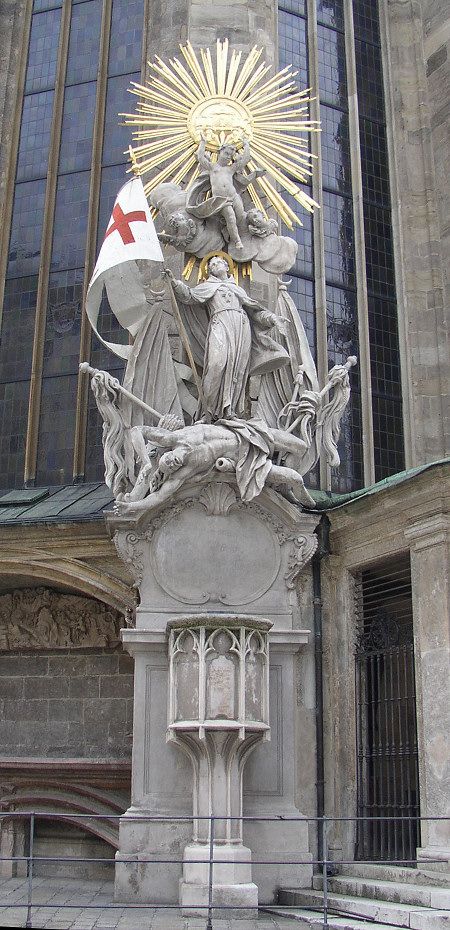
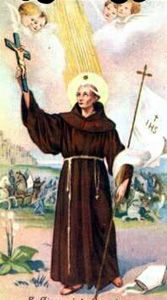
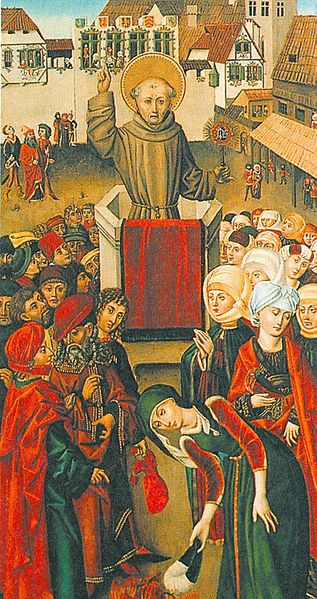
St John Capistrano was known as the defender of the rights of God
preaching throughout Europe and fought many heresies and led the
Christians troops against the invading Muslims. Ave Maria!
Today, October 23, we celebrate the feast day of Saint John of Capistrano
(1386-1456), “the Soldier Saint,” confessor, acclaimed preacher,
miracle worker, and crusader. Saint John lived at a time of difficulty
and despair across Europe, having just suffered the plague, currently
embattled in several wars, and attacks from Muslim forces of the East.
Similarly, the Church was embroiled in battles regarding the identity of
the pope (as schisms had created three separate individuals identified
as pope), and the Franciscan Order was similarly divided. Saint John was
a man of hope and action. His deep Christian optimism and complete
faith in the Lord drove him to attack problems at all levels with the
confidence engendered by trust in Christ.
John
was born at Capistrano in the Italian Province of the Abruzzi. His
father, who died while John was quite young, had been a well-respected
German knight. John received a thorough education, seen to by his
mother. As a student, John excelled, leading to immediate career
successes. He became a lawyer and was granted the position of governor
of Perugia at the young age of 26. He fought corruption and bribery and
became renowned for his high ethical standards and commitment to
justice.
When
war broke out between Perugia and Malatesta in 1416, John tried to
broker peace between the regions. Unfortunately, his efforts led only to
his imprisonment. During his time in prison, while he had plenty of
time for contemplation, John felt a deep spiritual stirring within in,
vowing to change his life for the better upon his release. Shortly
thereafter, following the death of his wife, he entered the order of
Friars Minor, was ordained a priest, and began to lead a very
penitential life.
John became a disciple of Saint Bernadine of Siena
and was immediately recognized for his sermons and ability to touch the
hearts of those who listened to him. As an Itinerant priest throughout
Italy, Germany, Bohemia, Austria, Hungary, Poland, and Russia, Saint
John preached to tens of thousands. He reportedly healed the sick by
making the Sign of the Cross over them. He also wrote extensively,
mainly against the heresies of the day. His preaching attracted great
throngs at a time of religious apathy and confusion. He and 12
Franciscan brethren were received in the countries of central Europe as
angels of God. They were instrumental in reviving a dying faith and
devotion. Together with Saint Bernadine of Siena, Saint John spread devotion to the Sacred Heart of Jesus, and Mary, Mother of God.
History tells us,
“Saint John traversed the whole of Italy; and so great were the crowds
who came to listen to him that he often had to preach in the public
squares. At the time of his preaching all business stopped. At Brescia,
on one occasion he preached to a crowd of one hundred and twenty-six
thousand people, who had come from all the neighboring provinces. On
another occasion during a mission over two thousand sick people were
brought to him that he might sign them with the Sign of the Cross, so
great was his fame as a healer of the sick.”
When
the Turks captured Constantinople in 1453, Saint John was commissioned
(at age 70) by Pope Callistus II to preach a crusade for the defense of
Europe. Barefoot and dressed in his humble robe, Saint John visited the
kings of Europe, uniting them and their armies against the invading
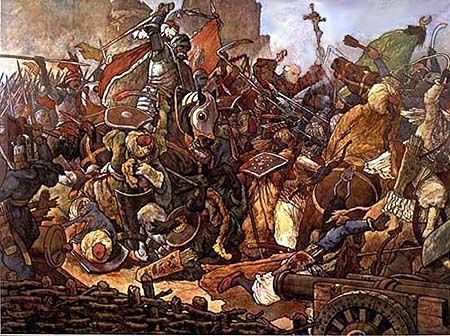
forces. He led an army of 70,000 Christian soldiers to Belgrade, and
when it appeared that they were outmatched by the Muslim army, he ran to
the front lines. Holding his crucifix up high, this thin, small old man
kept crying, "Victory, Jesus, victory!"
Full of courage in Christ, the Christian army won an overwhelming
victory and freeing the city from siege. Worn out by his age and
efforts, Saint John succumbed to the infections present on the
battlefield and died several months later. “An infinity of miracles”
followed his death.
Saint
John of Capistrano was a man of action, who gave up a successful and
lucrative career and life to follow Christ. His commitment to the Word
of God reminds us that the highest goal of this life is not worldly
honors, but union with God in heaven. On his tomb in the Austrian town
of Villach, the following message is inscribed: "This
tomb holds John, by birth of Capistrano, a man worthy of all praise,
defender and promoter of the faith, guardian of the Church, zealous
protector of his Order, an ornament to all the world, lover of truth and
religious justice, mirror of life, surest guide in doctrine; praised by
countless tongues, he reigns blessed in heaven."
From the writings of Saint John of Capistrano:
“Those who are called to the table of
the Lord must glow with the brightness that comes from the good example
of a praiseworthy and blameless life. They must completely remove from
their lives the filth and uncleanness of vice. Their upright lives must
make them like the salt of the earth for themselves and for the rest of
mankind. The brightness of their wisdom must make them like the light of
the world that brings light to others. They must learn from their
eminent teacher, Jesus Christ, what he declared not only to his apostles
and disciples, but also to all the priests and clerics who were to
succeed them, when he said, “You are the salt of the earth. But what is
salt goes flat? How can you restore its flavor? Then it is good for
nothing but to be thrown out and trampled underfoot.” Jesus also said:
“You are the light of the world.” Now a light does not illumine itself,
but instead it diffuses its rays and shines all around upon everything
that comes into its view. So it must be with the glowing lives of
upright and holy clerics. By the brightness of their holiness they must
bring light and serenity to all who gaze upon them. They have been
placed here to care for others. Their own lives should be an example to
others, showing how they must live in the house of the Lord.”
Lord, you raised up Saint John of Capistrano to give your people comfort in their trials. May your Church enjoy unending peace and be secure in your protection. We ask this through our Lord Jesus Christ, your Son, who lives and reigns with you and the Holy Spirit, one God, for ever and ever. Amen.
The letter of St John Capistrano to St Colette November 1442
It
can be your greatest friends that cause you the greatest anguish. St
John wanted Colette to join his reform of the Franciscan order, accept
his constitutions and submit to the jurisdiction of the friars he would
appoint as visitators. He was full of sincere enthusiasm for the
restoration of the Franciscan order - but he was not a Poor Clare and he
had never lived the life Colette professed. Colette and her sisters
prayed desperately to God that God would enlighten John’s heart and
mind. And God did. John completely reversed his position. Not only
did he not interfere with the life of the Sisters he place the Friars
who had joined Colette’s reform under her jurisdiction and empowered her
to appoint her own visitators. This is unique in Church legislation!
To
Sister Colette of the Order of St. Clare, entirely devoted to Christ
our Lord, our very dear daughter in the heart of the Spouse of virgins,
John Capistran of the Order of Minors, on the part of the Apostolic See
and the Most Reverend Father General wishes health and everlasting peace
in the Lord.
Desiring, with a father’s affection, to console you
in the Lord, I ratify and I confirm by these letters present, and
declare ratified and confirmed all the favours which the Most Reverend
Minister-General has accorded you and your chaplain, Pierre de Vaux, and
the chaplains of the convents of nuns which you have built and will
build
I declare that you have power to appoint one or more friars
of our Order to fill the office of Visitator of the nuns in the said
convents, or of friars who live in monasteries (of your way of life). To
these friars so chosen, in virtue of these letters present, I accord
and declare accorded the same faculties and the same power that
preceding Ministers General have heretofore given these Visitators.
I
ordain, in virtue of holy obedience, that the friars so named accept,
the office of Visitator with respect, and that they fulfil it with
diligence and devotion.
Given by me, at Besançon, the eighth day of the month of November, in the year of our Lord, 1442.
On the memorial of St. Peter of Alcantara (Oct. 19th), Fr. George
preached on this Franciscan's remarkable life of extreme penance and
lofty contemplation, and explains that although many can't imitate his
austerities, we must strive to live a continual life of penance and
sacrifice.
Ave Maria!
Born at Alcántara, Spain,
1499; died 18 Oct., 1562. His father, Peter Garavita, was the
governor of the place, and his mother was of the noble family of
Sanabia. After a course of grammar and philosophy in his native town,
he was sent, at the age of fourteen, to the University
of Salamanca. Returning home, he became a Franciscan in
the convent of
the Stricter Observance at Manxaretes in 1515. At the age of
twenty-two he was sent to found a new community of the Stricter
Observance at Badajoz.
He was ordainedpriest in
1524, and the following year made guardian of the convent of
St. Mary of the Angels at Robredillo. A few years later he began
preaching with much success. He preferred to preach to the poor; and
his sermons,
taken largely from the Prophets and Sapiential Books, breathe the
tenderest human sympathy. The reform of the "Discalced Friars"
had, at the time when Peter entered the order, besides
the convents in Spain,
the Custody of Sta. Maria Pietatis in Portugal,
subject to the General of the Observants.
Having been elected minister of St.
Gabriel's province in 1538, Peter set to work at once. At the chapter
of Plasencia in
1540 he drew up the Constitutions of the Stricter Observants, but his
severe ideas met
with such opposition that he renounced the office of provincial and
retired with John
of Avila into the mountains of Arabida, Portugal,
where he joined Father Martin a Santa Maria in his life
of eremitical solitude.
Soon, however, other friars came
to join him, and several little communities were established. Peter
being chosen guardian and master of novices at
the convent of
Pallais. In 1560 these communities were erected into the Province of
Arabida. Returning to Spain in
1553 he spent two more years in solitude, and then journeyed barefoot
to Rome,
and obtained permission of Julius
III to found some poor convents in Spain under
the jurisdiction of
the general of the Conventuals.
Convents were established at Pedrosa, Plasencia,
and elsewhere; in 1556 they were made a commissariat, with Peter as
superior, and in 1561, a province under the title of St. Joseph. Not
discouraged by the opposition and ill-success his efforts at reform
had met with in St. Gabriel's province, Peter drew up the
constitutions of the new province with even greater severity. The
reform spread rapidly into other provinces
of Spain and Portugal.
In
1562 the province of St. Joseph was put under the jurisdiction of
the general of the Observants, and two new custodies were formed: St.
John Baptist's in Valencia,
and St. Simon's in Galicia. Besides the above-named associates of
Peter may be mentioned St.
Francis Borgia,John
of Avila, and Ven.
Louis of Granada. In St. Teresa, Peter perceived a soul chosen
of God for
a great work, and her success in the reform of Carmel was in great
measure due to his counsel, encouragement, and defense. It was a
letter from St. Peter (14 April, 1562) that encouraged her to found
her first monastery at Avila,
24 Aug. of that year. St. Teresa's autobiography is the source of
much of our information regarding Peter's life, work, and gifts
of miracles and
prophecy.
Perhaps the most remarkable of
Peter's graces were
his gift of contemplation and the virtue of penance. Hardly less
remarkable was his love of God,
which was at times so ardent as to cause him, as it did St.
Philip Neri, sensible pain, and frequently rapt him into ecstasy.
The poverty he practiced and enforced was as cheerful as it was real,
and often let the want of even the necessaries of life be felt. In
confirmation of his virtues and mission of reformation God worked
numerous miracles through
his intercession and by his very presence. He
was beatified by Gregory
XV in 1622, and canonized by Clement
IX in 1669. Besides the Constitutions of the Stricter
Observants and many letters on spiritual subjects, especially to St.
Teresa, he composed a short treatise on prayer,
which has been translated into all the languages of Europe.
His feast is
October 22nd for the Franciscans (often seen as October 19th for the
general calendar).
TREATISE ON PRAYER AND MEDITATION
by
St. Peter of Alcantara
Chapter I.
Of the Fruit to be Derived from Prayer and
Meditation
SINCE this short treatise speaks of prayer and meditation, it will
be well to state in a few words what is the fruit which may be
derived from this holy exercise, so that men may give themselves to
it with more willing heart. It is a well known fact that one of
the greatest hindrances we have to attaining our final happiness and
blessedness, is the evil inclination of our hearts, the difficulty
and dullness of spirit we have in respect to good rules; for, if this
was not in the way, it would be the easiest thing possible to run in
the path of virtues, and attain to the end for which we were
created. Concerning which the Apostle says, "I delight in
the Law of God, according to the inward man; but I see another law in
my members warring against the law of my mind, and bringing me into
captivity to the law of sin." (Rom. 7:22-23) This, then,
is the universal cause of all our evil. One of the most
efficacious means for overcoming this dullness and difficulty, and
for facilitating this matter, is devotion; for as St. Thomas says,
"Devotion is nothing else than a certain readiness and aptitude
for doing good." For this takes away from our mind all
that difficulty and dullness, and makes us quick and ready for all
good. It is a spiritual refection, a refreshment, like the dew
of Heaven, a breath and inspiration of the Holy Spirit, a
supernatural affection. It so orders, strengthens, and
transforms a man's heart, that it imparts a new taste and inspiration
for spiritual things, a new distaste and abhorrence for sensible
things. The experience of every day shows us this. For
when a spiritually minded person rises from deep devout prayer, then
straight away all his good resolutions are renewed, together with
fervor and determination to do good; the desire then to please, and
to love, a Lord so good and kind as He has then shown Himself to be,
a willingness to endure fresh troubles, and chastenings, even to
shedding blood for His sake, then, finally, all the freshness of soul
is renewed and blooms again.
If you ask me, by what means so powerful and noble an
affection of devotion is attained, the same holy teacher answers that
it is by meditation and contemplation of diving things; for
from deeply meditating and pondering over these things there springs
up this disposition, and affection in the will, which is called
devotion; and this stirs and moves us to all good. It is
on this account that this holy and religious exercise is so extolled
and commended by all the Saints, as being The Means of acquiring
devotion, which, though it is but one virtue only, yet it disposes
and moves one to all the other virtues, and exists as a general
stimulus to them all.
If you would see how true this is, hear how plainly St.
Bonaventure declares it in these words:
"If you would suffer patiently the adversities and
miseries of this life, be a man of prayer. If you would gain
power and strength to overcome the temptations of the enemy, be a man
of prayer. If you would mortify your will with all its
affections and lusts, be a man of prayer. If you would
understand the cunning devices of Satan, and defend yourself against
his deceits, be a man of payer. If you would live joyfully, and
with sweetness walk in the path of penitence and sorrow, be a man of
prayer. If you would drive out the troublesome gnats of vain
thoughts and cares from your soul, be a man of prayer. If you
would sustain your soul with the richness of devotion, and kept it
ever full of good thoughts and desires, be a man of prayer. If
you would strengthen and confirm your heart in the pilgrimage with
God, be a man of prayer. Lastly, if you would root out from
your soul every vice and in their place plant the virtues, be a man
of prayer, for in this is obtained the unction and grace of the Holy
Spirit who teaches all things.”
"And besides all this, if you would climb to the
height of contemplation, and delight in the sweet embraces of the
Bridegroom, exercise yourself in prayer, for this is the way by which
the soul mounts up to contemplation and to the taste of heavenly
things.
"You see, then, of how great virtue and power is
prayer, and for proof of all that has been said (to say nothing of
Holy Scripture) let this now be sufficient assurance that we have
seen and heard, and see, day by day, many simple persons who have
attained to all these things above mentioned and to others greater,
through the exercise of prayer."
Thus far the words of St. Bonaventure. Then, what richer treasure?
What field can be found more fertile, yielding more abundantly than
this? Hear also what another most religious and holy doctor,
speaking of this same virtue, says:
"In prayer the soul is cleansed from sin, pastured
with charity, confirmed in faith, strengthened in hope, gladdened in
spirit. By prayer the inward man is directed aright, the heart
is purified, the truth discovered, temptation overcome, sadness
avoided, the perceptions renewed, languishing virtue restored,
lukewarmness dismissed, the rust of vices done away; and in it
there do not cease to come forth living sparkles of heavenly desires,
with which the flame of divine love burns. Great are the
excellencies of prayer, great are its privileges! Before it
Heaven is opened, secrete things are made manifest, and to it the
ears of God are ever attentive." (St. Lawrence Justinian, In
Signo Vitae)
This now is sufficient to show in some way what is the fruit of
this holy exercise.
Chapter II.
Of the Subject Matter of Meditation
HAVING seen what fruit may come of Prayer and Mediation, let us
now see what are the things on which we should meditate.
To which the answer is, that inasmuch as this holy exercise is
ordained to create in our hearts the love and fear of God, and to
lead us to keep His Commandments, the most fitting subject for this
exercise will be that which should most surely lead to the end
proposed. And although it be true that all created things,
whether earthly or heavenly, may move us to this, yet, generally
speaking, the Mysteries of our Faith which are contained in the
Creed, are the most efficacious, and profitable. For here are
treated the subjects of the Divine blessings, the Last Judgment, the
pains of Hell, and the glory of Paradise, where there are the most
powerful stimulants to move our hearts to the love and fear of God;
and in it are treated also the Life and Passion of Our Savior Christ,
in which consists all our good. These two subjects especially
are treated of in the Creed, and are those on which we for the most
part make our Meditations. And therefore, with much reason it
is said, that the Creed is the most fitting subject for this holy
exercise, although at the same time, there may be with every one some
subject which might more especially move his heart to the love and
fear of God.
Agreeably, then, with this, in order to help on
the young who are now entering upon this path, to whom we should give
food which has been, as it were, already digested, I will now briefly
set forth two kinds of Meditation for all the days of the week.
Taken, for the most part, from the Mysteries of our Faith, some are
for the evening, and some for the morning; so that, as we give
our bodies their two meals each day, so should we give our souls,
whose food is Meditation and the consideration of things Divine.
Of these Mediations, some are upon the Mysteries of Sacred Passion
and Resurrection of Christ, and some upon the other Mysteries of
which I have spoken. Those who have not time to make such
retirement twice in the day, will, at least, be able to mediate one
week upon the former mysteries, and another week upon the latter.
Or, they may fine themselves entirely to those on the Passion and
Life of Jesus Christ, which are the principal ones; although it
would not be well, in the beginning of the soul's conversion, to omit
the others, seeing that they are especially suitable at such time
when the fear of God and detestation of our sins are to be chiefly
desired.
MEDITATION FOR MONDAY
On this day, you shall enter upon the memory of your sins, and
upon the knowledge of yourself, to see how many evil things you have
done, and to see that you have nothing that is good save from God.
For this consideration is the means of acquiring humility, the mother
of all the virtues.
Monday Morning Meditation
For this purpose you
must first think of the multitude of the sins of your past life,
especially of those committed in the days when you knew not God.
For if you consider them well, you will find that they are more in
number than the hairs of your head, and that you lived in that day
like the Gentile who knows not God. Consider then, briefly, the
Ten Commandments, and the Seven Deadly sins, and you will see that
there are none into which you have not often fallen, in deed or word
or thought. Let your mind, then, rest upon the Divine
Blessings, and upon your past time, and consider how you have made
use of them. For you have to give an account of all these
before God. Tell me, then, how have you used the days of your
childhood, your youth, your manhood, indeed all the days of your past
life?
In what way did you use your bodily senses, and the
powers of your soul, which God gave to you for the purpose of knowing
and serving Him? In what did you use your eyes, except in things of
vanity?
In what did you use your ears, except to hear things of
falsehood; in what your tongue, except in all manner of rash
oaths and murmurings? and your taste and all your senses, except in
sensual pleasures and flattery?
How have you profited by the Holy
Sacraments, which God ordained for your assistance?
What
thanksgivings have you made for all His benefits?
How have you
responded to His inspirations?
How have you used your health and
strength, your natural talents, your earthly goods, your
opportunities and occasions for living well?
What care have you
taken of your neighbor whom God commended to you, and what works of
mercy towards him can you show?
Then what will you answer on that day of reckoning when God shall
say unto you: "Give an account of your stewardship."
O withered tree, destined for eternal torments! What will you
answer on that day, when there shall be required from you the account
of your whole life, and of every point and moment in it? Think, next,
of the sins which you have committed, and do each day commit, even
after your eyes have been opened to the knowledge of God, and you
will find that the old Adam still lives in you, with many of the old
roots and habits. See how you have stood aloof from God, how
unthankful you have been for His benefits, how rebellious against his
inspirations, how slothful in things concerning His service, which
you never performed with that readiness and diligence and purity of
intention which you do owe Him; nay, think of how you have discharged
them even for the sake of human respects and interests!
Consider, also, moreover, how hard you are towards your
neighbor, and how gentle with yourself; how you love your own will,
your self, your flesh, your honor, and your own interests!
See how
you are always proud, ambitious, quick to anger, vainglorious,
envious, malicious, prone to amusement, inconstant, full of levity,
sensual, given to recreations, laughter and idle talk. See,
too, how inconstant you are in good purposes, how inconsiderate in
your words, and imprudent in your deeds, and how cowardly and
half-hearted in any matter of importance.
And further, after you have taken note of the multitude of
your sins, consider then their gravity, so that you may see how on
all sides your misery has grown upon you. For this you should,
in the first place, think of these three circumstances in your past
life, namely,
Against Whom have you sinned?
For what end did you
sin?
And in what way?
If you think, against Whom you did sin, you will find that it was
against God, whose goodness and majesty are infinite, whose blessings
and mercies to man are more in number than the sands of the
sea-shore. Or if you think, for what end you did sin, it was
for some point of honor, some foul lust, or some trivial interest, or
very often for something of no interest whatsoever, for no other
reason than habit, and disregard for God. Or if you think, in
what way you did sin, it was with such ease and audacity as to be
without scruple or fear; nay, at time with such ease and content as
if you were sinning against a god made of wood who neither knew nor
saw anything that was done on earth. Is this the honor which is
due to so great a Majesty? Is this the thanks you gave for so
great blessings? Is this the return you make for that most
Precious Blood shed upon the Cross, for those scourgings and
buffetings endured on your behalf? O miserable you, for what
you have lost, and more for what you have gained for yourself, and
much more still, if with all this, you do not sense your impending
perdition!
Monday Evening Meditation
After all this it is
most profitable to let your thoughts rest a while on the
consideration of your nothingness; that is, how you have by
yourself nothing, but sin, or in other words, nothingness; how
all else is from God alone. For it is clear that as all natural
gifts, so those too, of grace, which are greater, are His only.
From him is the grace of predestination, which is the source of all
other graces; from Him the grace of our vocation, and all the
grace accompanying it; from Him the grace of perseverance, and
that of life eternal.
What have you, then, from which to glory, save your nothingness
and sin?
Rest, then, awhile in the consideration of that
nothingness, and take note that this, and all else, comes from God;
so that you may see clearly and manifestly what you are, and what He
is; how poor you are, and how abundant in riches he is; and,
consequently, how little you can trust in and esteem yourself,
and how greatly you can trust in Him, love Him, glory in Him!
Then, having considered all these things, think of yourself
with thoughts most lowly. Ponder that you are nothing but "a
reed shaken in the wind." of no weights, or virtue, or firmness,
or steadfastness or anything else. Ponder that you are another
Lazarus, dead for four days, a carcass foul-smelling and abominable,
so much that they who pass by cover their noses, and shut their
eyes. Judge on your own that this is what you are before God
and His angels, and hold yourself to be unworthy to lift your eyes up
to Heaven, or that this earth should bear you, or that creatures
should serve you; unworthy of the bread which you eat and of the air
which you breathe. With that sinner of the street, cast
yourself down at the Savior's feet, with your face covered in
confusion and shame like the woman taken in adultery; and with much
sorrow and compunction of heart, beg of Him pardon for your sins, and
that, out of His infinite pity and mercy, He may vouchsafe to turn to
you, and receive you into His house.
THE SECOND PART OF THIS TREATISE WHICH SPEAKS OF DEVOTION
Chapter I.
What is Devotion?
THE greatest trouble those persons suffer from who give themselves
to Prayer is the failing in Devotion which they so often experience
in it. When there is no such failing, there is nothing sweeter,
or more easy that to pray. For this reason, now that we have
treated upon the subject-matter of Prayer, and upon the manner of
praying, it will be well to consider the things which help Devotion,
and also those which hinder it, and the temptations which most often
assail devout people in it; and certain other points that are
necessary to observe in this exercise. But first it will
greatly help the matter to set forth what Devotion is, that we may
know to begin with, what is the precious thing for which we are
contending.
Devotion, says St. Thomas Aquinas, is a power which makes one
prompt and ready for any virtue, and stirs and helps one to do well.
(Summa II, II, Q. 82, Art. 1.) This definition declares
manifestly the great necessity and usefulness of this power, for it
contains in itself more than some would think. We have on this
account to consider that the chief hindrance to living a good life is
the corruption of human nature which came to us through sin, and from
which comes the great inclination we have towards evil, and the
difficulty and unwillingness we have in respect to what is good.
These two things make the path of virtue most difficult to us, while
in itself it is the thing most sweet, most beautiful, most to be
desired, most honorable in the world. It is against this
difficulty and unwillingness the Divine Wisdom has provided this most
complete remedy in the power and succor of Devotion. For as the
north wind disperses the clouds, and leaves the sky clear and serene,
so true Devotion drives away from our mind all that unwillingness and
difficulty, and leaves it then free and disposed for all that is
good. This virtue so become as power within us as being at one
a very special gift of the Holy Spirit, a heavenly dew, a succor and
visitation of God attained through Prayer. Its very nature is
to contend against the difficulty of which we have spoken, and to
overcome this luke-warmness, to give us readiness and fill the soul
with good desires, to enlighten the understanding, to strengthen the
Will, to kindle in us the Love of God, to extinguish the flame of
evil desires, to teach hatred of worldly things, and abhorrence of
sin, and to give us new fervor, new spirit, new power, and incentive
to well doing.
For as Samson, wile possessed of his hair, had greater
strength than any man in the world, and when this was taken away from
him, became as weak as other men; so is the Christian soul strong
when he has this Devotion, and weak when he has it not.
And this is what St. Thomas desired to show in his definition,
and, without doubt, this is the greatest praise one could give to
this virtue, that, being of itself only one virtue, it is a stimulus
and incentive to all others. Let not him then that would travel
by the path of virtues, go without these spurs; for without
them he will never be able to arouse the evil beast of his nature
form is sluggishness.
From what has been said it will be clearly
seen, then, what is true and real Devotion. For Devotion is not
a certain tenderness of heart, or sense of consolation which those
who pray feel sometimes, unless there be also a promptitude and
disposition for good works, for, when at times God would prove who
are His own, it often happens that the one is found and not the
other. The truth is that form this Devotion and readiness there
often arises the consolation spoken of: and, on the other hand,
that very consolation and spiritual delight will increase the
Devotion itself, which is the readiness and incentive to well-doing.
And, therefore, God's servants may, with good reason, desire and ask
for these joys and consolations, not for the pleasure they give, but
because they are the means of increasing the Devotion which fits them
for well-doing, as the Prophet showed when he said, "I will
run the way of Thy commandments, when Thou has set my heart at
liberty," (Ps. 119:32) that is, with the joy of Thy
consolation which was the cause of my readiness.
And now let us proceed to treat of those means by which this
Devotion is to be attained, and, since with this virtue are united
all others leading to the special knowledge of God, we will consider
the means of attaining to the perfection of Prayer and Contemplation,
to the consolations of the Holy Spirit and the love and wisdom of
God, and to that union of our souls with God, which is the goal of
all spiritual life.
And this, lastly, is to consider the mans by
which we may attain to the possession of God Himself in this life,
which is that Treasure of the Gospel, the "Pearl of great
price" for the possession of which the husbandman joyfully
despoiled himself of all that he had.
Hence it is we see that the highest aim of our theology is,
that from it we may learn the way to the Supreme Good, and may make
this life to become a ladder by which we may advance step by step to
the eternal happiness awaiting us.
Taken from the English Translation, A Golden Treatise on Mental
Prayer, edited by G. S. Hollings, S.S.J.E., (reedited by the
Franciscan Archive), publ. by A. R. Mowbray & Co. Ltd., 1904:
a non-copyrighted edition.
(As there is no picture of Bl. Josephine, I use an old photo of a Poor Clare nun above as I didn't want to have a post with no pictures!)
Blessed Josephine Leroux entered the convent of the Poor Clares at
Valenciennes when she was 22 years old. In 1770 she made her vows. Then
the French Revolution broke out, and the religious were rudely driven
from their convents.
Josephine at first returned to her family. But when Valenciennes
was captured by the Austrians, Josephine could not resist the impulse to
return to the enclosure. However, the convent of the Poor Clares at
Valenciennes had not yet been rebuilt, and she took refuge in the
convent of the Ursulines, where her own sister lived.
But the victorious revolutionary army retook the city, and
Josephine was placed under arrest as having been disloyal to her
country. Without being in any way perturbed, she confronted the band of
soldiers who came to arrest her and she said, "It was hardly necessary
to make so much ado for the purpose of taking a weak woman captive!"
Then, having served her captors with refreshments, she followed them to
prison.
Because she had resumed the life of a religious contrary to the laws,
Josephine was condemned to death. With holy serenity and perfect
resignation to God's holy will she accepted the death sentence and
prepared for it by receiving the Bread of Heaven for her journey to the
Divine Bridegroom. With a cheerful countenance she went out to the place
of execution, singing sacred hymns along the way. She declared herself
truly fortunate at being deemed worthy to give her life for the Catholic
Faith.
"Could anyone fear to leave this place of exile," she said, "when he reflects on the beauty of Paradise?"
At the scaffold she gratefully kissed the hand of the
executioner, and in a clear voice forgave everybody. Then she placed her
head on the block. Her sister, Mary Scholastic, and four other
companions died a martyr's death with her. This occurred on October 23,
1794. Pope Benedict XV enrolled her among the blessed.
God our Father, You give us joy each year in honoring the memory of
blessed Josephine. May her prayers be a source of help for us, and may
her example and chastity be our inspiration.
from: The Franciscan Book Of Saints, ed. by Marion Habig, OFM