Friday, August 2, 2013
For the August 2nd Feast of Our Lady of the Angels of the Portiuncula
Fr. Elias preaches on the Franciscan Feast of the Portiuncula, commemorating the Chapel of Our Lady of the Angels which was very small and so called The Little Portion, the Portiuncula where Our Lady gave so many blessings and increase in members to the newly formed Franciscans. Father explains how this Chapel has a plenary indulgence for visiting it on this day, what this means and how to get it.

The Crucifix of San Damiano - A More Detailed Explanation

The
History of the San Damiano Crucifix
An unknown Umbrian artist painted the
Crucifix Icon in the 12th Century. There is strong Syrian influence, and history tells us
that there had been some Syrian monks in the area.
It is painted on wood (walnut) to which cloth had been glued. It is about 190 cm high, 120 cms wide and 12 cms thick. It is more than likely it was painted for San Damiano to hang over the Altar as the Blessed Sacrament was not reserved in non Parish Churches of those times and especially those that had been abandoned and neglected as we know San Damiano had been. In 1257 the Poor Clares left San Damiano for San Giorgio and took the Crucifix with them. They carefully kept the Cross for 700 years. In Holy Week of 1957, it was placed on public view for the first time over the new Altar in San Giorgio's Chapel in the Basilica of St Clare of Assisi.
The Icon of
the Transfigured Christ
For Eastern Christians the Icon is a
representation of the living God, and by coming into its presence it becomes a personal
encounter with the sacred, through the grace of the Holy Spirit. The San Damiano Icon is
then a personal encounter with the transfigured Christ - God made man. The Crucifix
contains the story of the death, resurrection and ascension into glory. It expresses the
total and universal Paschal Mystery of Christ. It invites us all to take part in it with a
lively and lived faith, just as St Francis did. Christ's saving death is shown in John's
Gospel in its serene majesty, and this Crucifix portrays this in picture form. It is not
surprising that Saint Francis was attracted to this Icon and that the inspiration for his
life came from this Christ who spoke to him "Go repair my Church ... ".
The Figure of
the Christ
The central figure of the icon is
Christ, not only because of the relative size, but because Christ is a figure of light
dominating the scene and giving light to the other figures "I am the light of the
world. Whoever follows me will not walk in darkness, but will have the light of life.
" (John 8:12). Christ stands upright, not nailed. The eyes of Jesus are open: He
looks out to the world, which He has saved. He is alive, the one who is eternal. Jesus'
vestment is a simple loin cloth - a symbol of both High Priest and Victim. The chest,
throat and neck are very strong, Jesus gives power of re-creation to His Disciples (John
22:23). He breathed on His Disciples (John 20:22), the Greek word used recalls the moment
of Creation (Gen 2:7). The shadow over the face of Jesus is increased by the fact the halo
and face are tilted forward on the original Icon. The humanity of Christ veils the true
glory of the Word who lives in the super illuminous darkness of the Godhead. Behind the
outstretched arms of Christ is His empty tomb, shown as a black rectangle.
The Medallion
and Inscription
 The Ascension is portrayed within this circle of red: Christ is breaking out of the
circle, holding a golden cross which is now His Royal Scepter. His garments are gold - a
symbol of royalty and victory. His red scarf is a sign of His Dominion and Kingship;
exercised in love. Angels welcome Him into Heaven. IHS are the first three letters of the
name of Jesus. The little bracket above indicates it is shorthand. NAZARE is the Nazarene;
REX is' king' and IUDEORUM is 'of the Jews', which is reported in St John's Gospel
"Jesus the Nazarene, King of the Jews".
The Hand of
the Father
 From within the semi-circle at the very top of the Icon, He whom no eye has seen reveals
Himself in a benediction. This blessing is given by the right hand of God with the finger
extended - the Holy Spirit. The Father gives the gift of the Holy Spirit to all because of
the merits of the Christ's Passion. |
 The
Mystical Vine
Around the Cross are various
calligraphic scrolls which may signify the mystical vine "I am the vine, you are the
branches... " (John 15), which also contain the words "Greater love has no
one than this, that one lays down one 's life for one friends ". At the base of
the cross there seems to be a section that looks like a rock - the symbol of the Church.
The seashells are symbols of eternity - a mystery hidden in the vast and timeless sea of
eternity is revealed.
|
Mary and
John
 As in John's Gospel, Mary and John are placed side by side. Mary's mantle is white meaning
victory (Rev 3:5), purification (Rev 7:14); and good deeds (Rev 19:8). The gems on the
mantle refer to the graces of the Holy Spirit. The dark red worn under the mantic indicate intense love, while the inner dress is purple - the Ark of the Covenant (Ex 26: 1-4). Mary's left hand is raised to her cheek - her acceptance and love of John, and her right hand points to John while her eyes proclaim acceptance of Christ's words "Woman, behold your son... " (John 19:26). The blood drips on to John at this moment. John's mantle is rose color indicating eternal wisdom, while his tunic is white - purity. His position is between Jesus and Mary as is fitting for the disciple loved by both of them. He looks at Mary "Son, behold your Mother", but points to Christ.
Numbers
There are 33 figures in the Icon -
Two Christ figures, 1 Hand of the Father, 5 major figures, 2 smaller figures, 14 angels, 2
unknown at His hands, 1 small boy, 6 unknown at the bottom of the Cross and one rooster.
There are 33 nail heads along the frame just inside the shells and seven around the halo.
The Other Major
Figures:
Mary
Magdalene
Mary Magdalene is next to Christ
making her very special; her hand is on her chin indicating a confided secret "He is
risen ". She wears scarlet, which is a symbol of love; her mantle of blue deepens
this.
 Mary Clopas
Some authorities make her the mother
of James. She wears garments of an earthen color a symbol of humility, and her light green
mantle - hope. Her admiration of Jesus is indicated by the gesture of her hand.
The Centurion
of Capernaum
He holds a piece of wood in his left
hand, indicating his building of the Synagogue (Luke 7: 1 - 10). The little boy beyond his
shoulder is his son healed by Jesus. The three heads behind the boy show "he and
his whole household believed" (John 4: 45 - 54). He has extended his thumb and
two fingers, a symbol of the Trinity, while his two closed fingers symbolize the hidden
mystery of the two natures of Jesus the Christ. "Truly He is the Son of God"
(Mark 15:39).
The Lesser Figures: Longinus
The Roman soldier who pierced Jesus'
side with a lance.
Stephen
Tradition gives this name to the
soldier who offered Jesus a sponge soaked in vinegar wine after Jesus cried out "I
thirst" (John 19: 28 -30).
|
The
Unknown Saints
 At the bottom of the Icon are six unknown saints whom Scholars postulate are STs Damian,
Rufinus, Michael John the Baptist, Peter and Paul, all patrons of Churches in the Assisi
area. St Damian was the Patron of the Church that housed the Cross and St Rufinus was the
Patron Saint of Assisi. There is too much damage of that area to make a proper
identification. |
The
Astonished Angels
 There sat two groups of angels - animatedly discussing the scene unfolded before them. "For God so loved the world that He gave His only begotten Son, that whosoever believes in Him shall not die but have life everlasting" (John 3:16).
The Tomb

As mentioned before behind Christ is the open tomb;
Christ is alive and standing over the tomb. The red of love overcomes the black of death.
The gestures of the unknown saints at His hands indicate faith. Could these be Peter and
John at the empty tomb? (John 20: 3 - 9).
The Rooster
Firstly, the inclusion of the rooster
recalls the denial of Peter who wept bitterly. Secondly, the rooster proclaims the new
dawn of the Risen Christ 1 the true light (1 John 2:8). "But for you who revere my
name, the Sun of Righteousness will rise with healing in its wings" (Malachi 4:2 or
3:20 depending on your translation).
The Shape of
the Cross
The shape of the Cross has changed to
enable the artist to include all who participated in the drama of the Passion. Note that
the arms of the cross lift to Christ's right indicating that the Good Thief (traditionally
called Dismas) went to Heaven; while the left hand dips - the other thief did not.
(above from http://www.franciscanfriarstor.com/archive/stfrancis/stf_san_damiano_cross.htm)
|
San Damiano Cross - A Brief Explanation
 |
PRAYER BEFORE A CRUCIFIX
St. Francis of Assisi
We
adore you,
Lord Jesus Christ, here and in all your churches in the whole world, and we bless you, because by your holy cross you have redeemed the world. |
A Brief Explanation
By: Fr. Michael Scanlon, T.O.R.
Most Sacred Heart of Jesus Province, USA
By: Fr. Michael Scanlon, T.O.R.
Most Sacred Heart of Jesus Province, USA
The San Damiano Cross
is the one St. Francis was praying before when he received the commission from the Lord to
rebuild the Church. The original cross presently hangs in Santa Chiara (St.Clare) Church
in Assisi, Italy. All Franciscans cherish his cross as the symbol of their mission from
God. The cross is called an icon cross because it contains images of people who have a
part in the meaning of the cross. The tradition of such crosses began in the eastern
Church and was transported by Serbian monks to the Umbria district of Italy.
The San Damiano Cross was one of a number of crosses painted with similar figures during the 12th century in Umbria. The name of the painter is unknown. The purpose of an icon cross was to teach the meaning of the event depicted and thereby strengthen the faith of the people. These conclusions have been reached based on a thorough study of the history of the cross and the literature concerning it. Very little literature is available in English. Most of it can only be read in Italian or French. The author also found it very helpful to compare the cross to similar crosses in Umbrian art.
The San Damiano Cross was one of a number of crosses painted with similar figures during the 12th century in Umbria. The name of the painter is unknown. The purpose of an icon cross was to teach the meaning of the event depicted and thereby strengthen the faith of the people. These conclusions have been reached based on a thorough study of the history of the cross and the literature concerning it. Very little literature is available in English. Most of it can only be read in Italian or French. The author also found it very helpful to compare the cross to similar crosses in Umbrian art.
Finally, much of the
English literature on the cross is faulty in its analysis since it dates back to sources
prior to 1938 when the cross was restored to its original depiction.
Reflections on The Cross of San Damiano
By Patrick McNamara, OFM,Cap.
By Patrick McNamara, OFM,Cap.
I look to the Cross,
I gaze upon its figure,
I wait, I listen, I hope.
I wait, I listen, I hope.
Will you speak, will
you move, will I be moved.
Will you once again
touch the heart of one who seeks.
Of one who questions, of one who seems so lost.
Of one who questions, of one who seems so lost.
Will you embrace the
soul, as you did that of Francis.
Will you take it to Yourself.
Will you take it to Yourself.
Will you give it
peace, give it comfort, give it love
This soul waits,
listens, prays for such grace.
This soul seeks the Love from the Lover.
This soul seeks the Love from the Lover.
It wavers. It
stumbles. It falls.
Your gaze looks down,
embraces all.
Takes all, Loves All. Your Grace heals, accepts.
Takes all, Loves All. Your Grace heals, accepts.
Again you respond,
Again you Love.
Again you speak to a searching and troubled heart.
I turn. I continue the journey. I continue in Hope.
I too have heard you Speak.
Again you speak to a searching and troubled heart.
I turn. I continue the journey. I continue in Hope.
I too have heard you Speak.
(above from http://www.franciscanfriarstor.com/archive/stfrancis/stf_san_damiano_cross.htm)
Thursday, August 1, 2013
For Today's Feast of Our Lady of the Angels of Portiuncula - The Portiuncula Indulgence

The first written document we have regarding this indulgence is dated October 31, 1277, some sixty years after the indulgence is said to have been granted.
The
Portiuncula is an ancient church dedicated to Mary under the title Our Lady of the Angels
and is located in Assisi, Italy. It was a spot very dear to the heart of Saint Francis.
The Porziuncola is the place where Franciscanism developed, and
where Saint Francis lived and died . The chapel, of antique construction and venerated for the apparition of Angels within it, belonged to the Benedictine monks of Subasio. It was on a piece of land called "Portiuncula" and later, the name of the land passed to the little church itself.
It was abandoned for a long time and was restored by Saint Francis. It was here that he understood his vocation clearly and here that he founded the Order of the Friars Minor (1209) "establishing here his home", St. Bonaventure tells us, "because of his reverence for the angels, and of his great love of the Mother of Christ" to whom the little church was dedicated. The land and the Chapel were gifted to him by the Benedictines for making it the centre of his new religious family.
On 28 March, 1211 Clare, daughter of Favarone di Offreduccio received her religious habit here from the hands of Saint Francis and so initiated the Order of the Poor Clares.
In 1216, in a vision, St Francis obtained from Jesus himself the Indulgence of the Pardon of Assisi that was approved by Pope Honorius III. This plenary indulgence may ordinarily be gained on August 2 and 15; pilgrims may gain it once a year on any day of the year.
At the Porziuncola, that was and is the centre of the Franciscan Order, St Francis assembled all the Friars in the Chapter every year to discuss the Rule and to renew their dedication to the Gospel Life. The Chapter of Mats (Stuoie) in 1221 was attended by more than 5000 friars.
The Porziuncola is situated now inside the Basilica of Saint Mary of the Angels in the town of the same name around 5 km from Assisi.
Here he began and grew in his religious life; here he founded the Franciscan Order; here he manifested his love and great devotion to the Mother of God. When Francis knew he was dying, he requested to be brought to the Portiuncula to end his earthly life.
As we
honor Our Lady of the Angels, may we find inspiration for our own growth and development
in the Gospel way of life that Saint Francis embraced and lived so completly.
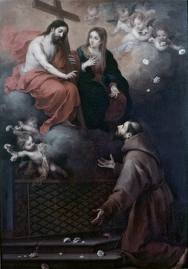
As we celebrate the Feast of Our Lady of the Angels of
Portiuncula, the words of Thomas of Celano account not only the
rebuilding of a church. His words account the simple and devout way in
which Francis desired with all his heart to imitate Christ. The words
divinely written in the gospels were Francis’ model for life.
From The Life of Saint Francis by Thomas of Celano:
From there he moved to another place, which is called the
“Portiuncula,” where there stood a church of the Blessed Virgin Mother
of God built in ancient times. At that time it was deserted and no one
was taking care of it. When the holy man of God saw it so ruined, he
was moved by piety because he had a warm devotion to the Mother of all
good and he began to stay there continually. The restoration of that
church took place in the third year of his conversion. At this time he
wore a sort of hermit’s habit with a leather belt. He carried a staff
in his hand and wore shoes.
One day the gospel was being read in that church about how the Lord
sent out his disciples to preach. The holy man of God, who was
attending there, in order to understand better the words of the gospel,
humbly begged the priest after celebrating the solemnities of the Mass
to explain the gospel to him. The priest explained it all to him
thoroughly line by line. When he heard that Christ’s disciples should
not possess gold or silver or money, or carry on their journey a wallet or a sack, nor bread nor a staff, not to have shoes nor two tunics,
but that they should preach the kingdom of God and penance, the holy
man, Francis immediately exulted in the spirit of God. “This is what I
want,” he said, “this is what I seek, this is what I desire with all my
heart.” The holy father, overflowing with joy, hastened to implement the
words of salvation, and did not delay before he devoutly began to put
into effect what he heard.
The origin of the Portiuncula Indulgence has been lost in the haze of centuries just as the origin of the chapel itself.

Our Lady Queen
of the Angels
Portiuncula Indulgence
(by Diana Serra Cary)
(excerpt reprinted
with permission from The Catholic Hearth magazine, "Our Lady Queen of the
Angels," by Diana Serra Cary, July-August 1994, pp. 43-45.)
One time when Francis was kneeling in prayer before the image of Our Lady, he seemed to behold men and women from every corner of the world converging upon this obscure little chapel in the Umbrian forest. He had been praying for the forgiveness of the sins of mankind when suddenly the dark interior seemed illumined by the light of a million candles. Jesus and Mary appeared in the midst of a dazzling cloud of angels, and he heard a voice that fell like music on his soul, "What do you wish me to do to help poor sinners?" Francis hardly knew how to answer, but suddenly the words came tumbling out and he asked the Lord to grant a full pardon to all who came to visit the church of Portiuncula and made a good confession. It then seemed that Jesus was in favor of this. He turned smilingly to His Mother and she, in turn, nodded to St. Francis and smiled.
Typical of the saint's impetuosity and generosity of soul, he marched off to see the Pope and beg from him the coveted indulgence. The reigning Holy Father, Honorius III, was literally dumbfounded at the request to grant such a generous indulgence. At that time, the summer of 1216, plenary indulgences were rarely granted by the Church. The plenary indulgences that had been granted were given to those fighting men who took up the cross and the sword and went as crusaders to the Holy Land. Later, this hard won indulgence was extended to those who remained at home but helped the Crusaders in supplying men and alms.
Francis, however, was not to be refused. The Lord Himself had promised him, and the Roman Curia was bound to relent! The Pope finally yielded and left it to the astonished cardinals to limit the application of the new indulgence. The date set was from vespers of the first of August until sundown on the second. It is said that Francis chose this date because the feast of the Chains of St. Peter (his release from prison) is celebrated on the first of August, and Francis felt that sinners should also be freed from the chains of their sins on the day following this great feast. Furthermore, this date was the anniversary of the consecration of the Portiuncula chapel.
As Francis took his leave of the Holy Father, after obtaining the unprecedented privilege, the Pope is said to have asked if he did not wish some document to prove that his request had been officially granted. With characteristic Franciscan lightheartedness came the saint's reply: "I need nothing more than your word. Our Lady is the parchment, Christ the notary, and the angels our witnesses!"
When the first great August first arrived, seven bishops gathered in the little chapel of Our Lady of the Angels to dedicate it as "Our Lady of the Angels of the Portiuncula." And St. Francis, overjoyed, cried out to the crowd that overflowed the narrow building, "I want to make all of you go to heaven!"
But at the time there seemed something almost scandalous in this indulgence, and conservative prelates did little to make it known. In St. Francis' own lifetime the Portiuncula Indulgence was enjoyed by comparatively few Christians. Travel and communications were slow, and not even such good news as a plenary indulgence could travel swiftly over the mud-choked trails that passed for roads in thirteenth-century Europe. Later, of course, the indulgence was extended to all Franciscan churches on August first and second.
This chapel was the saint's favorite spot on earth. It was here he heard the Gospel that caused him to establish his First Order, following the command of Christ to go into the world and preach and baptize all men, taking neither gold nor script nor an extra cloak for the journey. Here Francis received his first Brothers, and from here he sent them into the world. In this chapel, St. Clare knelt before the image of Our Lady of the Angels, and on the floor her golden tresses fell beneath the scissors plied by Francis himself. Indeed, Francis placed such a high value on this chapel, which he had rebuilt with his own hands, that he wrote a special rule just for "Portiuncula."
(excerpt reprinted with permission from The Catholic Hearth magazine, "Our Lady Queen of the Angels," by
HOW ST. FRANCIS ASKED AND
OBTAINED THE INDULGENCE OF FORGIVENESS
OBTAINED THE INDULGENCE OF FORGIVENESS
He awoke one night in 1216 at the Porziuncola and an
inspiration stronger than usual prompted him to arise and go into the little chapel. He
knelt in prayer and, as he prayed, our Lord, accompanied by His Mother, appeared to him
and bade him ask for that which he desired most. "0 God," he said,
"although I m a great sinner, I beseech You to grant a full pardon of all sins to all
who, having repented and confessed their sins, shall visit this church." And Jesus
said to him: "Francis, you ask much, but you are worthy of greater things, and
greater things you shall have."
Our Lord then granted Francis' request and told him to
go to His Vicar for ratification of the indulgence. Honorius III, who was just beginning
his Pontificate, was holding court at Perugia, and it was to him that Francis presented
his petition.
Honorius was a spiritual, unworldly man, yet at such a request he hesitated. "Holy Father," Francis said urgently, "a little while ago I restored a chapel for you in honour of the Virgin Mother of Christ (the Portiuncula), and I beseech you to bestow on it an indulgence."
Honorius was a spiritual, unworldly man, yet at such a request he hesitated. "Holy Father," Francis said urgently, "a little while ago I restored a chapel for you in honour of the Virgin Mother of Christ (the Portiuncula), and I beseech you to bestow on it an indulgence."
Honorius wanted to give Francis the document of the indulgence, but Francis saw no need for it. "What have you to show that this indulgence has been granted you?" the Pope asked in amazement as Francis prepared to depart for Assisi without any written confirmation of the great permission. "Holy Father," he replied, "Your word is enough for me. If this is the work of God, it is for Him to make His work manifest. I desire no other document. The Blessed Virgin Mary shall be the charter, Christ the notary, and the angels the witnesses." Some days later, before the Bishops of Umbria, Francis said: "Brethren, I want to send you all to Heaven!"
CONDITIONS TO OBTAIN
THE PLENARY INDULGENCE
OF THE FORGIVENESS OF ASSISI
(for oneself or for a departed soul)
THE PLENARY INDULGENCE
OF THE FORGIVENESS OF ASSISI
(for oneself or for a departed soul)
- Sacramental Confession to be in God's grace
(during the eight days before or after);
- Participation in the Holy Mass and Eucharist.
- Visit to a Catholic Church, followed by PROFESSION OF FAITH, in
order to reaffirm one's own Christian identity;
- Say the OUR FATHER, in order to reaffirm the dignity as child of God
that one received in Baptism;
- A prayer for the Pope's intention, in order to reaffirm one's
membership in the Church, of which the Roman Pontiff is the foundation and sign of visible
unity.
THE INDULGENCE
Italian Bishops' Conference, Adult Catechism, n. 710
Sin not only destroys communion with God, but also
compromises the interior state of persons and their relationship with other creatures. For
a total repentance, it is not enough to be sorry and to receive the remission of faults.
It is also necessary that reparation be made for the disorder provoked by sin, a disorder
that usually continues after the sin. In this process of purification the penitent is not
alone. The penitent participates in a mystery of solidarity, for which Christ and the
Saints rejoice with one. God communicates to one the grace merited by others with the
immense value of their existence, in order to effect one's reparation rapidly and
effectively.
The Church has always exhorted the faithful to offer prayers, good works and sufferings for the conversion of sinners and for the repose of the faithful departed. During the first centuries, bishops reduced the duration and the severeness of public punishment, through the intercession of the witnesses of faith who survived tortures.
Progressively the consciousness grew that the power to bind and unbind, received from the Lord, included the faculty to free penitents from the residue left by already forgiven sins, by applying to them the merits of Christ and the Saints, in order to obtain the grace of a fervent charity. Priests grant this privilege to those who have the right interior disposition and have adhered to the prescribed norms. Participation in this penitential rite is a prerequisite to the concession of an indulgence.
Italian Bishops' Conference, Adult Catechism, n. 710
(above from http://www.franciscanfriarstor.com/archive/stfrancis/stf_portuncula_indulgence.htm)
Today, August 2nd, is the Feast of Our Lady of the Angels of Portiuncula

Shrine of the Porziuncola
The Porziuncola is the place where Franciscanism
developed, and where Saint Francis lived and died.
The Porziuncola is situated now inside the Basilica of Saint
Mary of the Angels in the town of the same name around 5 km from Assisi.

It was abandoned for a long time and was restored by Saint Francis. It was here that he understood his vocation clearly and here that he founded the Order of the Friars Minor (1209) "establishing here his home", St. Bonaventure tells us, "because of his reverence for the angels, and of his great love of the Mother of Christ" to whom the little church was dedicated. The land and the Chapel were gifted to him by the Benedictines for making it the centre of his new religious family.
On 28 March, 1211 Clare, daughter of Favarone di Offreduccio received her religious habit here from the hands of Saint Francis and so initiated the Order of the Poor Clares.
In 1216, in a vision, St Francis obtained from Jesus himself the Indulgence of the Pardon of Assisi that was approved by Pope Honorius III. This plenary indulgence may ordinarily be gained on August 2 and 15; pilgrims may gain it once a year on any day of the year.
At the Porziuncola, that was and is the centre of the Franciscan Order, St Francis assembled all the Friars in the Chapter every year to discuss the Rule and to renew their dedication to the Gospel Life. The Chapter of Mats (Stuoie) in 1221 was attended by more than 5000 friars.
The Porziuncola is situated now inside the Basilica of Saint Mary of the Angels in the town of the same name around 5 km from Assisi.
Here he began and grew in his religious life; here he founded the Franciscan Order; here he manifested his love and great devotion to the Mother of God. When Francis knew he was dying, he requested to be brought to the Portiuncula to end his earthly life.
As we honor Our Lady of the
Angels, may we find inspiration for our own growth and development in the Gospel way of
life that Saint Francis embraced and lived so completly.
From the Franciscan
Book of Prayer
(The following is
an excerpt from: the "Major Life of St. Francis" by St. Bonaventure.)
"The Portiuncula was an
old church dedicated to the Virgin Mother of God which was abandoned . Francis had great
devotion to the Queen of the world and when he saw that the church was deserted, he began
to live there constantly in order to repair it. He heard that the Angels often visited it,
so that it was called Saint Mary of the Angels, and he decided to stay there permanently
out of reverence for the angels and love for the Mother of Christ.
He loved this spot more than
any other in the world. It was here he began his religious life in a very small way; it is
here he came to a happy end. When he was dying, he commended this spot above all others to
the friars, because it was most dear to the Blessed Virgin.
This was the place where Saint
Francis founded his Order by divine inspiration and it was divine providence which led him
to repair three churches before he founded the Order and began to preach the Gospel.
This meant that he progressed
from material things to more spiritual achievements, from lesser to greater, in due order,
and it gave a prophetic indication of what he would accomplish later.
As he was living there by the
church of Our Lady, Francis prayed to her who had conceived the Word, full of grace and
truth, begging her insistently and with tears to become his advocate. Then he was granted
the true spirit of the Gospel by the intercession of the Mother of mercy and he brought it
to fruition.
He embraced the Mother of Our
Lord Jesus with indescribable love because, as he said, it was she who made the Lord of
majesty our brother, and through her we found mercy. After Christ, he put all his trust in
her and took her as his patroness for himself and his friars."
THE BASILICA OF
OUR LADY OF THE ANGELS
OUR LADY OF THE ANGELS
Shrine of the Porziuncola
The Porziuncola is situated now inside the
Basilica of Saint Mary of the Angels.
Basilica of Saint Mary of the Angels.

The portico of the façade was designed
by Poletti and G. Bazzani (1924-1930); the bronze statue o! the Madonna at the summit is
the work of G. Colasanti. The vast tree-lined esplanade leading to the Basilica was
designed by the architect G. Nicolosi and recalls the forest which once surrounded the Portiuncula.
The interior with its three ample,
harmoniously proportioned naves, in Doric style, was in large part reconstructed by L.
Poletti (1836-40) after a major section collapsed during an earthquake in 1832. The dome
and the Portiuncula were providentially spared.
On the curved structures supporting the dome there are four
frescoes by E Appiani (1757): The Clothing of St. Clare, The Donation of the Portiuncula
to St. Francis, St. Francis Hearing the Gospel of Perfect Renunciation in the Portiuncula,
and St. Bonaventure Composing the Life o! St. Francis.Important archeological remains have recently been brought to light: the origina1 choir behind the Portiuncula (visible below the pavement); paved floors probably in the first friary built in masonry at the Portiuncula (enclosed in the new crypt).
The new presbitery is the work of the architect B. Apolloni-Ghetti; the giltbronze statues at the altar are by E. Manfrini; the bas-reliefs of the amboes are by T. Fiedler. The Blessed Sacrament Chapel with its entrance to the left of the Portiuncula is reserved for prayer and reflection.
The 17th cent. decorations and paintings in the side chapels are by Pomarancio, the Assisi artists Sermei and Giorgetti, by Salimbeni, Appiani, Maggesi, and the Zuccari brothers.
Choir
The Choir of the Basilica and the pulpit (opposite side from Transitus chapel) are finely carved works done by Franciscans of the l7th century.

Our Lady Queen of Angels
Prayer
to Our Lady of the Angels
You
are fair, O Mary,
And the stain of original sin is not in you.
You are the glory of Jerusalem;
You are the joy of Israel;
You are the honor of our people;
You are the advocate of sinners, O Mary
And the stain of original sin is not in you.
You are the glory of Jerusalem;
You are the joy of Israel;
You are the honor of our people;
You are the advocate of sinners, O Mary
Our
Lady of the Angels,
Virgin most prudent,
Mother Most loving,
Pray for us,
Intercede for us with Jesus Christ our Lord.
(mention your request)
Virgin most prudent,
Mother Most loving,
Pray for us,
Intercede for us with Jesus Christ our Lord.
(mention your request)
AMEN.
Prayer
for Faith, Grace and the Intercession
of Our Lady of the Angels
of Our Lady of the Angels
Heavenly
Father, you filled the heart
of St. Francis with a special love
for the Mother of Your Son, Jesus,
and for the Portiuncula.
of St. Francis with a special love
for the Mother of Your Son, Jesus,
and for the Portiuncula.
In
this hallowed place you nourished
his spiritual life and inspired him
to found the Franciscan Order.
his spiritual life and inspired him
to found the Franciscan Order.
Through
the intercession of Our Lady
of the Angels may we be steadfast
in our faith and remain true to You.
of the Angels may we be steadfast
in our faith and remain true to You.
Grant
us the faith and grace always to do Your will.
Grant this through Your Son, Jesus Christ.
Grant this through Your Son, Jesus Christ.
AMEN
Salutation
Of The Blessed Virgin
(
by Saint Francis of Assisi )
Hail
Holy Lady most holy Queen,
Mary Mother of God.
Chosen by the Father in heaven
consecrated by Him.
With His most beloved Son and
Holy Spirit comforter,
On you descended and still remains
fullness of grace
And every good.
Mary Mother of God.
Chosen by the Father in heaven
consecrated by Him.
With His most beloved Son and
Holy Spirit comforter,
On you descended and still remains
fullness of grace
And every good.
Hail
His palace and His robe,
Mary Mother of God.
Hail His handmaid lowly and pure,
Loving servant of the Lord.
Hail holy virtues given by God
to all the faithful in the world,
So that no longer we faithless be,
And may become the
servants of the Lord. - AMEN
Mary Mother of God.
Hail His handmaid lowly and pure,
Loving servant of the Lord.
Hail holy virtues given by God
to all the faithful in the world,
So that no longer we faithless be,
And may become the
servants of the Lord. - AMEN
Mary
We Turn To You For Protection
We
turn to you for protection,
holy Mother of God.
holy Mother of God.
Listen
to our prayers
and help us in our needs.
( mention your special request )
Save us from every danger,
glorious and blessed Virgin.
and help us in our needs.
( mention your special request )
Save us from every danger,
glorious and blessed Virgin.
Venerable Solanus Casey, Capuchin Quote

"Worry is a weakness from which very few of us are entirely free. We must
be on guard against this most insidious enemy of our peace of soul.
Instead, let us foster confidence in God, and thank Him ahead of time
for whatever He chooses to send us."
- Venerable Solanus Casey
Sandals & Fiddlebacks - Franciscan Traditional Latin Mass
Formal fiddleback chasubles and modest Franciscan sandals come together
in the Extraordinary Form of the Mass (Traditional Latin Mass) at Our
Lady of Guadalupe Friary of the Franciscans of the Immaculate. The video
is put to beautiful music from the Franciscan Sisters of the
Immaculate, our sister order. The music was recorded in Italy and is a
fine example of the high quality of their music which, combined with the
friars in Italy, are playing a major part in spearheading the reform of
liturgical music in Italy.
Subscribe to:
Posts (Atom)